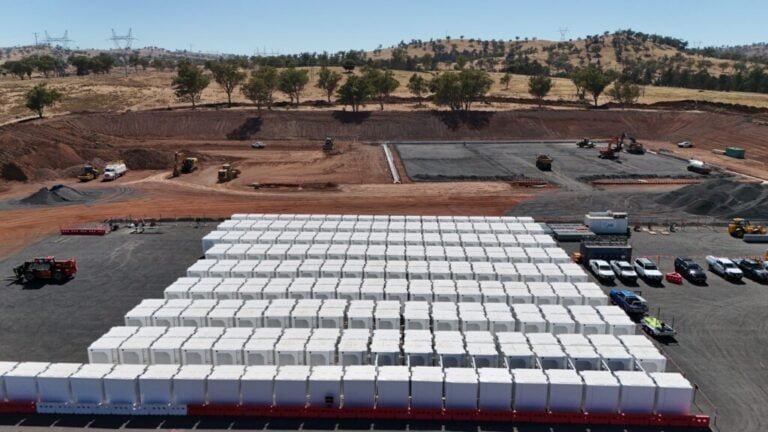
The facility itself will occupy a modest footprint of approximately 28 hectares, with the core battery storage system, co-located substation, inverters, and laydown area contained within a 20-hectare development area, and a separate 7.8-hectare high-voltage switchyard owned and operated by Powerlink Queensland.
The BESS will connect to Powerlink’s existing 275kV transmission line that runs adjacent to the site, forming part of the 136km line connecting the Gin Gin substation west of Bundaberg to the Calliope River substation near Gladstone.
The EPBC Act application notes that the developer has designed the facility to minimise local impact, with a 2.7-metre-high grassed berm proposed on the western side of the development area to provide a visual barrier from Red Hill Road and attenuate noise emissions for nearby residential receptors.
Grid-forming technology addresses system strength challenges
The Rutherglen Battery will utilise lithium iron phosphate (LFP) battery chemistry, an advanced lithium-ion technology known for its high energy density, extended lifespan and enhanced safety characteristics.
Critically, the battery storage system will deploy grid-forming inverter technology capable of providing system strength services without relying on traditional synchronous machines, positioning it as a key enabler of coal-fired generation retirement in the region.
Grid-forming technology has emerged as a crucial capability for large-scale battery storage systems in Australia’s National Electricity Market (NEM), particularly as coal-fired power stations that historically provided system strength and inertia exit the grid.
Utility AGL is currently commissioning its 1,000MWh Liddell grid-forming BESS in Australia, where technical teams have navigated uncharted territory in deploying the technology at scale.
The Liddell project, which secured AU$35 million (US$24 million) in funding from the Australian Renewable Energy Agency (ARENA) specifically to demonstrate grid-forming inverter capabilities, has revealed important insights about battery sizing for synthetic inertia provision.
It has also showcased the need for extensive stakeholder engagement with transmission network service providers and the Australian Energy Market Operator (AEMO) to establish a common understanding of how the technology performs and integrates with the grid.
You can learn more about some of the key lessons from the development of the Liddell BESS in our write-up from a panel discussion at the Energy Storage Summit Australia 2026 on Energy-Storage.news.
The Rutherglen Battery is strategically aligned with the Gladstone Regional Economic Transition Roadmap, with construction scheduled to commence in 2027 and completion targeted to coincide with the likely retirement of the Gladstone Power Station by 2029.
Despite the successful application to the EPBC Act, the project has not been without its challenges.
Indeed, the project’s path to approval has been complicated by regulatory changes introduced by the Queensland government on 11 December 2025, which established new planning requirements for battery storage system projects.
As a result, the development application previously lodged with Gladstone Regional Council is now considered improperly made and will be resubmitted through the State Assessment and Referral Agency under the new framework incorporating State Code 27.
The developers have welcomed these reforms, which establish clearer and more consistent standards for BESS developments. The company’s team is reviewing the Rutherglen Battery against State Code 27 and remains confident that existing reports and plans will meet the updated criteria, with only minor amendments and additions required.
Following the development permit being granted, an operational works approval for civil components, including earthworks, will be undertaken prior to works commencing on site, expected to be completed in 2026.
The EPBC Act approval represents a major milestone in a growing pipeline of large-scale battery storage projects securing federal environmental clearance across Australia.
Quinbrook bagged EPBC Act approval for its 780MW Supernode North BESS in Australia, while RES Australia’s joint venture secured EPBC Act approval for a 3.6GWh solar-plus-storage project in Queensland.
In addition, Tonic Group secured rapid EPBC Act approval for a 440MWh solar-plus-storage site in Western Australia.
Interested in Australia? Read Energy-Storage.news’ Energy Storage Summit Australia coverage and related content.