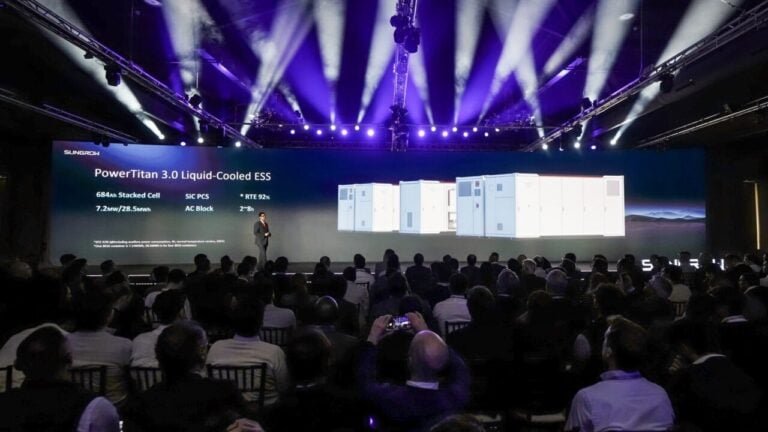
The product was launched for the European market at an event hosted by Sungrow in Madrid on Tuesday (27 January), where it also launched its single platform design for DC-coupled PV and energy storage that features a 1+X modular inverter.
This has been deployed already at Green Power Generation’s Cunderdin project in Australia, and Engie’s Coya project in Chile.
Sungrow Europe product manager Federico Feuchter Vazquez, product manager for Sungrow Europe, said DC coupling “takes into account all possible revenue streams in the European market”.
The continent is seeing increasing rates of negative power pricing and curtailment for utility scale solar PV in Europe. Figures from trade body SolarPower Europe, presented at the product launch, show that EU member states exceeded the interim target of 400GW of solar installed by 2025 to hit 406GW last year. That means that the flexibility offered by energy storage is of increasing importance, the trade body said this week.
Vazquez said that we are entering an era in which solar PV is not deployable without energy storage, thus making the DC-coupled solution a natural evolution to “enrich” projects. The company promises 3-5% higher round-trip efficiency in DC-coupled deployments of the PowerTitan 3.0.
Deployment speed
The new BESS model can be provided with an inbuilt DC/DC module. It also supports self-configuration and self-checks within one hour. Sungrow emphasised deployment speed as a highlight of the product, which, due to the AC block design, benefits from more streamlined construction than DC block deployments.
The company claims this to have been validated in the record-speed deployment of PowerTitan 2.0 units, also an AC block, at the 100MW/331MWh Bramley BESS project in the UK, by BW ESS, which was commissioned in 12 days. With the newer technology, Sungrow said developers could deploy up to 1GWh in 12 days.
Further, Sungrow said, with high energy density, at 483kWh/m2, the smaller footprint of the units is a further cost saver.
The firm claimed an industry-first large-scale application of a fully liquid-cooled Silicon Carbide Power Conversion System (SiC PCS), achieving 99.3% maximum efficiency and system round trip efficiency (RTE) of 92%.
Higher efficiency means about 20% less space is required for deployment and construction costs are lower.
Ken Stewart, senior key account manager at Sungrow UK & Ireland, told Energy-Storage.news this makes PowerTitan 3.0 “very advantageous” in easing concerns in the UK, where grid connection is now contingent on land permitting.
Grid forming capability
Sungrow’s Stem-Cell Grid-Forming Tech 2.0, which it said offers grid-forming synchronously, gigawatt-scale black start, mode switching between grid-following and grid-forming, adaptation to wide-range SCR changes and 20 milliseconds rapid response, is integrated into the PowerTitan 3.0.
Stewart noted that while PowerTitan 2.0, the predecessor product, had grid forming “functionality”, PowerTitan 3.0 has in built “capability”, “to future proof and augment” projects using the hardware.
Dr Henry Liu, director of Sungrow’s grid solution department, highlighted the growing role of grid-forming ESS in supporting renewables-rich grids and meeting evolving EU standards. He described it as “not rocket science technology”.