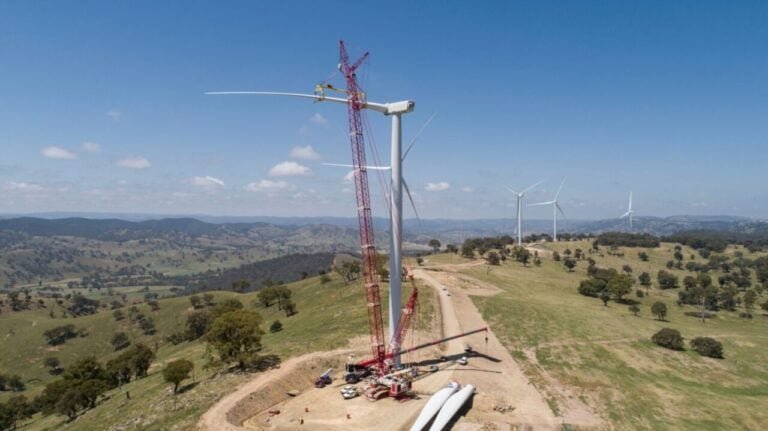
Law firm Allens advised the lenders on the refinancing. Allens co-lead partner Tim Stewart said the transaction reflected a broader pattern among developers with maturing asset portfolios.
“As portfolios mature, sponsors are increasingly seeking opportunities to further streamline and build flexibility into their debt platforms to allow for future growth and diversification,” he said.
Allens previously advised lenders on the portfolio’s original financing structure in 2023, as well as on financing the 414MW Uungula Wind Farm.
HSF Kramer project finance partner Gerard Pike said the refinancing was structured to create a more flexible non-recourse financing platform ahead of Squadron Energy’s upcoming renewable energy and storage projects.
“This financing is another evolution in the market to facilitate bringing these new projects into construction as efficiently as possible,” he said.
Flexibility for storage and hybrid projects built into the refinanced platform
The refinancing’s explicit provision for future battery storage and hybrid development reflects a shift already underway at Squadron Energy.
In 2024, the company applied for approval for an 8-hour duration BESS in New South Wales, seeking consent for a 1,200MWh battery storage system co-located with a 300MW wind project at the proposed Conargo Wind Farm in the South West Renewable Energy Zone (REZ).
The company is also behind a separate 1,800MWh wind-plus-storage development west of Gulgong in the Central-West Orana REZ, which the NSW Independent Planning Commission has recommended for approval.
Squadron Energy chief executive Rob Wheals has argued publicly that the country’s renewable buildout needs to diversify beyond solar-based hybrids.
Speaking at the Australian Clean Energy Summit 2026 last month, Wheals said Squadron Energy’s own analysis showed a grid built purely on solar-based hybrids would require five times as much infrastructure compared with a more diversified technology mix, and that wind and long-duration storage needed to attract the same investment signals currently flowing to solar and shorter-duration battery storage systems.
The refinancing lands as Australia’s battery storage fleet continues to expand at pace. NEM-wide battery discharge reached a record 4,325MW on 11 August, with the fleet cycling through an intraday operating swing of roughly 8.3GW between midday charging and evening discharge, according to analysis from energy transition adviser Geoff Eldridge.
The trend toward more flexible, diversified portfolio financing structures is among the themes expected to feature at the Battery Asset Management Summit Australia 2026, taking place 25-26 August in Sydney, where asset owners and lenders are set to discuss revenue strategy and capital deployment across the country’s expanding storage and hybrid pipeline.
Never miss an Australian energy storage story. Sign up for our Australia newsletter and get the latest project announcements, policy updates and market analysis delivered directly to you.
Solar Media (part of Informa Group) will host the Battery Asset Management Summit Australia 2026 on 25-26 August at the Amora Hotel Jamison in Sydney, bringing together asset owners, operators, trading teams and optimisers to address revenue strategy, lifecycle management and operational performance across Australia’s fast-growing battery storage fleet.
Readers of Energy-Storage.news can get 20% off their tickets using the code ESN20 at checkout. Find out more about the Summit on the official website.