For much of the last decade, perovskites have been promised to be the future of solar panels, but commercialization has been slow, and only a few manufacturers are willing to test pilot lines. A new technology in the energy storage market is having the opposite experience — just as quickly as sodium-ion designs have been suggested as suitable alternatives to lithium batteries, manufacturers are setting up and securing orders.

Unigrid sodium-ion battery development
“It’s been fun,” said Randy Selesky, chief commercial officer at ESS Inc. “I’ve been in this market a long time, and I have not seen the market really grab on to something this fast.”
For a market once best illustrated by lead-acid batteries for off-grid living, today’s global energy storage industry is dominated by lithium, when you exclude pumped hydro-storage. Within lithium’s share, lithium-iron-phosphate (LFP) has become the most-installed chemistry type in grid-scale and residential applications, accounting for 80% of new battery storage worldwide in 2023. While lithium batteries have contributed to the global energy storage market’s massive expansion, some of their properties leave much to be desired.
For one, although LFP batteries are much safer and less susceptible to thermal runaway than their lithium predecessors, some applications just can’t take on their slight fire risk. Lithium batteries also work best in a tight temperature range, and the auxiliary power needed to power chillers and fans to keep them comfortable might price-out projects in certain regions. Plus, the lithium supply chain is dominated by China, which makes establishing a fully domestic energy storage supply chain a difficult endeavor.
Enter sodium-ion. Made from an abundant nontoxic element, sodium batteries can be manufactured similarly to lithium batteries through the same-sized cells, modules and final systems. Sodium batteries benefit from their wide operating temperature range (-40°F to 140°F without output degradation), which negates the need for HVAC systems. And their lack of critical minerals means sodium battery manufacturing could theoretically set up in the United States, Europe, Australia — wherever.
Earlier this year, Morgan Stanley Research estimated that sodium-ion batteries would hold 2% market share by deployment in 2027, but would jump to 20% by 2030 and 37% by 2035. Two sodium chemistries — sodium chromium oxide (NCO) and sodium iron-phosphate pyrophosphate (NFPP) — are pulling ahead as the ones to lead the market into the next decade. NCO has a higher energy density while NFPP is cheaper to manufacture, but either offers an apt alternative to lithium, said Darren Tan, co-founder and CEO of sodium cell developer Unigrid.
“New technologies always serve to open new markets or new applications,” he said. “When we encounter customers who already use LFP for their applications, we tell them that they’re doing a great job and should keep doing it, unless they have certain challenges like not getting enough power or enough safety, it’s not lasting long enough, they need to run in the cold or extreme heat. That’s when we step in to solve these problems.”
Sodium-ion market takes shape
The promise of sodium-ion technology has attracted players from all corners of the energy storage market. Flow battery pioneer ESS has taken an interest and will release its first grid-scale sodium design next year. Selesky said the move into sodium isn’t a step away from long-duration flow batteries; it’s just adding another lithium alternative to the company’s offerings.

A prototype of the Bridge sodium-ion energy storage system from ESS.
“Lithium is still 95% of the market, in that two- to eight-hour range. This is the first product we’ve seen that can go head-to-head against the traditional use-cases of lithium-ion,” he said. “We saw this as an opportunity to go after 95% of the market, leveraging our 14 years’ [experience] of being able to do installation, integration, ongoing maintenance support.”
Selesky said ESS will shift its R&D to producing a 16- to 48-hour discharge flow battery, because there are still plenty of opportunities where long-duration energy storage is necessary.
“We see this as a perfect opportunity to reset iron-flow,” he said. “When you’re in long-duration, you’re creating a market and that market is still being created. [Working with sodium] gives us an opportunity to get on the flywheel and really start spinning product out.”
ESS will use NFPP cells from startup Alsym in its 1.2-MWh AC energy storage system. Alsym, a Boston-based sodium-ion cell developer, is manufacturing a small amount of product on the East Coast, and ESS will assemble the cells into the “Bridge” energy storage system at its manufacturing site in Oregon.
“[NFPP] follows the same characteristics that ESS has followed since its birth — no risk of fires and it’s safe,” Selesky said. “Our first launch is in 2027, and then we’re doing a second launch, which increases the density, in late 2028. That’s how fast this technology is moving. I can already see what’s in R&D that will come out three years from now.”
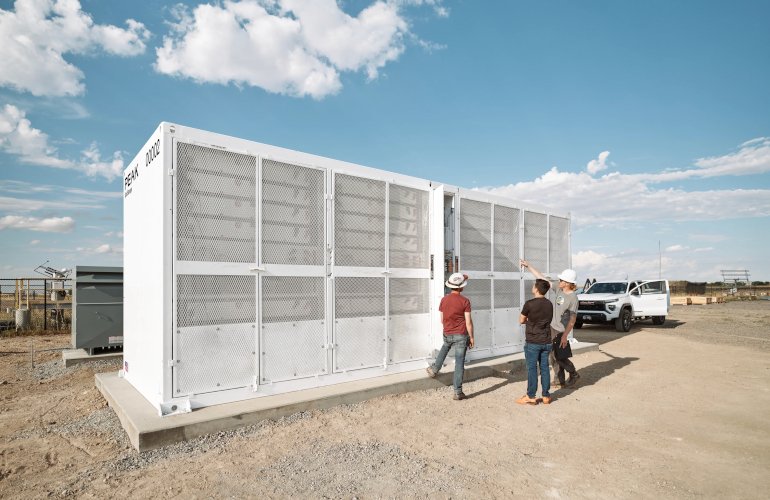
The technology is moving so fast, that a three-year-old company is already setting up multi-gigawatt-hour manufacturing. Peak Energy formed in 2023 and is on track to begin delivering its Sacramento-manufactured GS1 storage system by mid-year 2027.

A large-scale sodium battery from Peak Energy.
Brandon Kelly, Peak Energy’s chief scientist, said the company’s meteoric rise was all part of the original plan.
“Peak’s approach is to get to product quickly, not develop in a lab for 10 years and then launch a product and try and find a market,” he said. “There is a strong market demand, and there’s a technology that the base chemistry enables a much better product to meet that demand — from the actual product itself, the supply chain and energy security here in the States.”
The GS1 is a 3.1-MWh NFPP system, a chemistry that Kelly said is “a perfect fit for grid-scale storage.” Peak Energy’s core selling point is the sodium battery’s passive cooling, which cuts chillers and fans out of the equation.
“[With chillers,] there are moving parts, there’s refrigerant, coolant, filters, fans, tons of noise. It’s great that we can do it, and I’m happy that it’s enabling a lot of things. But those are engineering workarounds we have to do for lithium to meet the application,” he said. “Because this version of sodium-ion is more temperature tolerant, we can just let it get hotter and we can still hit the lifetime. Even in our passive system, we’re still at 85% state of health after 20 years. Lithium-ion, even with liquid cooling, is around 65%. And with sodium, you don’t have any moving parts, the amount of maintenance goes way down. It’s beautiful simplicity, which is enabled all the way down at the chemistry level.”
Room to play in residential
While most focus across the entire energy storage market is spent on grid-scale applications, the residential market can benefit from sodium designs too.
Unigrid, a sodium-ion cell R&D company that originated at the University of California San Diego, has been quietly developing the technology since the start of the decade. The company just announced a partnership with manufacturer Syntropic Power to make NCO batteries in the United States.
“It checks all the boxes. It has a great cycle life, great safety, great power, great cost,” Tan said of the NCO chemistry. “The only downside is it’s not available in China, so you can’t just buy if off the market. We work with foundries to develop this new production process. It not being available also means that we’ll be the only one supplying it, so that’s one of our key advantages.”

Unigrid testing an NCO battery. Credit: Unigrid
Sodium-ion manufacturing is so similar to lithium battery production that most of the major lithium players — BYD, CATL, Hithium — are quickly adjusting existing lithium manufacturing lines to make sodium designs. But this also means they’re focusing more on scaling grid-scale sodium batteries, which tend to champion NFPP designs. With Unigrid’s focus on NCO chemistry, Tan said the company is looking toward the less crowded residential storage space.
“In China, there is no such thing as a residential market, so the major Chinese players don’t dominate this space. It’s also the reason why residential batteries are historically unaffordable,” he said. “You have utility-scale batteries fighting for cents on the dollar, and then you have [residential batteries] that are still $10,000 and above. We realized this is an opportunity for us to step in and change the status quo. Sodium-ion is a reset.”
Unigrid developed a residential battery prototype, the 9.25-kWh Na+Casa, which can perform in extreme temperatures without external cooling devices and has a 10,000+ cycle life at 100% depth of discharge. Uniquely, the 9.25-kWh capacity rating was determined by current fire codes from the National Fire Protection Association that haven’t yet caught up with sodium-ion development. Sodium batteries are still considered to fall under the “all others” category (rather than lead, lithium or flow) and are limited to 10 kWh. The 9.25-kWh capacity of a single unit may be less than the 15-kWh lithium models on the residential market today, but sodium batteries excel in other areas and should still be considered, Tan said.
“Unlike lithium-ion, where a big chunk of your cost is lithium and its critical materials, sodium-ion is very much flipped,” Tan said. “The sodium-ion raw materials are extremely low cost, and most [of your cost] is in manufacturing. That means the potential for sodium-ion costs to come down is much greater. Today it is still higher than lithium-ion, but I expect in the next five to 10 years it will come down very sharply.”
Sodium battery companies may already be walking the walk, but soon they just might be running away with the energy storage market.