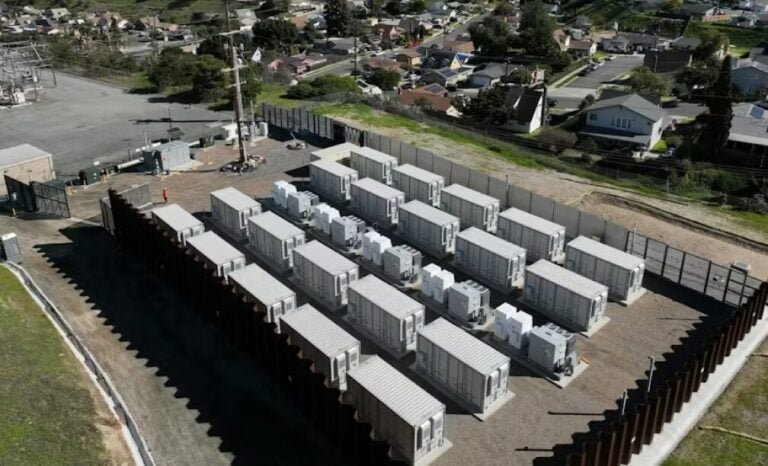
These comments, together with Cornell’s, illustrate how BESS procurement has evolved from primarily a price-focused purchase to a broader risk-management process. Buyers are no longer relying only on equipment costs; they are now thoroughly evaluating supply chain compliance, regulatory risks, and overall project economics.
This indicates the industry’s evolution from focusing on short-term cost savings to emphasising long-term value creation, where “disciplined development and long-term performance” are prioritised over “short-term arbitrage,” as Cornell says.
Prevalon Energy is a spin-out from Mitsubishi Power Americas, specifically from Mitsubishi Heavy Industries’ BESS division. The primary manufacturer for Prevalon Energy’s BESS is Clou Electronics, based in China and part of the Midea Group, a conglomerate mainly recognised for air conditioning systems.
The company’s collaboration with Clou offers valuable insights into how BESS procurement has changed over the past year and how it may develop further this year.
How has BESS procurement changed since 1 January, with active FEOC restrictions in place?
Since 1 January, procurement has become far more deliberate. Developers and utilities are no longer evaluating systems on price alone—they’re scrutinising origin, ownership, and control across the full bill of materials to ensure FEOC compliance and preserve ITC eligibility.
This has pushed procurement earlier in the project lifecycle, with deeper diligence around suppliers, manufacturing pathways, and documentation. The net effect is fewer last-minute equipment decisions and a stronger emphasis on bankability and long-term compliance.
How has BESS procurement changed since Jan. 1 concerning Section 301 tariffs?
Section 301 tariffs have reinforced the need for diversified sourcing strategies. Procurement teams are increasingly modelling multiple supply paths—factoring tariffs, logistics, and delivery risk alongside base equipment cost.
In many cases, the lowest upfront price is no longer the lowest total project cost once tariffs, schedule risk, and financing impacts are fully accounted for.
Are Chinese-manufactured BESS still the cheapest option?
On a narrow, equipment-only basis, Chinese-manufactured systems can still appear cheaper. However, that gap has narrowed significantly.
When tariffs, FEOC restrictions, potential loss of tax credits, financing impacts, and long-term service considerations are included, the economics are far closer than they were even a year ago. For many projects, compliant systems with clearer regulatory standing now pencil similarly—or better—on a total cost and risk-adjusted basis.
What has Prevalon done prior to the active restrictions and increased tariffs to secure BESS?
We anticipated this shift. Well before the restrictions took effect, we diversified our supply chain, secured long-lead equipment under multiple sourcing scenarios, and aligned our platform strategy to remain flexible as policy evolved. This preparation allows us to support projects across different compliance and tariff profiles without forcing customers into a single path.
How will these changes impact the industry over the next year?
In the near term, the industry will continue working through uncertainty as guidance is finalised and supply chains adjust. We expect tighter project screening, greater focus on start-of-construction timing, and increased demand for partners who can navigate policy, engineering, and execution together.
Over time, this should drive a healthier market—one that rewards disciplined development and long-term performance rather than short-term arbitrage.
How do you expect Prevalon to be impacted over the next year?
We see this as a net positive. As projects become more complex and the stakes increase, the value of an accountable integrator and long-term partner grows. Customers are looking for support across controls, cybersecurity, compliance, and lifecycle service—not just equipment supply. That aligns directly with how we operate.
To what extent is domestic content supply playing a role in upcoming projects?
Domestic content is increasingly part of the conversation, particularly for projects pursuing bonus incentives or seeking to reduce policy risk.
That said, it’s not a binary decision. Most customers are evaluating a range of options—balancing domestic manufacturing, allied-country supply, cost, schedule, and performance. Our role is to help customers make informed tradeoffs and structure projects that remain resilient as policy and market conditions evolve.
The Energy Storage Summit USA will be held from 24-25 March 2026, in Dallas, TX. It features keynote speeches and panel discussions on topics like FEOC challenges, power demand forecasting, and managing the BESS supply chain. ESN Premium subscribers can get an exclusive discount. For complete information, visit the Energy Storage Summit USA website.