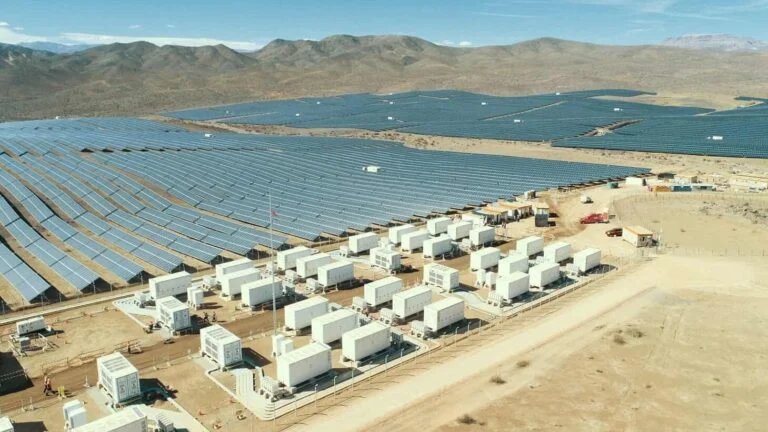
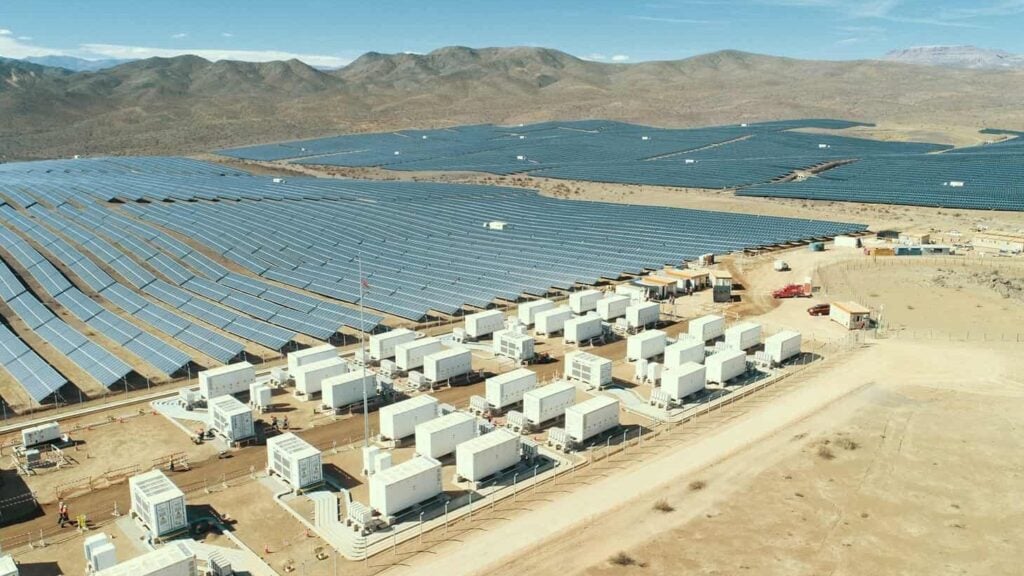
Nearly 21GWh of grid-scale BESS came online globally last month, of which around a fifth was in Saudi Arabia while the majority was in China.
The latest figures are out from Benchmark Mineral Intelligence, which we report as part of a monthly series for ESN Premium.
They show that grid-scale battery energy storage systems (BESS) entered commercial operation last month globally totalling 6,516MW/20,855MWh of capacity.
Some 61% of that was in China, 19% was in Saudi Arabia, 11% was in Europe while just under 5% was in South and Central America. See a full table of the figures further down.
This article requires Premium SubscriptionBasic (FREE) Subscription
Already a subscriber? Sign In
Try Premium for just $1
- Full premium access for the first month at only $1
- Converts to an annual rate after 30 days unless cancelled
- Cancel anytime during the trial period
Premium Benefits
- Expert industry analysis and interviews
- Digital access to PV Tech Power journal
- Exclusive event discounts
Or continue reading this article for free
The monthly activity brings the total year-to-date (YTD) figure of commission BESS capacity to 177GWh, a year-on-year increase of 35%.
| Region | MW | MWh |
| Africa | 100 | 200 |
| Asia (ex China) | 52 | 208 |
| China | 4,131 | 12,757 |
| Europe | 914 | 2,290 |
| Middle East | 1,000 | 4,000 |
| North America | 100 | 400 |
| Oceania | 20 | 40 |
| South & Central America | 199 | 960 |
| Total | 6516 | 20,855 |
Europe in particular has ramped up its activity, commissioning three times the amount of capacity that it did in the same eight-month period in 2025: 18.2GWh. In August, 914MW/2,290MWh came online, including a 150MW/600MWh project from EDF in Belgium and a 500MW/1GWh project from CIP in Scotland.
Saudi Arabia’s figure was made up of two 500MW/2GWh projects (the Tabuk and Ha’il projects) supplied by China-based Hithium. The South and Central America figures meanwhile are made up of projects that Engie brought online during the month.
North America had its quietest month of the year by far, with only 100MW/400MWh coming online, mainly comprising EDP’s Sandrini project in California.
China meanwhile deployed 4,131MW/12,757MWh of capacity. The largest of these were two in inner Mongolia (the Inner Mongolia Xilingol Dongsu Energy Storage Project sub-project I & 2, 500MW/2GWh each with StarCharge as integrator) and one in Hebei (a 300MW/1.2GWh project with Sungrow as integrator).
Energy Storage Summit Latin America brings together developers, investors, utilities and policymakers to explore how storage is advancing system stability, regulation, deployment and new revenue models across the region. With insights from Chile, Argentina, Brazil, Mexico and beyond, the Summit focuses on financing, policy clarity, hybridisation, supply chain development and project optimisation as LATAM accelerates its storage buildout.
Read Next
A roundup of some of our key takeaways from the Energy Storage Summit Germany this week, including around FCAs, inertia, the capacity market (CM), EU restrictions on China, and the future of one very notable system integrator.

Recent moves from the US federal government could prove more damaging to US renewable energy deployment than foreign entity of concern (FEOC) compliance requirements, according to legal and industry experts.
On 26 August, US President Donald Trump banned the import of inverters, transformers and other power equipment citing a potential risk to US grid security, via emergency executive order (EO).

Greek renewables developer Metlen Energy & Metals has signed an agreement with utility Copec for the sale of the Tamarico II solar-plus-storage project in Chile’s Atacama region.

Our collection of user-posted analysis, views, and unofficial news, gathered from our networks on LinkedIn, returns for its third outing.
Most Popular
