If there should ever be a sector that supports using Made-in-America products in construction, it would be the federal government. For decades, the government has had some type of “Buy American” stipulation for projects funded with federal dollars. More recently, the Build America Buy America (BABA) Act of 2021 requires all iron, steel, manufactured products and construction materials purchased for projects using federal funds to be made in the United States. Manufactured products are required to have 55% of their production costs originating in America.

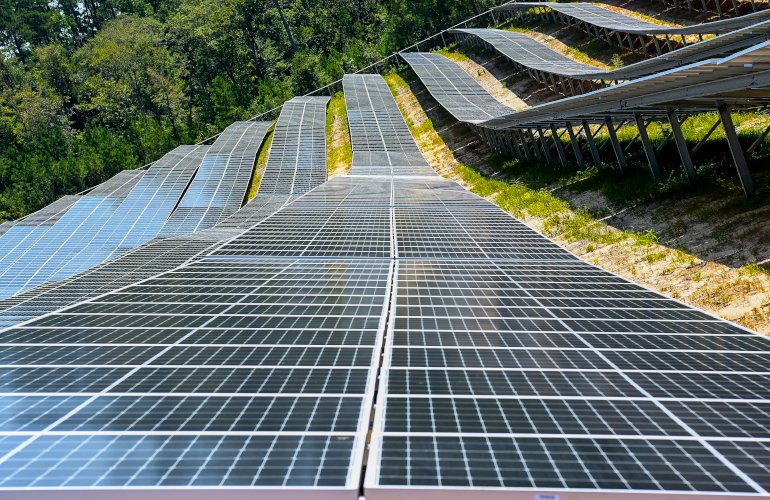
A 13-MW solar project was completed in August 2025 for U.S. Army Garrison Fort Polk in Louisiana. Credit: Angie Thorne, Fort Polk Public Affairs Office
Despite the domestic solar manufacturing market recently expanding, meeting that 55% American threshold for manufactured products is still a tall order — for solar panels, inverters and batteries. There are waiver options for the BABA Act if there are no available domestic products, and government agencies do seek waivers when it comes to solar installations. The Dept. of Energy has applied for a BABA waiver to use inverters with automatic shutdown on a project in Alaska, citing domestic nonavailability. The U.S. Army was granted a waiver in September 2025 based on the nonavailability of domestically assembled solar panels for a project at the National Guard Readiness Center in Reno, Nevada.
While it’s sometimes impossible to use only American components on federal solar projects, there is a more concentrated effort to at least not use Chinese products. The entire solar industry is trying to understand foreign entity of concern (FEOC) rules on private projects, and some federal agencies must now also adhere to the non-China requirement.
But figuring out those guidelines is still a work in progress — for everyone.
Solar trends in government
Before Donald Trump took office again, the federal government was encouraging solar and storage adoption within its reach. President Joe Biden’s 2021 Federal Sustainability Plan called for federal facilities to use 100% carbon pollution-free electricity by 2030. The Dept. of Defense, which consistently consumes 80% of all energy within the U.S. government, quickly began rubber-stamping solar and storage projects. Solar was being installed at training centers, Veterans Affairs hospitals, garrisons, military housing and even considered for the Pentagon.

The 1.1-MW floating solar array at U.S. Army base Fort Bragg in North Carolina. Credit: Sharilyn Wells, Fort Bragg Garrison Public Affairs Office
U.S. Army base Fort Bragg in North Carolina is home to the largest floating solar project in the Southeast. The 1.1-MW solar array atop Big Muddy Lake at Camp Mackall was completed by Duke Energy and Ameresco in 2022. The project features a 2-MWh Tesla energy storage system and hundreds of LG silicon solar panels, which were assembled in the United States at the time of installation (LG has since exited the solar business).
Still, that did not stop then-congressman Michael Waltz (R-Florida) in 2023 from questioning Sec. of the U.S. Army Christine Wormuth during a House Armed Services Committee meeting on the panel supplier for the Fort Bragg installation. Sec. Wormuth incorrectly surmised that “given that most solar panels are made in China, there’s a good chance that those panels were made in China.”
Although the installation at Fort Bragg used American-assembled LG solar panels and adhered to existing BABA Act guidelines, or was provided the appropriate waivers, there’s still a misinformed China paranoia within Congress when it comes to solar equipment. Bombshell reporting from Reuters in 2025 only added to the concern, when it seemed to confirm the existence of rogue Chinese communication devices in solar inverters.
Congressmembers are still using that cybersecurity threat in documents despite the Dept. of Energy later revealing it had found no definitive evidence of malicious software in U.S. solar projects using Chinese inverters. National laboratories inspected around 30 inverters and found two situations where communications differed from official documentation, but nothing was malicious or intentional, the DOE said.
Again, all these solar projects complied with BABA Act purchasing requirements, but Made-in-America demands on U.S. solar projects have taken a backseat to “No-China.”
FEOC rules for the feds
On Dec. 18, 2025, Trump signed into law the National Defense Authorization Act (NDAA) for Fiscal Year 2026 which authorizes appropriations for the Dept. of War (formerly Dept. of Defense) and Dept. of Energy national security programs. Included in this law is a section prohibiting the Dept. of War from purchasing solar panels or inverters from foreign entities of concern — China, Iran, North Korea and Russia.

Solar panels are installed on a parking deck at the Louisville VA Medical Center in 2025. Credit: Michael Maddox, U.S. Army Corps of Engineers, Louisville District
Just like with BABA, the FEOC stipulation can be overruled if there are no alternative sources of panels or inverters, or if the Sec. of War determines there is no national security risk posed by their use. This only applies to projects directly procured by the Dept. of War and does not apply to third-party financed contracts.
While private industry is still waiting for FEOC guidelines from the Dept. of the Treasury, the Dept. of War hasn’t explained how to comply with its own FEOC stipulation in the NDAA. And Congress is getting antsy.
On Jan. 14, 10 Republican members of Congress wrote to Sec. of War Pete Hegseth with concerns that the department had yet to establish “a policy addressing the national security risks of using Chinese energy infrastructure in the department’s energy resiliency efforts.” The congressmembers, led by Rep. Stephanie Bice of Oklahoma, cited the now-walked-back claim of Chinese spyware being used in solar inverters. They said that solar systems with rapid shutdown capabilities could be remotely activated by an “embedded adversary.” The congressmembers called for an immediate ban on the direct purchase of Chinese solar panels as well as new policies to prohibit the installation of panels and inverters from FEOCs. Hegseth and the Dept. of War have yet to respond.
Until guidelines are provided, government agencies will continue building solar and storage projects with the products available. In the Dept. of Energy BABA waiver mentioned above, project engineers have requested to use SMA inverters on the Alaska project that requires automatic shutdown. The German inverter brand would comply with assumed FEOC requirements too, showing there are plenty of non-Chinese options already used across the market.