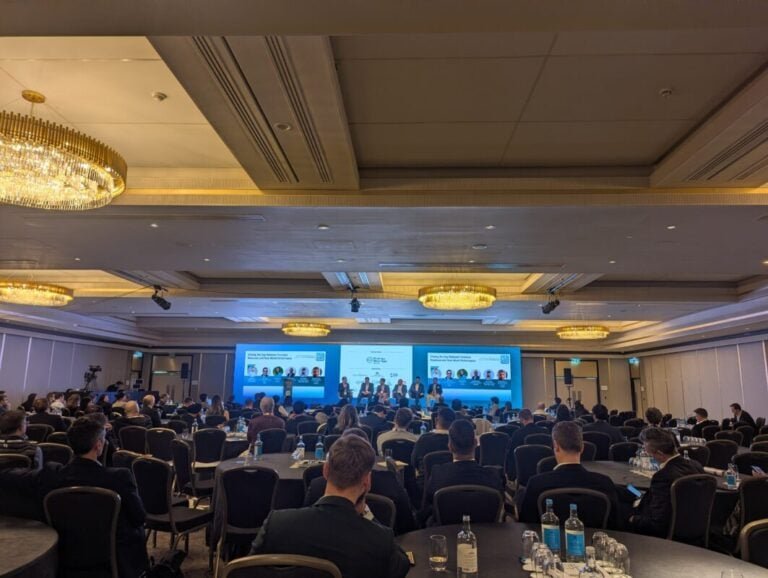
He went on to say that some revenues could be considered “promised”, but that these are the ones tied to physical tolling arrangements. This was a topic of conversation on day one of the summit, but Murphy said that there are “15 reasonable ones signed across Europe” at present, suggesting that these are not representative of broader power price forecasting trends.
Those trends, according to Simon Ede, senior managing director advisory at Kyos Analytics, are the “hardest thing” to predict accurately. Instead of trying to nail down a more accurate power price forecast over the span of decades, he encouraged those in the industry to be prepared to draw “a line in the sand” and accept that, at a certain point, an investment decision will simply have to be made.
“When you’re looking 15, 20 years into the future to get yourself financing, you’re going to have to ask yourself ‘what am I expecting out of these curves?’” he asked. “You have to build your expectation around that uncertainty, think about how it might manifest itself, do a lot of scenarios and sensitivities and [say] ‘where do I put my chips on the table?’”
Working ‘hand-in-glove’ to overcome variance
This uncertainty inherent to power price prediction is amplified by the uncertainty that can come on a purely technical level, pertaining to the performance of an individual BESS. According to Manohar Bassan, commercial head of UK and Ireland at lithium-ion OEM Envision Energy, revenue curves can often be based on “what the BESS OEM envisions,” adding a further element of uncertainty and variance to making financial decisions.
“It’s a balancing act between what kind of curves we provide, and the revenues that are modelled against [different] types of curve,” he added.
Robin Redfern, partner at consultancy Everoze, meanwhile, said that the very definition of energy capacity is often not properly understood, or at least agreed upon, in contract negotiations.
“There’s a big chunk—the vast majority—of a battery’s state of charge that can be used in both directions … but there’s a little bit at the bottom and the top, which you can only use at low rated power, and reducing amounts as you get towards charging to 100% and reducing amounts as you get towards discharging at 0%,” he explained. “And those bits, sometimes, are included in the definition [of capacity] and other times they’re not. That—just that—can account for a 5% difference, which is a year’s worth of degradation.
“There’s quite a lot of useful revenue in that, which is untapped or misused,” he added.
While power price forecasting continues to be a challenge, more broadly, the speakers agreed that better coordination between OEMs, asset managers, offtakers and investors could be beneficial in order to keep a BESS’ actual production in line with its initial forecasts.
“As an asset owner, what we’ve observed is that there’s an inherent tension between OEM and optimiser,” said Sam Langston, power markets manager at Pulse Clean Energy. “The OEM is incentivised to maximise availability, in terms of available power and energy; optimisers value certainty.”
“Your optimiser and OEM need to be working hand-in-glove and sometimes those contracts aren’t aligned,” he continued, giving an example of how misalignment can have a significantly negative financial impact for all parties involved. “As an asset owner you need to be the translator between the two … if an OEM says they’re going to have a site back by 3pm sharp, and not ten seconds [later], because the optimiser’s put a contract in place for 3:05, ten seconds late can have material revenue impacts.”
This can be particularly significant because, as Bassan said, there is already an imbalance between risk and reward for asset owners and OEMs: “What is the risk for an OEM to take any more risk than they should, because we’re not making revenue from any of these assets, in order for the owner to make more revenue off it?”
“Contracting is delicate,” he concluded.