Earthquakes don’t rank highly as a natural risk to solar projects despite the isolated devastation they can cause. Wind, snow and even salt buildup from ocean breezes broadly cause solar technicians more headaches than seismic activity.

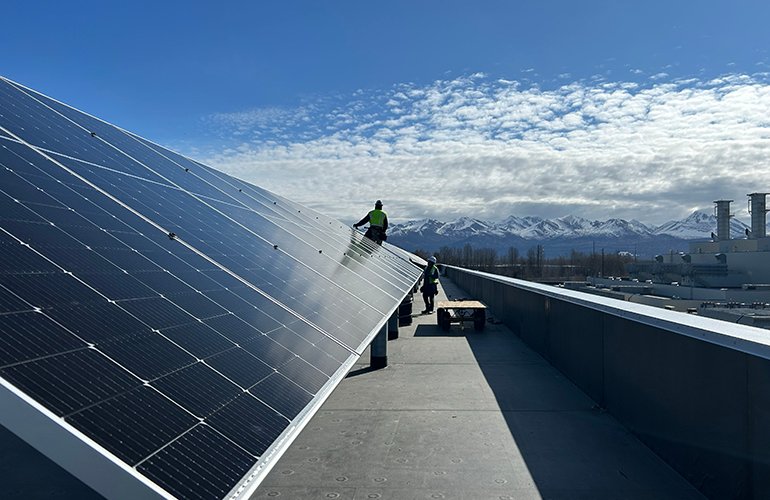
Earthquakes don’t pose a great threat to solar projects. Project engineers and racking manufacturers have accounted for seismic activities. Alaska Solar
The reason earthquakes aren’t a common concern for solar is two-fold. The first is that seismic activity in the United States is limited mostly to the West Coast, primarily in California and further north in Alaska.
Secondly, project designers consider the lateral movement in structures caused by earthquakes to be similar to wind. The oft-used phrase of solar panels becoming “sails” when hit by a strong gust has made manufacturers reinforce the attachment strengths of their racking and mounts, so that precaution for wind also prepares arrays for earthquakes.
Earthquakes can be a risk to ground-mounted solar projects, but they are new structures that can be engineered to account for seismic activity and other environmental pressures. Rooftop solar is trickier, because it is mostly installed on existing structures built to certain standards that might not anticipate PV.
“When you’re doing engineering, the biggest force tends to be the thing that makes you strengthen the system up to a certain point, and that is consistently wind,” said Ben May, founder and CEO of Alaska Solar, a residential and commercial contractor in the Last Frontier. “Yes, it has to be strong for seismic, but it has to be stronger for wind. Where seismic has come into play … it’s this factor that has precluded doing ballasted systems unfortunately.”
Buildings are rated to withstand a certain amount of downward pressure per-square-foot on their roofs. In regions that experience earthquakes frequently, the additional weight of a ballasted system can exceed those limits.
This is especially pertinent in Alaska, a state that has earthquakes about every 15 minutes and experienced the second strongest earthquake in recorded global history. Combined with the downward pressure of snowfall, ballasted solar arrays on rooftops become even trickier.
“The moment you put that weight on top of a building and then shake it, the leverage, or the moment of it, becomes really significant and important,” May said. “If you increase that moment by putting ballasts up there, then whatever the building was built for is exceeded and doesn’t work.”
But ballasts aren’t ruled out entirely for these types of projects. It’s possible to design a ballasted solar array to account for seismic displacement by giving array rows setbacks from obstructions and the roof’s edge.
Directly attaching to a roof with seismic anchors doesn’t require the same setbacks as a ballasted system, besides mandatory fire access. Direct attachment reduces a solar project’s weight on a building compared to a ballasted project. It’s the lighter option, but it raises concerns with building owners about drilling holes into roofs — despite the waterproofing involved.
However, attaching to the roof makes the array an extension of the building, which helps distribute environmental pressures throughout the structure.

Credit: Alaska Solar
“There will be a transition when you go from the rack into the building,” said Ahmed Youssef, senior project manager at Pure Power Engineering. “You have a positive connection between both of them to transfer the load from the rack system into the building.”
Buildings located in regions with seismic activity often have additional structural bracing measures to withstand lateral movements — solid shear walls on building exteriors; moment-resisting frames attached to structural columns and beams; or braced frames placed between structural beams. These reinforcements can also help support a solar array.
Enstall, a company of brands in solar racking like IronRidge, engineers its mounts for projects based on a site’s controlling loads — or the prevailing conditions there. For seismic activity, Enstall consults the American Society of Civil Engineers’ historical studies on earthquakes.
“You design to an earthquake that has a uniform risk category of a failure of a building or a structure,” said Matt Kuzila, manager of structural engineering at Enstall. “We generally look at what could be the worst-case scenario, because we don’t know where a specific product is going to be installed. So, we look at all the worst cases within the 50 states. We’ll then take that load and test to it.”
Every company Solar Power World interviewed for this story said they hadn’t witnessed any damage to solar projects from earthquakes. The industry has taken steps to mitigate the seismic lateral force for both ground-mounted and rooftop solar projects.
“The beauty of solar is, solar racking and panels have strength through flexibility,” May said. “Aluminum is the main metal for residential and commercial rooftops. It’s lovely. It bends, but it doesn’t break. A good tree flexes in the wind, and the next day it’s the same as it was.”