Last week, First Solar presented its full-year 2025 results and guidance for 2026. Despite what appeared to be another routine quarterly update, analysts on Wall Street took a different view. In the days that followed, the company’s share price fell by double-digit percentages. To understand this more, I decided the next focus for this series should be First Solar, looking at what comes next for the company.
Investments into Series 7 capacity
Since 2020, First Solar has committed more than $5 billion in capital expenditure to expand manufacturing capacity in the United States, primarily through purpose-built greenfield facilities in Alabama and Louisiana, as well as in India (Tamil Nadu). These investments were based on the company’s Series 7 thin-film technology, while Series 6 production continues at legacy facilities in Southeast Asia (Malaysia and Vietnam) and on earlier lines in Ohio. Since 2023, Series 7 technology has dominated the production of modules from First Solar.

Following nearly $4 billion in capacity investments between 2022 and 2024, including new facilities in Alabama, Louisiana and Tamil Nadu, First Solar’s annual production has trended at about 16 GW since 2024, with volumes forecast to approach 20 GW in 2027. Output is now weighted toward the Series 7 platform.
Prioritizing domestic production

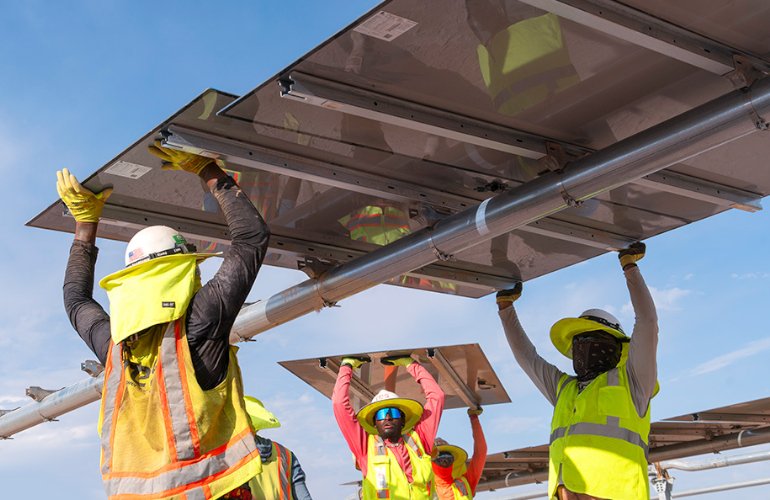
First Solar’s Series 7 panel features backrails made of steel.
First Solar’s overseas footprint was established when global demand was fragmented, and companies were looking to expand in low-cost regions. First Solar’s initial investment in Southeast Asia was in Kulim, Malaysia, in 2008. By 2010, labor costs in Malaysia were higher than other parts of Southeast Asia, leading to First Solar’s decision to expand in Vietnam.
A decade later, expansion in India followed with a factory in Tamil Nadu, supported by various incentives and the prospect of a strong pipeline in a country with an ambitious long-term demand profile.
However, as First Solar was establishing its overseas footprint, things started to change domestically. Section 201 tariffs, successive AD/CVD rulings, UFLPA enforcement and growing scrutiny of China-linked supply chains were gaining traction, with the Inflation Reduction Act in 2022 providing an attractive production-based incentive scheme.
First Solar then chose to invest in new Series 7 facilities in Alabama and Louisiana, alongside a further expansion in Ohio. By the end of 2025, U.S. operations accounted for more than 70% of First Solar’s global module output, compared to about 30% at the start of 2020.

Capital investments in U.S. manufacturing capacity since 2022 have changed First Solar’s global production footprint, with domestic output now the primary driver of growth and margin expansion.
Repurposing Southeast Asia capacity
Previously the driver for First Solar’s global production, the sites in Malaysia and Vietnam are now under scrutiny. For years, these facilities were largely insulated from U.S. solar trade actions which targeted silicon-based imports. However, as U.S. policy moved to domestic incentives, maintaining overseas sites has required a rethink. This has forced the first major restructuring of First Solar’s Southeast Asian operations in more than a decade.

First Solar’s “finishing” plant in South Carolina
During 2025, production at these sites was scaled back significantly. Rather than idle capacity, First Solar is moving these facilities into a somewhat hybrid role aligned with its latest U.S. footprint addition in South Carolina.
Unlike the investments in Alabama and Louisiana, the South Carolina project, announced in 2025, is a different model. Described by the company as a “finishing” facility, it involves the conversion of an existing industrial building for final module assembly, rather than the construction of a fully integrated line.
Scheduled to commence operations at the end of 2026, this marks a departure from First Solar’s “all-under-one-roof” mantra. Instead of completing the entire process within a single fab, the company is effectively separating front-end (cell) and back-end (module) stages.
Under this model, front-end processing (mainly the deposition stages and laser scribing), analogous to the “cell” stage in crystalline silicon manufacturing, would continue in Malaysia and Vietnam. The partially completed product would then be shipped to South Carolina for module assembly. This approach creates a near-term solution for the Southeast Asian plants, while enabling U.S.-based assembly to qualify for module-specific 45X credits.
Once fully implemented in 2027, the Southeast Asian facilities are planned to operate primarily as front-end production hubs, possibly running at about 65% of their 2024 peak output, with an estimated 60-70% of “cells” shipped to South Carolina for final module assembly.

First Solar is restructuring its Southeast Asia manufacturing footprint by separating front-end cell processing from back-end module assembly. Under this model, most of the semi-finished output is expected to be shipped to the United States for final assembly at the South Carolina finishing facility, slated to commence operations in late 2026.
The increase in U.S. produced modules could see the contributions from 45X credits in 2027 increase by about 50% compared to 2025 levels, contributing more than 80% of company’s maintainable earnings (or adjusted EBITDA).

With full ramp-up of its U.S. manufacturing facilities in Alabama, Louisiana and South Carolina, First Solar’s annual 45X production credits could approach $2.5 billion by 2027, equivalent to more than 80% of projected adjusted EBITDA.
How did Wall Street miss the signs?
After First Solar’s quarterly call last week, my forecast for the company’s 2026 operations differed only marginally from changes after the company’s previous investor call back in October 2025 when comments during the Q&A firmed up the near-term plans for Southeast Asia and South Carolina. Yet the response to the 2026 guidance was broadly one of a “miss.”
It seems that the revenue and earnings forecasts had not factored in the previously announced changes to the production schedule for 2026, ahead of an uptick in 2027 once the recalibration was done. This whole episode seems even more perplexing as First Solar’s level of forecasting transparency, during its disclosures on Feb. 24, was probably the most detailed I have seen from a listed solar company in 20 years. My conclusion here was that the miss was likely more from Wall Street and goes back to corrections that should probably have been implemented a few months back.

Since the introduction of the Inflation Reduction Act in 2022, First Solar’s liquidity, capital strength and earnings power have strengthened considerably. In contrast, the company’s main China-based peer group has faced balance-sheet pressure following the onset of the second PV manufacturing downturn in 2023.
What’s next — lobbying
First Solar’s U.S. manufacturing model depends on protecting both cost and price metrics. On the cost side, the 45X credits lower effective costs and create operating margins that few competitors can match. On pricing, a combination of trade and regulatory policy helps maintain elevated market pricing in the United States by limiting the flow of low-cost silicon-based modules into the country.
Going forward, First Solar needs to sustain these dynamics, potentially lobbying to extend 45X credits beyond the current sunset in the early 2030s, while remaining active in the evolving trade landscape as competitive tactics shift toward new hubs in the Philippines, Turkey, the Middle East and North Africa.
What’s next — overseas capacity
Perhaps the most uncertainty surrounds Malaysia and Vietnam. The proposed restructuring somewhat places the Southeast Asian factories into a holding pattern, keeping options open while First Solar assesses U.S. trade policy and the benefits from further investment in the South Carolina facility.
Should the U.S. policy environment improve, with demand justifying imports, the Southeast Asia sites could see their life extended. The alternative is probably to call time on production in Southeast Asia altogether.
What’s next — technology
Historically, First Solar has promoted the steady improvement of its cadmium telluride (CdTe) technology. Quarterly and annual reporting frequently showed incremental efficiency gains. In recent times, these updates have been less visible.

First Solar thin-film and perovskite R&D
With attention focused on its technology roadmap, First Solar has highlighted the prospects for perovskites. In 2023, the company acquired Swedish start-up Evolar AB. In 2024, the company commissioned resources in Ohio as part of its new R&D innovation center, including pilot-line activities. In early 2026, a licensing agreement with Oxford PV was revealed.
For sure, the direction is credible. Perovskite and tandem architectures offer a possible roadmap, and this aligns with industry efforts to push efficiencies above single-junction architectures. But First Solar’s current competitive strength rests largely on maintaining the status quo; something that has become more apparent in recent times as Chinese competitors have become burdened by the prolonged manufacturing downturn in the region.
However, one should never underestimate the R&D capability of a company that has single-handedly created a value-based proposition for manufacturing solar panels based on the deposition of thin-film materials over the past 20 years.
What’s next — capital
First Solar is somewhat unique in the PV industry today: highly profitable, cash-rich, limited debt exposure, policy-aligned and mostly institutionally owned. But the company has just one product, targeted largely to a single end-market. Therefore, growth depends either on increasing output volumes based on the existing business model or diversifying outside its comfort zone.
While likely not a new topic at the board level, transferable skills the company has accumulated regarding domestic U.S. manufacturing execution, policy navigation, supply-chain localization and capital discipline could be applicable across a range of adjacent U.S.-focused energy and industrial technology segments.
Therefore, 2026 could finally be the year that M&A becomes not simply an ad-hoc investor call comment, but reality.