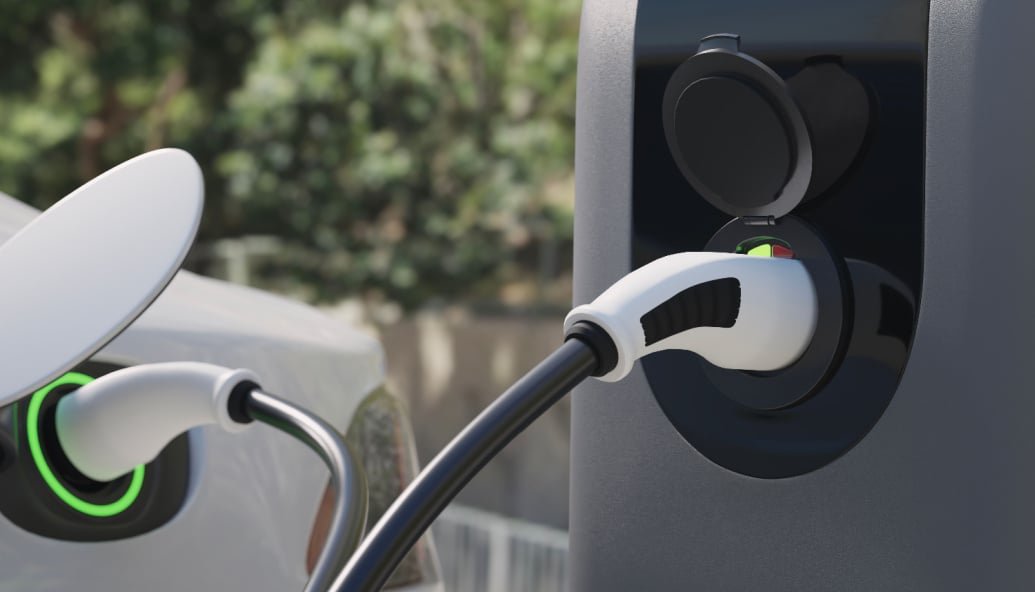
When an EV charges at 32 amps on a 3-phase AC supply, the cable is carrying sustained electrical load for hours at a time. That is not a temporary pulse. It is not intermittent household use. It is continuous current transfer at infrastructure scale. As EV adoption accelerates across the UK, discussions about grid readiness tend to focus on substations, transformer capacity and smart load balancing. Those are essential pieces of the system. But reliability at scale is shaped just as much by the physical components that sit at the very end of the energy chain. The final metres matter.
Continuous load changes the equation
At 32A, resistive heating becomes a design constraint, not a footnote.
Electrical losses in a cable follow a simple principle: heat generated is proportional to current squared multiplied by resistance. Small increases in resistance at high current produce disproportionately higher thermal stress.
In a lightly used domestic scenario, this may remain within comfortable margins. In high-utilisation environments such as workplace charging, fleet depots or public AC networks operating at 22kW, the cable can experience repeated multi-hour load cycles every day.
Underspecified conductors, inconsistent material purity or marginal connector tolerances do not fail instantly. Instead, they degrade. Contact resistance increases gradually. Localised heating rises. Insulation compounds harden or crack. Over time, performance drifts.
The result is rarely a dramatic failure. More often it is reduced efficiency, intermittent instability or premature replacement.
At network scale, those effects compound.
Micro-losses become measurable at scale
Grid modelling often assumes stable endpoints. But every charging session includes losses between charger and vehicle. If those losses increase due to poor cable design or degradation, energy efficiency declines incrementally across thousands of charging events.
Individually, the loss may be small. Across large fleets or public charging networks, the cumulative effect becomes measurable in energy terms and maintenance cost.
Distribution network operators and infrastructure investors increasingly recognise that hardware variability at the endpoint introduces uncertainty into system performance. Predictable load behaviour depends on predictable component performance.
In that context, the charging cable cannot be treated as a commodity.
Thermal cycling and infrastructure fatigue
High-current AC charging subjects cables to repeated thermal cycling. They heat during operation and cool after disconnection. In the UK climate, this happens alongside moisture exposure, road salt contamination and wide temperature swings.
Connector interfaces are particularly sensitive. Even minor degradation increases contact resistance, which in turn increases heat. Heat accelerates further degradation. The feedback loop is well understood in electrical engineering, but often underestimated in procurement decisions.
For public networks, this translates into higher maintenance frequency, service call-outs and reputational impact when chargers appear unreliable.
As EV penetration grows, public confidence depends not only on charger uptime, but on consistent hardware performance across all visible components.
From commodity to infrastructure-grade component
The early phase of EV infrastructure expansion prioritised speed of deployment and capital cost. As networks mature, lifecycle performance becomes more important.
Infrastructure operators are now evaluating:
- Conductor cross-section relative to sustained current
- Connector metallurgy and contact stability
- Environmental sealing and IP protection
- Certification traceability and manufacturing controls
At 22kW AC, the cable must be engineered for sustained three-phase load rather than occasional use. Properly specified Type 2 32A charging cables are designed specifically for this operating envelope, supporting continuous high-current transfer without excessive thermal drift.
Manufacturers such as Voldt®, who produce certified Type 2 charging cables in Europe with CE, UKCA and TÜV compliance, position these assemblies as load-bearing electrical components rather than simple accessories. The distinction is not branding. It is engineering intent.
Designing for continuous 32A service requires conductor integrity, stable contact surfaces and environmental resilience that extends beyond minimum compliance thresholds.
Smart charging depends on stable hardware
Smart charging and dynamic load management assume accurate current delivery. If a cable experiences thermal throttling or unstable contact resistance, charging profiles deviate from expected behaviour.
As bidirectional charging and vehicle-to-grid applications evolve, hardware stability becomes even more important. Energy flow may reverse. Current may vary dynamically. Repeated load variation stresses both conductor and connector systems.
In that environment, endpoint reliability becomes part of grid stability architecture.
Lifecycle cost and sustainability implications
Short-lived components increase material throughput and embedded carbon. Replacing degraded cables across large networks undermines the sustainability case for electrification.
Durable, properly specified high-current cables reduce replacement frequency, stabilise maintenance budgets and support long-term infrastructure performance.
As EV charging scales from early adoption to mainstream energy demand, the economics shift. The lowest upfront cost is not always the lowest lifecycle cost.
The final metres define the system
Power plants and substations define capacity. Software defines load optimisation. But the final metres of cable define how reliably energy is delivered into vehicles every day.
At 32A, a charging cable is not peripheral hardware. It is a continuously loaded power component that must be engineered accordingly.
In an electrified transport system operating at scale, infrastructure resilience depends on more than megawatts. It depends on the integrity of the components that carry them.
This is a featured article.
Copyright © 2026 Energy Live News LtdELN
Grab the opportunity to progress your Net Zero journey. The Big Zero Show 2026 is for end users responsible for reducing cost, carbon and energy and its mission is to educate and help them progress their Net Zero journey. It will run March 24th at The University of Chicago Booth School of Business.