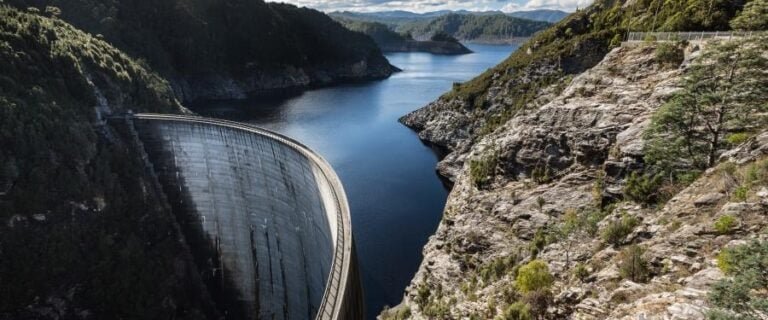
The project represents a strategic component of Tasmania’s ‘Battery of the Nation’ initiative, which gained significant momentum following Australia’s Clean Energy Finance Corporation commitment of a record AU$3.8 billion (US$2.5 billion) to the Victoria-Tasmania Marinus Link interconnector.
The Cethana project will utilise Lake Cethana as the lower storage while constructing a new off-river upper storage with approximately 12.4 million cubic meters of capacity across 95 hectares.
The facility features an underground power station housing four reversible pump-turbine units connected through a 390-meter vertical high-pressure shaft and a 1,450-meter high-pressure tunnel system.
Hydro Tasmania selected Cethana from 14 potential sites following comprehensive feasibility studies that began in 2017. The multi-criteria analysis evaluated technical capacity, environmental sustainability, financial viability, and constructability factors.
The project’s 750MW capacity provides optimal flexibility for responding to different renewable energy buildout scenarios while maximising available interconnection export capacity.
Construction will require clearing up to 335.5 hectares of native vegetation, including 245.5 hectares of wet and dry eucalypt forest. The project area spans approximately 1,740 hectares, with a disturbance footprint of 392 hectares during construction, reducing to 192 hectares in operation. A temporary workforce accommodation facility housing 450 workers will be established 6km southwest of Middlesex.
The facility aims to provide firming capacity for Tasmania’s growing renewable energy portfolio while supporting grid reliability as coal-fired generation retires by 2038.
Underground construction will employ drill-and-blast techniques with raise-bore excavation for shaft development, while surface works utilise conventional earthmoving methods.
Sunshine Hydro’s 1,400MW Djandori site to address Queensland coal transition
Australian renewable energy company Sunshine Hydro has submitted plans for the Djandori pumped hydro generation facility, a 1,400MW project located in Queensland’s Gladstone Local Government area.
The facility comprises six reversible pump-turbine generator sets rated at 233MW each, representing the first stage of a larger renewable energy generation and transmission system.
The project features an upper reservoir with a storage capacity of 24 gigalitres across 64.7 hectares and a lower reservoir with a storage capacity of 27 gigalitres across 172.1 hectares. Both reservoirs will be constructed on previously logged or grazing land in the headwaters and downstream waters of Little Colosseum Creek.
The underground power station complex connects through a 1,700-meter main access tunnel with associated surge tanks and drop shafts.
Djandori’s strategic positioning leverages existing transmission infrastructure while targeting Queensland’s transition from coal-fired power generation.
Construction will require clearing 245.9 hectares within a 961.3-hectare project area, with all excavated material expected to be reused within the project footprint.
The staged development approach aims to address funding dependencies, extended timeframes and design uncertainties for future transmission and ancillary infrastructure components.
Stage 1 focuses on reservoir construction and underground works, enabling subsequent powerhouse installation and transmission line development through separate EPBC referrals.
Queensland’s pumped hydro development landscape experienced a turbulent year in 2025. While the state government committed AU$48 million to the 5.7GWh Borumba pumped hydro plant, it simultaneously cancelled the world’s largest pumped hydro project at Pioneer-Burdekin due to cost concerns and environmental considerations.
The state’s energy storage strategy has since been revised to emphasise shorter-duration technologies, with plans for 4.3GW of short-duration energy storage by 2030 alongside selective pumped hydro developments.
Other major Queensland pumped hydro projects, including the 9.6GWh Big G project, continue to seek regulatory approval.
These new applications contribute to Australia’s expanding pumped hydro pipeline, which has gained momentum following the successful commissioning of the 2GWh Kidston project, ending Australia’s 40-year pumped hydro drought.
The Energy Storage Summit Australia 2026 will be returning to Sydney on 18-19 March 2026. To secure your tickets and learn more about the event, please visit the official website. ESN Premium subscribers receive an exclusive discount on ticket prices.