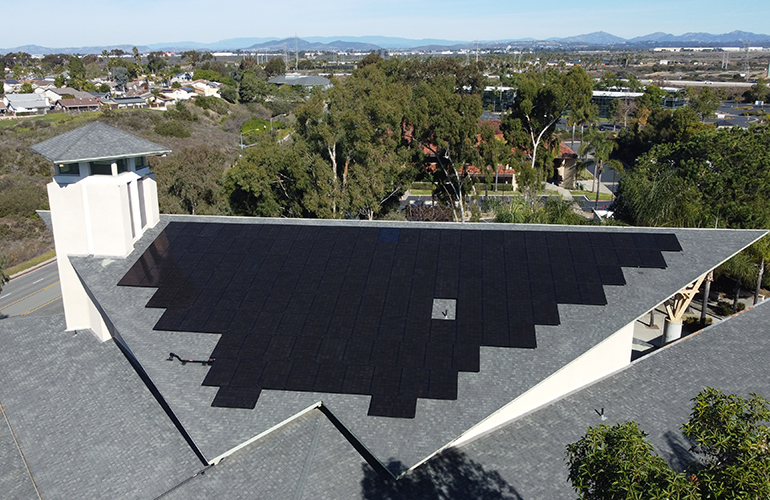
A 55-kW solar project on the roof of a California church has saved a congregation of about 150 people tens of thousands of dollars in just two years. With those savings, Canyons Church in San Diego’s University City neighborhood has reinvested back into itself, expanding youth programming, updating its sound system and maintaining the five-acre plot on which it’s located.

Watthub developed a 55-kW solar project for Canyons Church in San Diego, California. Rising energy costs and an outperforming array have saved the church more money than anticipated since installing solar. Credit: Watthub
This project happened thanks to Watthub, a commercial solar developer from Scottsdale, Arizona, that arranged a power purchase agreement (PPA) with Canyons Church. The church has a monthly PPA payment, but most of its utility bill is covered by solar production. Local utility SDG&E is steadily increasing its rates, so the savings from solar is stretching further than originally quoted.
Solar Power World spoke to John McDonnell, founder of Watthub and co-founder and principal of solar contractor SunRenu, and Nancy Loomis, executive assistant for Canyons Church, about how this project came to be and the impacts it’s continuing to have post-installation.
This interview was edited for brevity.
What has this solar project made possible for the church?
McDonnell: We did our initial proposals that said with the net of PPA payments, you’ll save $25,000 a year, but come to see all the rate hikes, and two years later, they’re saving almost $40,000.
Loomis: Which is extremely significant for a church that runs on donations. That was part of the other motivation for us. We have about five acres that the church is on, which takes a lot of maintenance. We have the funds available now to do some of the upgrades that we needed to, but we’ve put a lot into the kids’ ministry as well and upgraded some of that area and hired another youth pastor just recently, so we can get our junior high programs and high school programs going. So, all of those savings help us to do other things.
How did Watthub make the PPA happen?
McDonnell: This was unique because it’s a small project. It’s 55 kW, and to do a PPA for 55 kW is usually just not available. Anything under 100 kW isn’t. But we have a network of projects and the tax equity for the small stuff, so we have a track record of that. We’ve been doing this for almost 18 years now, so we’re no stranger to the PPA space, and we’re no stranger to commercial solar.
What is the site like?
Loomis: We’re in an area that’s close to UCSD. We’re close to the “Golden Triangle” area. Our location’s easy to get to. We have the sanctuary and a preschool as well. The sanctuary is where the panels are — up on the very top part of our roof. What was nice about our project is that all of our buildings are connected to one meter. We were able to put the solar on one of our buildings and we didn’t have to do separate things, because there was one meter. That made it a little bit easier.
McDonnell: Multiple interconnections raise cost, and the cost raises PPA rates, but we were able to keep a real low PPA rate.
Loomis: For us, being able to do the PPA made a lot of sense rather than having to do an outright purchase. This was back in ’22 — trying to come out of the COVID era. I had to convince the board, because it’s a 25-year commitment. But so is our commitment to SDG&E. That’s a lifetime, commitment, right?
Did you encounter any challenges in construction or permitting?
McDonnell: Permitting just takes a long time. They’re backed up, and permitting in California is getting a lot worse. But this was a relatively smooth process where we submitted for it, they came back with some corrections and we made them. One of the challenges was our interconnection point, because it’s on one meter, and the meter was across the building, so we interconnected into a sub-panel in the building that the array was on. We had to design appropriate disconnects within 10 ft and all the utility requirements. That was a little bit trickier.
What makes this project unique?
McDonnell: This is a success story. The parties involved worked really well together. The nature of the PPA and the outperformance and how much savings it’s producing. I’ve been in the business a long time and there are a lot of nightmare stories out there, and this was the opposite. We want to rebuild confidence in American businesses and real estate investors that solar does work.
How does it impact you being able to bring a project like this to fruition — one that has had such a lasting effect in the short time that it’s been in operation?
McDonnell: I’m proud that we built a really good system and it’s been operating properly. Some systems don’t go right. Rapid shutdown fails, and we have to go out and fix it. Inverters can go and we replace them under warranty, but then you’ve got a month with no inverter power. This is a shining light in our portfolio, that it has operated as expected. We get out there, we service it, we clean it and we do routine maintenance under the PPA. That’s at no cost to Canyons Church. This is a great reference point.
Loomis: It’s helped us because as we’ve grown we’re using more of the utility. We now rent to a small school in one of our buildings, so that uses more electricity. We’re using a lot more power than we were at the time we installed this, but it’s allowed us to do that, because it hasn’t increased our bills significantly. We were paying $7,000 in the summertime. That was two or three years ago. That was just minimal building use. But we’ve added a lot of things, and it’s allowed us to continue to grow where I don’t think we could have managed that three years ago.
Project info
Name: Canyons Church solar project
Location: University City, San Diego, California
Project timeline: Initiated 2022, commissioned early 2024
System size: 55 kW
Components:
- Modules: Canadian Solar 370-W modules
- Inverters: CPS 50-kW string inverters
- Mounts: IronRidge rails and Flush Mount system