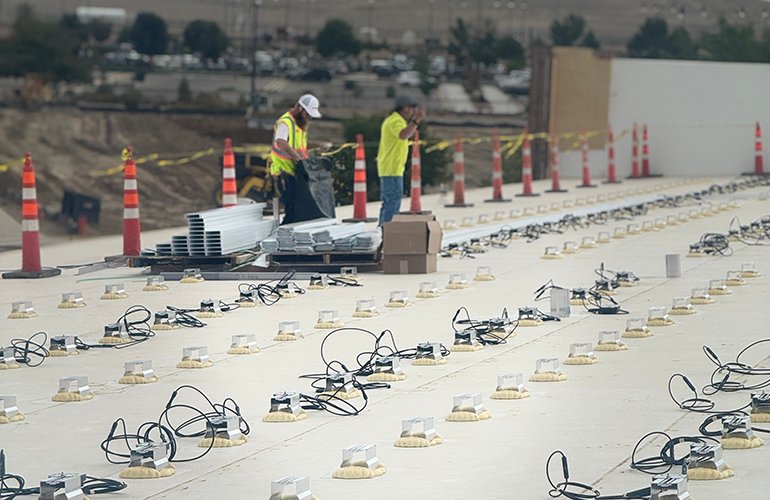
Constructing solar projects on commercial buildings without penetrating the roof surface is commonly achieved with ballasts, but some mounting companies have developed other methods to securing these arrays without penetrations.
Ballasts are the industry standard for securing solar projects to flat commercial rooftops. Typically, concrete blocks are placed on flat trays attached to racking to hold arrays in place with sheer weight. But sometimes roofs can’t handle the additional weight from thousands of concrete blocks.
These alternative mounting methods from manufacturers SolarStack and SolarStrap use adhesive and heat welding methods to attach racking to the roof without puncturing it. They were also initially invented to fill a regional need and have since found a larger place in solar construction.
Foam for lag bolts
SolarStack is an anomaly in the PV mounting market. Company founder Tim Graboski has been a certified roofing contractor in Florida since the 1990s. This is a state that sees hurricanes annually, so keeping roof coverings in place is both a challenge and important for building safety.
Hurricane Andrew hit Florida in 1992 and ripped countless tiles from residential rooftops — tiles that had been mechanically attached to roofs, leaving many holes for leaks. Not long after, a new attachment method was introduced to the roofing industry: spray polyurethane foam (SPF).
SPF proved effective on both residential tile and commercial rooftops, and it became the basis for SolarStack’s eponymous mounting system. Chemically speaking, SPF has a “closed cell” structure, unlike other spray foams used for purposes like filling in cracks in concrete.

SolarStack, a non-penetrative PV mount, awaits module installation. Credit: SolarStack
“Once it cures, it’s like a rock,” said Sam Mitchum, CCO of SolarStack. “It’s a construction adhesive. In the Southwest United States, they make actual entire roofs out of this foam.”
SolarStack is a block-style mount with several top channels running lengthwise to attach end- and mid-clamps for solar panels. SolarStacks are manufactured in flush-mount and 5° and 10° tilted models.
They’re installed by spraying SPF “patties” onto the roof and pressing the mount into the foam until it’s flush with the roof surface. As the foam cures, the mount rises about half-an-inch from the roof. If it’s installed incorrectly, a SolarStack can be removed using something like a masonry trowel.
SolarStack received a Florida Product Approval and was the second solar racking company to earn a Notice of Acceptance from Miami-Dade County — one of the most stringent building code authorities in the United States.
“If you can do it here, you can certainly do it anywhere else,” Mitchum said. “But that’s just on paper. We really received confidence in our product when we had these back-to-back hurricanes that slammed Florida. We had systems that were hit by 170-mph winds.”
Compared to driving lag bolts into the roof or placing ballast blocks, SPF does have some quirks. Once the SPF spray canisters are activated, the foam can cure in the nozzle if it isn’t used at least every 60 seconds, and the canisters must be emptied within 30 days. Any SPF exposed outside the mount must be covered in a painted UV-rated protectant.
The foam must also be kept at an internal temperature between 70° and 90°F. But SolarStack has adopted another foam that can be applied in temperatures at least above 32°F.
“Contractors have jobs where they couldn’t do ballast. That’s where SolarStack is a great solution,” Mitchum said. “Now they can go back to those jobs where they couldn’t sell solar — they couldn’t put that dead load of ballast on the roof. It’s a solution — you just have to try it. If you try it, then you’ll see it actually has the strength we’re talking about.”
Mounting by matching the roof
In the mid-to-late 2000s, southern California solar contractor PermaCity kept encountering roadblocks to getting permits for commercial projects. The permitting authority pushed back against ballasted projects, and taller stanchion mounting products were costly.
To work around this, PermaCity invented a solar racking and mounting system that uses material significantly lighter than ballasts: roofing membrane. SolarStrap is an International Code Council-listed and FM-approved mounting and racking solution that in certain cases can be installed without penetrating a commercial rooftop.

SolarStrap racking is secured to commercial roofs through heat welding. Credit: SolarStrap
Casey Smith, president and CEO of SolarStrap, said about 80% of these projects do require penetrations but don’t pierce the final roof membrane. Any penetrations with SolarStrap are made by certified roofers.
“Our system is working within the roof warranty,” Smith said. “A lot of what we do with our points that attach to the roof are done with roofing details, working with certified roofers. Our big play is keeping that warranty.”
A certified roofer drives screws into the joist below. They heat weld an 11-in. circle of single-ply roofing over those screws to prevent any leaks. The roofing membrane is reinforced back to the original equipment manufacturer’s status, and attachments technically don’t penetrate the final layer of roof. In reroof or new-build projects, no penetrations are necessary.
The racking foundation — or the “strap” — is a flat aluminum piece lined with additional roofing material that is also heat bonded to the roof. Then there’s another 5-by-8-in. rectangle of roofing membrane that is welded over that original circular cap.
“That acts as a sacrificial piece of membrane,” Smith said. “If something happens, it would happen to our piece of roof, not theirs.”
Then two upright standoffs are attached to the strap, and modules and power electronics can be installed from there. The total system weight — being lighter than ballasts — has made it a solution for building rooftop solar on historic buildings, Smith said.
Non-penetrative and non-ballasted mounting products like SolarStack and SolarStrap might use uncommon methods for securing PV to rooftops, but they reduce the risk of leaks and the downward strain of placing concrete blocks. And installers will have an easier time getting them to the roof.