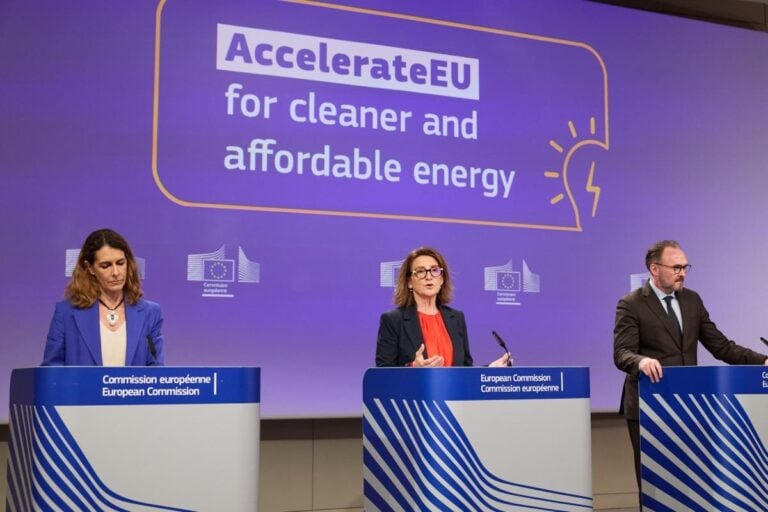
The plan, AccelerateEU, “will bring both immediate and more structural relief measures to European citizens and businesses,” EC president Ursula von der Leyen said.
On the one hand, there are proposals to coordinate fuel stock inventory management at the Member State level for things like underground gas storage and jet fuel and diesel stocks, as well as targeted support for consumers.
However, there are also measures to accelerate the adoption of clean energy sources across Europe, including promoting domestic manufacturing, investing in renewables, upskilling workers, electrifying the economy, and upgrading the grid.
“We must accelerate the shift to homegrown, clean energies. This will give us energy independence and security, and mean we are better able to weather geopolitical storms,” von der Leyen said.
While the EC said that energy security is not at risk today, price volatility will impact EU citizens. Although 70% of electricity comes from renewables and nuclear, overall, 57% of energy consumed in the bloc comes from imported fossil fuels, on which €340 billion was spent during 2025, before the current war began.
AccelerateEU comes in response to a March request by EU heads of government and the measures, which sit alongside existing policies like REPowerEU (to reduce dependence on Russian imports, the cause of the previous price spike), will be discussed by EU leaders a meeting in Cyprus today and tomorrow (23-24 April).
The EC recognised that public funding will be insufficient to cover a projected €660 billion investment in the energy transition to 2030 and seeks to mobilise private investment through the Clean Energy Investment Strategy. A Clean Energy Investment Summit will be organised to bring financial services industry stakeholders to the table.
AccelerateEU still missing ‘concrete measures’ to encourage energy storage adoption
“Renewable-based electrification is the most effective way for Europe to cut its fossil fuel import dependence, and AccelerateEU rightly puts it at the centre of the EU’s crisis response,” the deputy CEO of trade association SolarPower Europe, Dries Acke, said in a statement responding to the proposals.
However, while welcoming the decision to set an EU electrification target and scale up energy storage deployment, Acke said the EC had failed “to propose concrete measures to get to these levels of battery storage and other non-fossil flexibility,” which he described as essential in reducing the impact of international gas prices on electricity prices in Europe.
SolarPower Europe is calling for a market-based mechanism to boost non-fossil fuel flexibility which could secure electricity supply and lower wholesale electricity prices, Acke said.
Meanwhile, Energy Storage Europe (formerly the European Association for Storage of Energy) said AccelerateEU “sends a strong system-wide policy signal,” in recognising the importance of flexibility to EU energy affordability, security, competitiveness and decarbonisation, in a statement authored by head of advocacy Tina Strafela.
“For the storage sector, this is key: energy storage is being recognised not only as a decarbonisation enabler but a strategic competitiveness asset in the EU policy framework. The recognition that energy storage is no longer a side topic to renewables but a strategic infrastructure is a far more powerful investment signal than a narrow renewables policy,” the Energy Storage Europe (ESE) statement said.
While the “energy storage industry is ready to deliver,” EU policymaking now needs to show “equal ambition,” according to ESE, which offered a list of recommendations for next steps.
These include faster permitting, guidance on improving grid connection measures for Member States, fair implementation of Electricity Market Design rules and recognition of storage as a standalone asset class alongside targeted Capex support, promotion of manufacturing and supply chains, network tariff and taxation reforms.
Long-duration energy storage still left out
ESE also called for the definition of sub-targets for multi-day and seasonal energy storage within the 200GW by 2030 energy storage target and the mandating of long-term flexibility assessments in EU National Energy and Climate Plans (NECPs) to identify “gaps in multi-day energy resilience.”
As discussed in a video interview with ESE policy head Jacopo Tosoni at the Energy Storage Summit 2026 in London in February, EU Member States are due to present flexibility needs assessments as part of the Electricity Market Design reform on 1 July this year, extending to 2030. Based on these assessments, the EU will be able to make decisions on State Aid schemes to support flexibility resources investments, including storage.
However, as Tosoni and his association have said previously, the assessments do not extend to a long-term view, while explicit mention of storage duration has been absent from most high-level EU conversations.
Flow Batteries Europe (FBE), while again, welcoming the AccelerateEU communication and its recognition of the role of energy storage, said Europe would be at risk of repeating “the same mistake all over again,” if it continued to overlook long-duration energy storage (LDES) as a “crucial tool.”
Only short-duration battery energy storage systems (BESS) and pumped hydro energy storage (PHES) are mentioned as energy storage solutions in AccelerateEU communications, FBE noted.
FBE asserted that several LDES manufacturers are already based in Europe and have diversified supply chains, arguing that they would meet the same fate as solar PV and lithium-ion battery manufacturers before them if policymakers fail to explicitly include LDES in follow-up initiatives and treat LDES technologies such as flow batteries as strategically important in terms of net-zero investment, procurement, grid and flexibility.