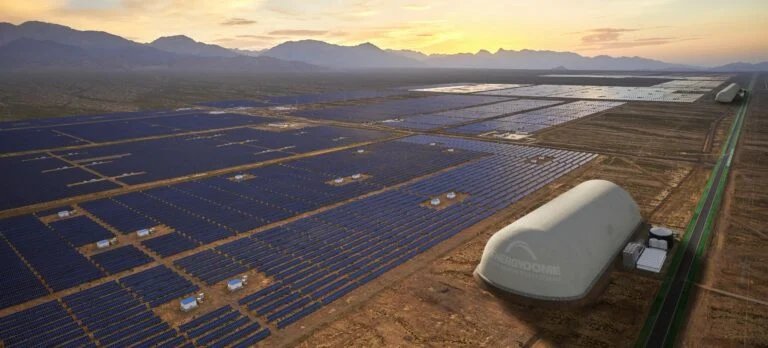
The battery stores energy based on the adiabatic compression of carbon dioxide, which is liquified during charging and evaporated as it discharges. Heat given off during compression is stored and expands the gas, driving the turbines to generate power.
Earlier in April, the company signed a memorandum of understanding (MOU) with digital infrastructure company New Era Energy & Digital (NUAI) to deploy its Battery Plus technology in Odessa, Texas.
According to Energy Dome, the Battery Plus technology combines waste heat recovery with energy storage. It uses waste heat directly from open-cycle gas turbine exhaust during discharge, which the company claims eliminates the need for prior heat storage. It further claims that this method enhances efficiency, offers combined-cycle-like performance, and reduces costs.
Research and consultancy firm Sightline Climate has also ranked the company as the top non-lithium LDES company on its LDES leaderboard.
At the Wood Mackenzie discussion, Oppici claimed that because Energy Dome does not use any Chinese-sourced materials, it is cost competitive with equipment from China, but it also qualifies for the investment tax credit (ITC).
LDES deployment
When asked by Khan where Energy Dome and other LDES technology is seeing traction, Oppici said, “In the last couple of years we have seen mainly here in the US, the eight hour application, being used to bring capacity for data centres.”
Metzroth added, “We see a huge opportunity with large load customers as well, and they need speed to power, things that are available. We’re very interested in other things like geothermal or nuclear, but we need to be able to deploy capacity right now.”
Khan asked Metzroth, “You’re saying LDES is perhaps more quickly deployed right now than nuclear or geothermal?”, to which Metzroth responded “Absolutely.”
Of course, the promising potential of a technology is not, on its own, enough to convince utilities like Xcel to pursue their use.
Metzroth’s advice is to scale up slowly, it “Shows you know how to manage a project, and actually deliver on your promises, that is very important to (utilities).”
Oppici noted that this strategy has played a role in helping Energy Dome secure projects. The company started with smaller scale projects in Europe before moving to the larger scale projects it typically does now.
Data centres
The previously mentioned MOU with NUAI in Odessa is likely to represent one of these larger projects. While Energy Dome has not stated what the size of this project will be, NUAI specified that the parties will evaluate how Energy Dome’s battery can support NUAI’s 1GW data centre.
This also highlights a larger trend of data centres utilising LDES technology, as seen in Meta and US ‘multi-day’ energy storage startup Noon Energy’s 1GW/100GWh data centre deal, and another announcement, last year, from Energy Dome, that Google would be investing its technology.
A question from the audience, relayed by Khan, focused on how LDES technology can scale outside of data centre development.
“Unfortunately, I don’t think at the moment, that there is structural revenue in place that can actually justify development outside of that firm capacity,” Oppici said.
Metzroth, in turn, noted that structural changes need to happen in order to utilise LDES beyond data centres. “There’s not really a marketing mechanism for value stacking at all. When you’re saying, ‘Look this LDES can do all these different things. It has all these different services, you know?’ Well, that’s great, but we don’t get paid for it,” she explained.