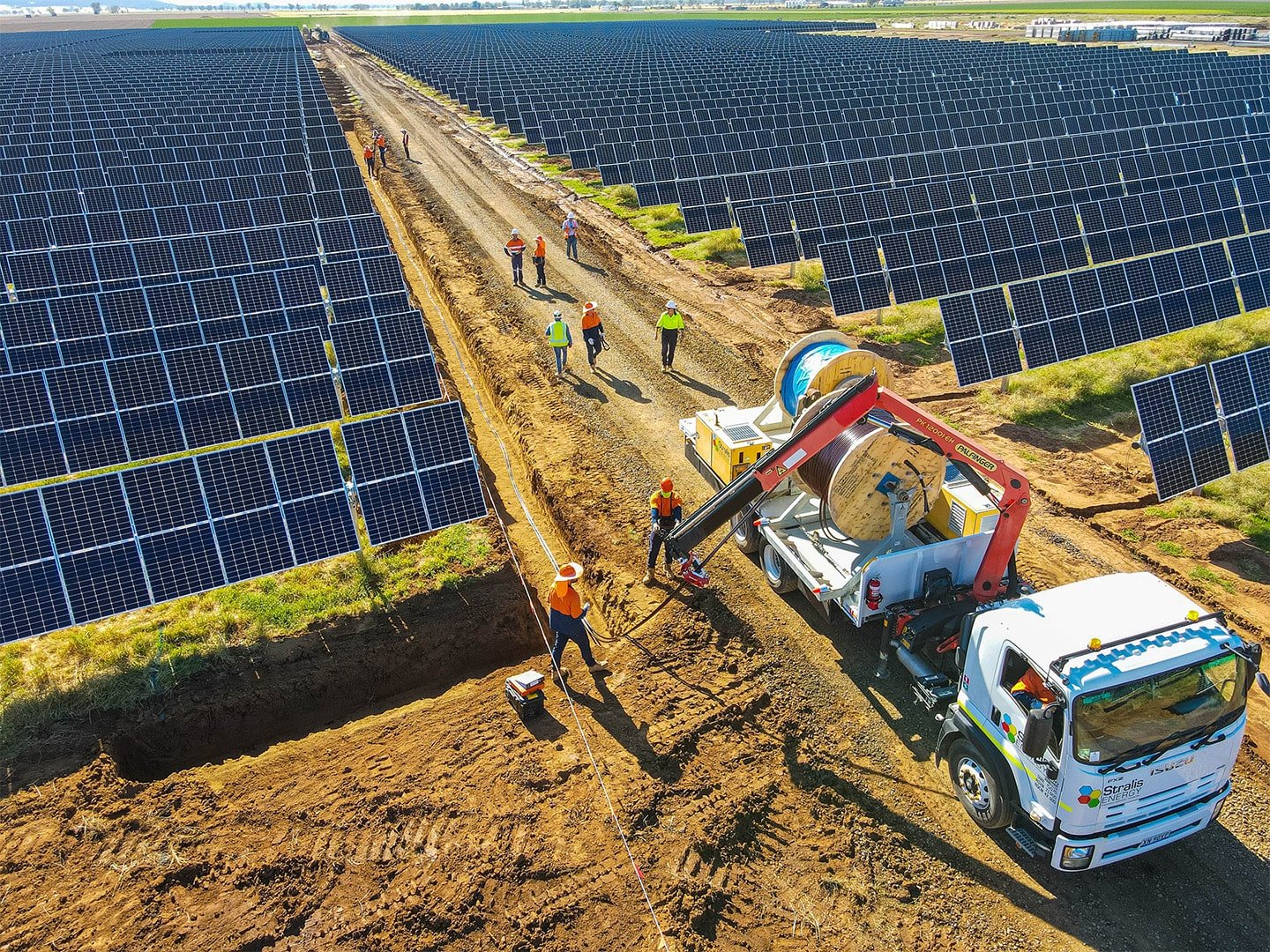
As utility-scale solar expands rapidly across the United States, operators are encountering environmental and operational challenges that mirror those faced in Australia’s solar market. From fire risk and extreme heat to vegetation growth and equipment reliability, post-construction performance has become as critical as the build itself.

The Gunnedah Solar Farm constructed by PCL in New South Wales, Australia.
In Australia, the utility-scale solar industry has a common post-construction norm: a two-year defects liability period (DLP). During this time, the engineering, procurement and construction (EPC) provider is responsible for the operations and maintenance (O&M) of the solar project, generally at the point of practical completion, more commonly referred to as substantial completion in North America.
This standard is market-driven rather than legislatively enforced. Most lenders and investors expect a 24-month DLP within EPC project contracts. DLPs usually define specific post‑construction responsibilities that the EPC retains after completion. This adds ongoing obligations for EPC contractors to maintain, monitor, study and repair the site.
In practice, the extended DLP model shifts focus from reacting to failures toward actively protecting long-term asset performance. For owners, it reduces early-life performance risk. For EPCs, it creates earlier visibility into design or installation issues that would otherwise surface after warranties expire. The DLP norm in Australia stands in stark contrast to most EPC contracts in the United States, where a one-year correction period after substantial completion typically relies on warranties, correction clauses and statutory law.
Although this may appear to add burden and risk, the approach offers a valuable opportunity to better manage the post-construction stage and ensure a smooth transition from construction to operations.
The solar and storage team at PCL Construction has completed three utility-scale projects totaling about 400 MWAC in Australia, and our approaches to O&M could be applied as solar power continues to develop across the United States.
Managing fire risk in high‑heat solar markets

The Stubbo Solar project completed by PCL in New South Wales, Australia.
The climate in Australia features long periods of dry heat interrupted by sudden heavy rainfalls, like patterns in southern U.S. states from Arizona to Georgia. Extreme heat presents challenges for solar generation.
Unsurprisingly, one of the greatest operational risks is fire. In our tropical climate, grass can grow up to 100 mm (4 in.) per week, creating a consistently high fuel load on site. Even mowing can pose a fire hazard, so care must be taken to avoid cutting dry grass on hot, windy days.
To mitigate this risk, operators are increasingly deploying AI-driven fire and smoke detection systems that monitor entire sites. These systems detect thermal events early, allowing operations teams to act promptly and prevent small issues from becoming major problems.
Lesson for America
AI-driven monitoring and proactive vegetation management can help southern U.S. sites manage fire risk during long dry periods and high-fuel-load seasons.
Wildlife management without compromising safety
Animals and wildlife can pose operational challenges. Grazing helps keep grass low and reduces fire risk, but animals can get caught in or chew on exposed cords, which presents its own hazards. Native species such as spiders and snakes remain a factor, though thankfully solar facilities are free from tree hazards — and no drop bears to worry about!
To address these challenges, effective cable management systems can be implemented to keep cords out of reach and protected from grazers. These measures allow operators to maintain healthy vegetation while keeping sites safe and operational.
Lesson for America
Cable protection and proactive wildlife management ensure that grazers and native animals do not disrupt operations, a strategy easily transferable to southern U.S. sites with similar wildlife or grazing programs.
Introducing condition‑based maintenance
When it comes to O&M, there are two main types of maintenance performed:
- Preventive maintenance – Planned and scheduled on a weekly, monthly or annual basis
- Corrective maintenance – Fixing broken or malfunctioning components

Nanticoke Solar project completed by PCL in Alberta, Canada.
Condition‑based maintenance sits between these two approaches. For example, if an inverter runs 15°C (about 27°F) hotter than the others, it may not trigger an alarm. Rather than waiting for a fault condition, operators can study component behavior and intervene before issues require corrective maintenance.
This approach is enabled by advanced analytics capabilities that go beyond on‑site, event‑ and alarm‑driven troubleshooting. By collecting site historian data at a granular level, operators can perform deeper root cause analysis, study performance trends and proactively develop predictive maintenance schedules for high‑risk components before issues occur.
In several cases, these insights allowed intervention weeks before a component failure would have triggered a forced outage. This approach helps maximize site production and reduce downtime.
In addition, strong supply chain management processes provide operators with more options for long lead time spare parts, helping further shorten site downtime.
Remote operations centers, or off-site monitoring facilities, allow operators to act on subtle equipment insights and make more proactive, data-driven decisions.
Lesson for America
As solar projects ramp up across hot‑climate regions, condition‑based maintenance and off‑site monitoring can help operators detect emerging issues earlier, prioritize interventions more effectively and protect asset performance beyond the initial construction phase.
What proactive O&M looks like on the ground
The workday starts early with a full site inspection to check for damage, potential fire hazards or misaligned trackers. Managers assign preventative maintenance tasks, monitor the SCADA system and address issues as they arise. After construction, we monitor and manage our client’s facility to prevent problems before they occur. Just as a skilled mechanic keeps a car running smoothly, our operators ensure sites generate power with minimal intervention. While we are always improving, we continue to refine scheduling and operational efficiency.
Translating experience into solar success
Australia’s experience with utility-scale solar O&M demonstrates the value of proactive maintenance, robust monitoring and adaptive approaches to environmental challenges. By applying these lessons in the United States, operators can build on existing solar momentum, enhance reliability and maximize energy production. From fire and wildlife management to condition-based maintenance and off-site monitoring, these practices offer practical insights that help U.S. projects run efficiently, safely and sustainably. We welcome collaboration with U.S. operators to adapt these practices locally and share ideas on best practices.
 Jack Somers is a senior engineering and commissioning manager with PCL Construction’s Solar and BESS division in Australia. With more than 10 years of experience as an electrical engineer and Project Management Professional (PMP), he has led engineering, commissioning, and post‑construction operations on large‑scale solar and energy storage projects across Australia, with a focus on performance, reliability, and hot‑climate operations.