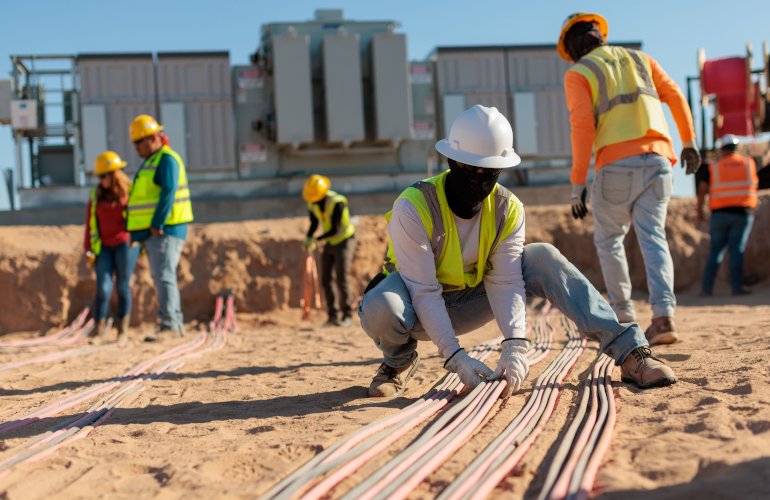
Beneath almost every solar field, out of sight and often out of mind, lies a network of underground cables whose unexpected failures have become one of the industry’s most pressing reliability challenges. Unlike cables in a typical utility that operate at 25% rated load, renewable energy feeder cables typically operate at 90 to 110% load. These “feeder” cables take the energy from the solar field and transmit it to the local utility provider’s grid. The power is then mixed with other power sources and keeps the entire electrical grid operating at peak performance.

Credit: DEPCOM, a Koch Engineered Solutions company
The safe and reliable operation of cables feeding the grid from a solar field is critical. No one wants to generate power only to lose it in the cable field. The anticipated life of renewable feeder cables is approximately 40 years, but, realistically, cable lifespans have been failing much sooner. This leaves grid owners wondering what can be done to extend cable life.
Renewable feeders run near their limits
Underground cables spend much of their existence in water due to the natural water in the ground. The temperature of the earth 6 ft down is 54°F with 100% humidity. This natural water bath provides sufficient water for the cable to absorb moisture into the insulation. Water diffuses into the cable and slowly degrades the insulation. The insulation of the underground cable prevents electrons from escaping the conductor and being lost to the ground. This water diffusion ages the cable more quickly than if it were in a dry environment. Once electrons are lost to the ground, the cable can catastrophically fail much quicker. The double whammy of a higher load on the cable (making the cable warmer) and the presence of moisture in the insulation causes premature cable failure.
A simple way to restore performance

Credit: Southwire
Despite all the potential damage that can happen to these cables, there is something solar project owners can do to protect and extend the life of their cables. Silicone cable rejuvenation restores the strength of the insulation, dries out the cable and extends the life by many years.
The process is simple — the cable is isolated and de-energized, and special connectors are attached. Silicone fluid is then passed through the conductor. This fluid will diffuse into the insulation and chemically remove the water and patch any voids in the insulation. This restores the strength of the insulation to like-new or better. Once the process is complete, the cable can easily be expected to last the entire life of the solar field.
A failure on a cable in the field could result in days or weeks of downtime while patching the failure site or waiting for a replacement cable. The entire rejuvenation process can be completed in a few hours, making it between six- and 12-times faster than cable replacement and an optimal choice for cable reliability, Southwire has determined.
Additionally, the process of silicone rejuvenation is economically and environmentally advantageous. Typically, it is significantly less than half the cost to rejuvenate a cable versus replacing the same cable. The impact on the environment is also significant, with rejuvenated cable having a 99.9% better carbon footprint than cable replacement.
Timing matters, evaluate early

Credit: Southwire
It is recommended to look at the cables in solar fields as early as five years after installation. This is when the groundwater fills the insulation and starts to weaken the cable’s strength and shorten its life. Southwire has found that some solar cables that have not been treated to remove water have failed in as little as 10 years.
Early inspection can save a cable before it fails. Early cable failures lead to an unreliable feed system and will eventually need to be replaced or repaired (spliced) with silicone injection to restore its strength. Additionally, it’s imperative that any cable failure be rejuvenated, repaired or replaced as soon as possible. If not fixed right away, the initial failure can lead to other failures on the system due to the similarity of the other surrounding cables and the environment they are in.
The entire purpose of the solar array is to keep feeder cables at peak performance and fully energized. Obviously, it makes sense to keep the cables performing as long as the field is economically viable. For more than 35 years, utilities, industrial complexes and renewable energy fields have been using silicone rejuvenation on electrical cables. With the demand for electricity increasing every year, rejuvenation is a logical and easy solution to extend cable life rather than opting for a full replacement.
Dr. Wayne Chatterton has a Ph.D. in organic Chemistry from the University of Toronto (1990). He has spent his entire career in the electrical industry, previously working for Dow Chemical in the development of cable rejuvenation fluids and UtilX/Novinium. Currently, Dr. Chatterton is the Vice President of Services Solutions Sales at Southwire as well as a senior member of the IEEE and ASTM committees D9 and D27. He has worked on transformer fluids, circuit breaker lubricants, insulating rubbers, diffusion pump fluids, and has numerous patents on cable rejuvenation fluids and processes.