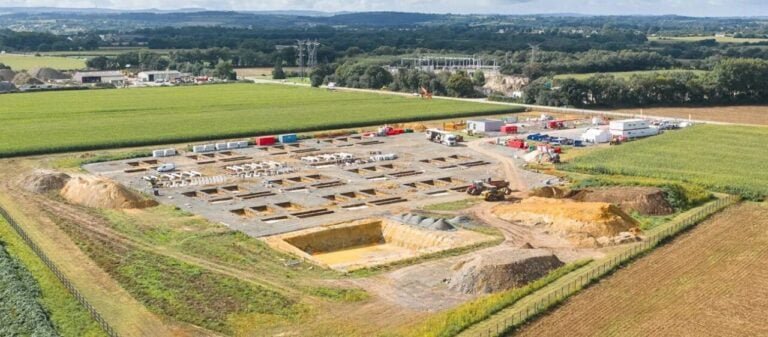
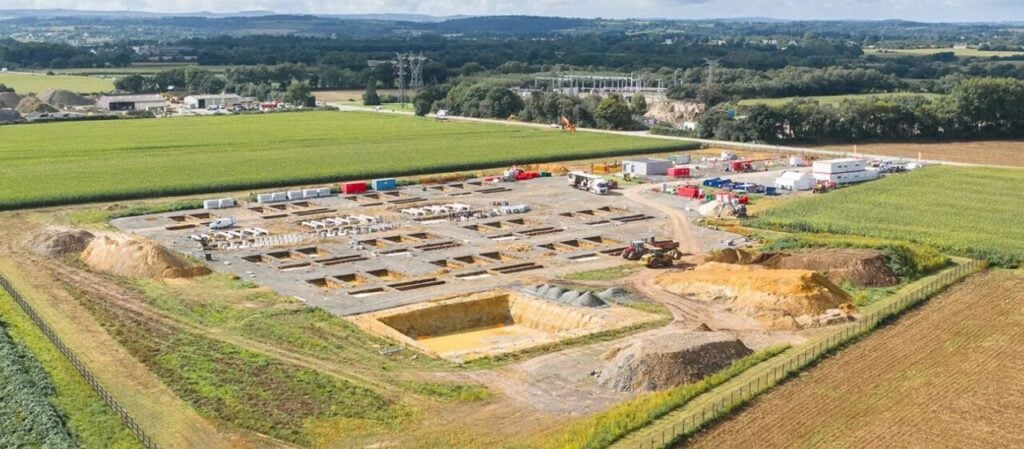
IPP Neoen will provide Réseau de Transport d’Electricité (RTE) with grid-forming function from a BESS project in Brittany, France.
Neoen’s Breizh Big Battery (BBB) is currently under construction for operation in summer 2026, and will be retrofitted with grid-forming inverter capabilities.
It will then provide grid-forming services to RTE, the transmission system operator of France, for a one-year period at least starting in the second half of this year. BESS in France (and most places, generally speaking) are currently grid-following rather than grid-forming.
Grid-forming BESS can autonomously stabilise voltage and frequency by actively compensating for grid variations, instead of always having to synchronise with the grid’s frequency. This allows them to offer faster and less limited responses to grid variations and events. Specific services that this enables include inertia, voltage control and black start.
This article requires Premium SubscriptionBasic (FREE) Subscription
Already a subscriber? Sign In
Try Premium for just $1
- Full premium access for the first month at only $1
- Converts to an annual rate after 30 days unless cancelled
- Cancel anytime during the trial period
Premium Benefits
- Expert industry analysis and interviews
- Digital access to PV Tech Power journal
- Exclusive event discounts
Or continue reading this article for free
Neoen’s announcement implied only a single inverter will be converted to grid-forming mode.
The 92MW/183MWh lithium-ion BBB project is Neoen’s first large-scale BESS in France, the company’s home market.
Gabriel Bareux, R&D director from RTE, commented: “I am delighted with this experiment, which aims to test cutting-edge technological advances capable of enhancing grid stability. It marks a first in France and represents the culmination of research in which RTE is at the forefront at the European level. Our ambition is to turn the rise of power electronics into an opportunity for the electricity system’s operation.”
Grid-forming inverters have additional software capabilities compared to grid-following ones, and the grid trials required by TSOs and grid operators for connection are longer and more complicated than for grid-following. Grid-following capabilities do not necessarily require additional inverter hardware, but the inverters need to be based on up-to-date technology.
Markus Ovaskainen, sales director for Finland-headquartered BESS and inverter supplier Merus Power recently told Energy-Storage.news that most BESS projects online today would probably need a power conversion system (PCS) hardware retrofit to be able to provide grid-forming services.
The ‘retrofit’ in the case of Neoen’s meanwhile may be software-only, as it is a new project.
The European Network of Transmission System Operators for Electricity (ENTSO-E) recently proposed requiring grid-forming capabilities from all BESS projects connected to the grid.
Hassen Bali, co-founder and director of developer Ion Ventures, recently told us that he expects inertia to emerge at scale as a new application for BESS.
Neoen is also active in deploying large-scale BESS in Italy, Finland, Sweden, Australia and Germany, where it recently secured a seven-year toll for a project. The firm was acquired by infrastructure investor Brookfield in 2024.
Energy-Storage.news publisher Solar Media is hosting the Energy Storage Summit EU 2026 in London, UK, on 24-25 February 2026 at the InterContinental London – The O2. See the official website for more details, including agenda and speaker lists.
InterContinental London – The O2, London, UK
This isn’t just another summit – it’s our biggest and most exhilarating Summit yet! Picture this: immersive workshop spaces where ideas come to life, dedicated industry working groups igniting innovation, live podcasts sparking lively discussions, hard-hitting keynotes that will leave you inspired, and an abundance of networking opportunities that will take your connections to new heights!
Held alongside The Battery Show Europe, Energy Storage Summit provides a focused platform to understand the policies, revenue models and deployment conditions shaping Germany’s utility-scale storage boom. With contributions from TSOs, banks, developers and optimisers, the Summit explores regulation, merchant strategies, financing, grid tariffs and project delivery in a market forecast to integrate 24GW of storage by 2037.
Battery Asset Management Summit Europe is the annual meeting for owners, operators, investors, and optimisation specialists working with operational BESS assets across the continent. The Summit focuses on how to maximise performance and revenue, manage degradation, integrate advanced optimisation software, navigate evolving market and regulatory frameworks, and plan for repowering or end-of-life strategies. With insights from Europe’s most active storage markets, it equips attendees with practical guidance to run resilient, profitable battery portfolios as the sector scales.
Read Next
While the UK grid-scale BESS market continues to be among the busiest in Europe, there are still huge questions and plenty work to be done in several key policy areas.
Virtual BESS tolling platform startup Terralayr has raised €192 million (US$223 million), primarily for its own build-own-operate BESS pipeline. CEO Philipp Man spoke to Energy-Storage.news about the funding round and growing its capacity virtualisation and tolling platform.
Duke Energy, Elevate Renewables, and Fluence Energy, along with BrightNight and Cordelio Power, are advancing BESS projects across the BESS.
Fluence senior VP and chief enterprise operations officer Roman Loosen explains how 2025 saw energy storage go from “important” to “essential.”
We hear from IPP Zelestra about its decision not to proceed in Italy’s MACSE auction and the auction’s wider implications on demand for private tolls.