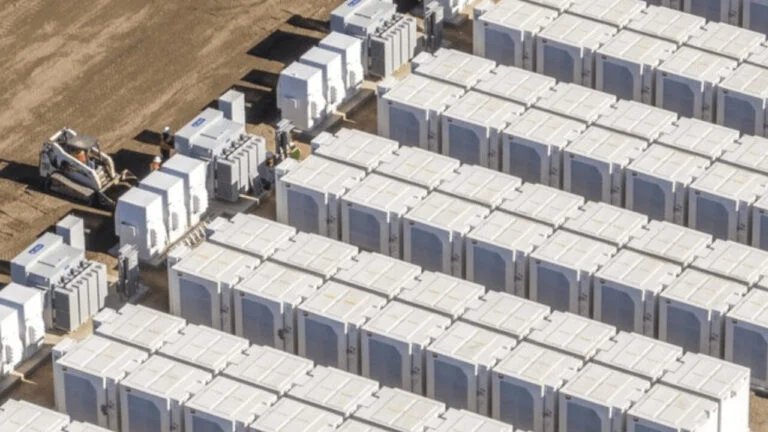
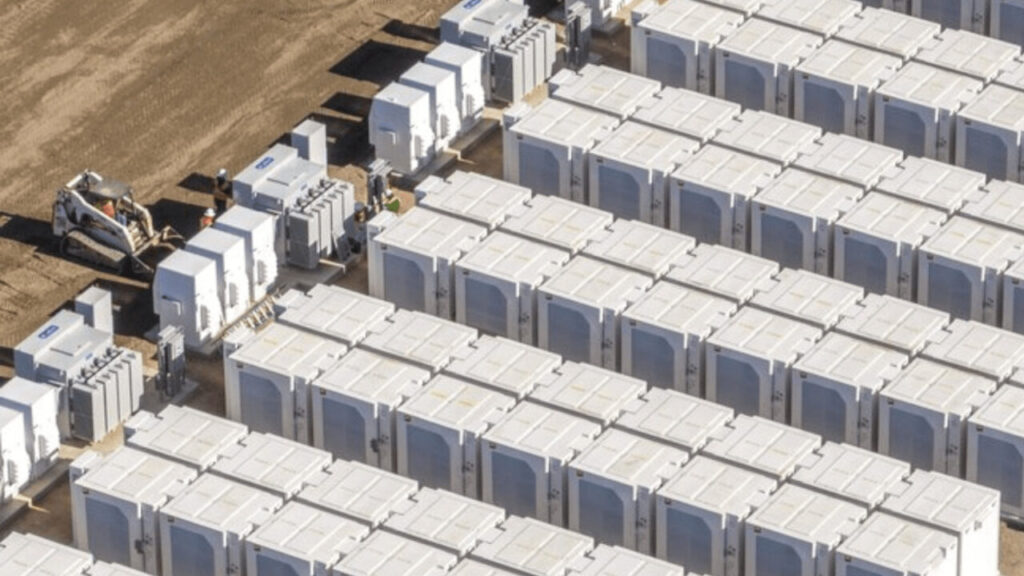
Denmark-headquartered multinational energy company Ørsted has purchased a 150MW battery energy storage system (BESS) project in Michigan, US, from developer ESA Solar Energy.
Announced 7 May, energy software and consulting group Ascend Analytics led the transaction of the Salzburg BESS project. The company said that through its Ascend Energy Exchange (AEX) renewables and storage marketplace, it provided asset valution, financial modeling, market outlook, and end-to-end transaction advising.
The companies claimed that the Salzburg BESS project’s location makes it well-suited to fulfill Michigan utilities’ offtake needs. The project has passed significant development checkpoints, including permitting and interconnection advancement, and is slated to come online between 2029 and 2030.
The companies also cited Michigan’s emerging energy storage market, a result of the state’s 60% renewable portfolio standard (RPS) target by 2035, and its 2040 100% clean energy target.
This article requires Premium SubscriptionBasic (FREE) Subscription
Already a subscriber? Sign In
Try Premium for just $1
- Full premium access for the first month at only $1
- Converts to an annual rate after 30 days unless cancelled
- Cancel anytime during the trial period
Premium Benefits
- Expert industry analysis and interviews
- Digital access to PV Tech Power journal
- Exclusive event discounts
Or continue reading this article for free
ESA said it has “deep experience” in Michigan, and the Midcontinent Independent System Operator (MISO), which Michigan is located in, as a whole. It will maintain a local presence to provide post-close development services.
Recently in Michigan, utility DTE Energy said it would forego customer rate increases for two years, dependent on the success of a US$16 billion data centre campus, built for tech company Oracle, and involving a BESS.
According to the utility, its two data centre contracts, one approved and one pending Michigan public service commission (MPSC) review, are expected to generate approximately US$9 billion for electric system improvements through 2045, potentially reducing cost burdens on other customers.
Michigan regulators approved six battery energy storage projects for DTE in March, adding 1,332MW of capacity statewide. Half of these projects, the 132MW Fish Creek Energy Centre, 100MW Cold Creek Energy Centre, and 100MW Pine River Energy Centre, will support the Oracle data centre, dubbed Red Barn.
Although it was originally founded as a national oil and gas exploration company, utility and independent power producer (IPP) Ørsted is among the world’s biggest offshore wind energy developers and divested its oil and gas assets in 2017. The Danish government remains the NASDAQ-listed company’s largest shareholder. In 2019, Ørsted deployed its first 20MW standalone BESS project in the UK, followed by a 40MW BESS in 2021.
In August 2024, the company said it was developing a 1GW BESS pipeline in the Midwest US. Ørsted and US developer Mission Clean Energy submitted grid connection applications for projects in the Central and North regions of MISO.
In March 2025, Ørsted broke ground on a 300MW/600MWh BESS that would be co-located with onshore substation infrastructure for the Hornsea 3 offshore wind farm in the UK.
In February of that year, Ørsted announced that its Board of Directors had approved revisions to the company’s business plan, including reductions in capital investment. CEO Rasmus Errboe characterised the decision as a response to a “challenging year for the [renewables] industry.”
At that time, it also took a final investment decision (FID) on a 250MW/500MWh BESS co-located with one of its operational solar developments in Fort Bend County, Texas.
On 6 May, Ørsted gave its interim report for Q1 2026, showing that while the company did make a profit, its profit for the period dropped 46% from DKK 4.9 billion (US$771 million) in Q1 2025 to US$409 million in Q1 2026.
Errboe stated that one of the company’s main priorities “is to ensure a focused and disciplined approach to capital allocation, where our focus going forward primarily will be on offshore wind in Europe and select markets in APAC.”
Held alongside The Battery Show Europe, Energy Storage Summit provides a focused platform to understand the policies, revenue models and deployment conditions shaping Germany’s utility-scale storage boom. With contributions from TSOs, banks, developers and optimisers, the Summit explores regulation, merchant strategies, financing, grid tariffs and project delivery in a market forecast to integrate 24GW of storage by 2037.
You can expect to meet and network with all the key industry players again in 2025 from major US asset owners, operators, RTOs and ISOs, optimizers, software and analytics providers, technical consultancies, O&M technology providers and more.
Launching September 2026 in Berlin, Energy Storage Summit Germany is a new standalone event dedicated to Germany’s energy storage market. Bringing together investors, developers, policymakers, TSOs, manufacturers and optimisation specialists, the Summit explores the regulatory shifts, revenue models, financing strategies and technology innovations shaping large-scale deployment. With Germany targeting 80% renewables by 2030, it offers a focused platform to connect with the decision-makers driving the Energiewende and the future of utility-scale storage.
Read Next
Independent power producer (IPP) Innergex and system integrator Prevalon Energy have energised the San Andrés II battery energy storage system (BESS) in Chile.
Australian utility AGL has said adding its Liddell and Tomago BESS to its existing coal-fired generation could boost portfolio returns by 10%

The business model for battery energy storage systems (BESS) in the US is changing rapidly, according to industry experts who gathered recently to discuss revenue strategies and market conditions.
Organic flow battery company CMBlu Energy has closed a €50 million (US$58.76 million) Series C financing with participation from Samsung Ventures.
Australia has installed 380,712 home battery storage systems, representing 10.7GWh of storage capacity, since the introduction of the Cheaper Home Batteries Program last year, Chris Bowen, Australia’s minister for climate change and energy, has disclosed.