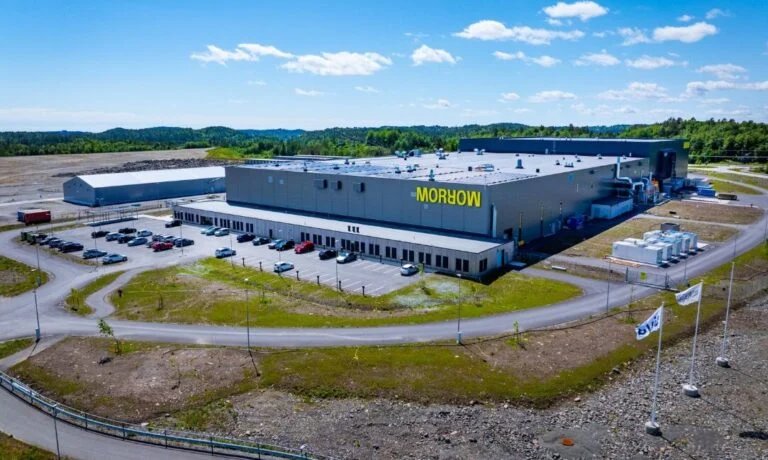
- competition in the global battery market has intensified and brought prices down
- capital costs have increased
- there have been delays in its industrialisation process
- the investment market has become more restrained
It appears resigned to Morrow not continuing as a going concern. The firm does hope that a buyer for the estate could emerge to continue to develop its technology and manufacturing.
Jon Fold Von Bülow, acting CEO of Morrow, said: “I firmly believe this is not the end. The platform we’ve built, from LNMO technology to industrial capabilities, still holds significant value, and I hope it finds a new home to continue the journey. If you are a builder, investor, or partner with interest in advancing European battery capacity, now is the moment to lean in.”
Its shareholders are Å Energi, Siemens Financial Services, ABB, Maj Invest, Nysnø and Noah, totalling approximately NOK3.3 billion (US$356 million) of investment, plus shareholder-provided loan guarantees of over NOK500 million. Government body Innovation Norway has also provided loans of NOK550 million, of which NOK300 million has been spent, and it has received grants of NOK202 million from elsewhere.
The Agder District Court will now appoint a bankruptcy administrator shortly for the Norwegian companies to assume control over assets and operations. Employees wages are safeguarded under a government-administered scheme.
Targeting LFP and LNMO; different approach than Northvolt’s
Morrow is the third of the big Nordic battery companies to fall, after Northvolt and Norway-based Freyr Battery, which cancelled its gigafactory projects and pivoted to becoming a US solar player.
Morrow had recently secured master supply deals with Finnish technology company Preventia as well as a German defence company. Previous to those, it has secured offtake commitments from Nordic system integrators Nordic Batteries and Eldrift as well as a Ukraine government body for deployments there.
It was primarily targeting the manufacture of lithium iron phosphate (LFP) cells, the dominant chemistry for battery energy storage system (BESS) applications, but has also been developing lithium nickel manganese oxide (LNMO) technology. A non-China supply chain with LNMO is possible much sooner than for LFP.
That was one of several points that the then-COO Andreas Meier made in an interview with Energy-Storage.news in 2024, in which he explained how the firm aimed to compete with cheaper Chinese batteries. From that chat and its other announcements, the company appeared to be going down a different route to Northvolt, which filed for bankruptcy later that year.
Morrow was starting out much smaller, focusing on the BESS market and focusing on cell production. Northvolt on the other hand tried to basically everything (though it did then try to divest those non-core activities two months before declaring bankruptcy).
Perhaps related, industry reaction to Morrow’s demise on LinkedIn has been much more amicable, with many talking about its humility (see the acting CEO’s post here). The reaction to Northvolt’s on the other hand contained much more frustration and anger. People also criticised Freyr’s attempts at commercialising unproven semi-solid LFP tech from 24M Technologies (which is now also reportedly shutting down).