Welcome to my first contribution to Solar Power World, part of a new series of articles looking specifically at U.S. solar manufacturing trends. The series will review and discuss the companies behind investment decisions, technologies deployed, equipment and materials suppliers, production levels and profitability metrics.
Each article will focus on companies and technologies that are key to the overall fortunes of the U.S. sector. The first piece looks at T1 Energy, a new entrant since late 2024. A review of the issues facing the company reveals why cell (not module) manufacturing roll-out is proving so difficult across the whole U.S. solar sector.
More facts, less fiction needed on manufacturing metrics
Plans to create a viable U.S. solar manufacturing ecosystem are not new. Hundreds of companies have come and gone, with First Solar one of the few major successes.
The last meaningful effort to establish a domestic U.S. solar manufacturing sector coincided with the thin-film boom-and-bust cycle nearly two decades ago. During that period, more than 50 U.S.-based companies — often venture-backed, supported by Dept. of Energy programs or spun out of universities — announced plans to develop thin-film manufacturing capacity. These efforts spanned multiple technology variants, including a-Si/µc-Si, CIGS/CIS, CdTe and even organic or dye-sensitized concepts, as well as a wide range of manufacturing approaches such as flexible roll-to-roll production, glass-based modules, cylindrical geometries and concentrator-oriented designs. The period was highly chaotic and equally fragmented.
Comparing the approaches then with the silicon-based strategies dominating the current phase is like chalk-and-cheese. But there are similarities, most notably a deluge of capacity announcements, bullish marketing rhetoric and third-party observers quick to add up capacities and come to hasty conclusions.
However, the most alarming difference between then and now relates to credible third-party analysis at the company-specific level. During the thin-film phase before, the sector benefited hugely from the informative coverage from a group of highly adept investigative journalists/enthusiasts who sought the truth behind the claims, including Eric Wesoff’s list of deceased solar companies with now-defunct Greentech Media and in-depth blogs from the likes of Edgar Gunther, Mark Osborne and Tom Cheyney.
Where is this scrutiny today? And why the current obsession with capacity counting?
Last October, media announcements championed the U.S. solar manufacturing ecosystem as an entire solar supply chain reshored. There was also a narrative that the United States was on track to become a net exporter of modules. Moreover, companies even started claiming market-share supremacy based solely on capacity announcements.
Having monitored this topic for about 25 years, it is fair to say that capacity announcements in the solar industry are routinely akin to meaningless metrics. Even when factories come to fruition, what is installed is rarely what was announced, and what is produced often falls well below even these levels.
There are many factors that should be looked at instead, such as production volumes, profitability, corporate finances (especially debt metrics), viability of company strategy, secondary revenue streams to offset ramp-up and investment cycles, product quality/reliability, equipment/material suppliers and credible in-house technical expertise.
Here’s hoping these new articles will help in some way to plug the analysis gap. If you read my Q&A with Kelly Pickerel last week, you will realize why the contributions are here. Quite simply, Solar Power World has been the leading voice on U.S. manufacturing issues for the past few years and the findings from the articles should complement the excellent coverage undertaken by the editorial team.
T1 Energy progress is impressive but cell ramp-up will be the real challenge
As noted earlier, T1 Energy is the focus of the first article. As will become apparent, T1 Energy not only merits first-company coverage status but (within just over 12 months) has been required to address every issue and challenge imaginable, simply to carve out a viable business plan over the next two years.
Largely by virtue of its rapid execution plan to date, T1 Energy is also one of the first new U.S. manufacturing entities to be faced with the $64,000 question: How do you make silicon solar cells?
By choosing T1 Energy largely as a case study, this allows a smooth transition into a discussion on the generic issues related to solar cell equipment supply — by default allowing a deep dive into T1 Energy’s proposed Chinese cell equipment partner and China’s overall landscape.
To get the necessary perspective, a short history is needed on the background leading up to T1 Energy’s cell expansion plans. It’s not a simple story by any means, but here is a snapshot.
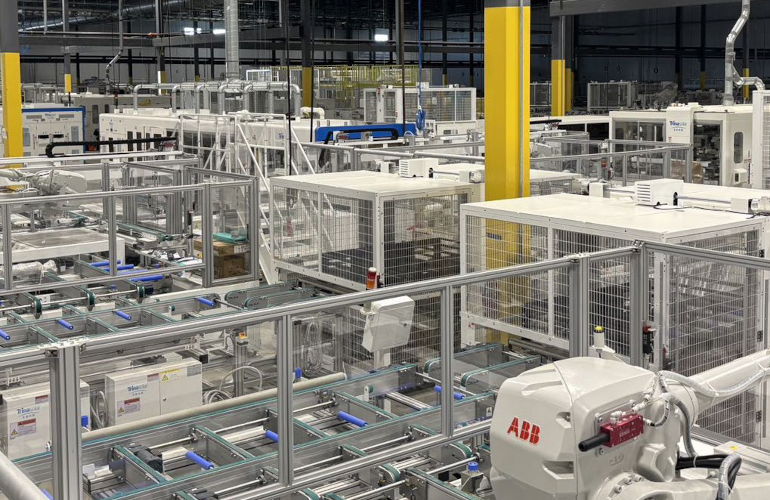
Inside the Wilmer panel assembly factory.
In 2023, Trina Solar leased a warehouse in Wilmer, Texas, to accommodate a 5-GW solar panel assembly facility with seven production lines, mostly from Chinese equipment suppliers SC Solar and Autowell. As foreign entity of concern (FEOC) regulatory considerations emerged in 2024, Trina restructured its U.S. operations. Within days of initial production in November 2024, Trina basically “sold” the manufacturing assets to FREYR Battery.
Established in 2018, FREYR was listed on the NYSE through a vehicle founded by U.S. investors to move into “green” manufacturing. Despite strong cash injections, FREYR’s battery technology failed to scale. Burning cash, the company pivoted to solar and changed its name to T1 Energy.
With selling the Texas plant to T1 Energy, Trina moved from an owner-like to a creditor-like position. Further restructuring occurred at the end of 2025, according to available filings and reporting, when T1 Energy appears to have employed a combination of a tax credit sale and a capital raise (also earmarked for cell expansion) to remove conditions that might have affected Sec. 45X credit eligibility in 2026, which resulted in Trina retaining a minority ownership stake.
During 2025, T1 Energy effectively ramped the Wilmer module site with impressive yield metrics. By the end of the year, factory output was consistent with 4.5-GW annualized production volumes — a strong return given the company’s track-record.
Future supply-chain sourcing was unveiled: Corning (for Hemlock polysilicon and Corning’s new ingot/wafer plans), Talon PV (through a minority stake for potentially a second domestic cell source) and Nextpower (for domestic-made frames).
Plans were announced to add a cell factory in Rockdale, Texas. T1 Energy also revealed it would partner with Chinese equipment supplier LAPLACE Renewable Energy for the turnkey delivery of the cell production lines for Rockdale.
Talk about a busy 2025!
T1 Energy’s selection of LAPLACE
The tactics and strategy employed by Trina and T1 Energy — concerning the Wilmer facility, related FEOC, intellectual property (IP) and supply-chain partnerships since 2022 — appear to have been rolled out with meticulous efficiency, largely providing a blueprint in how to navigate the complex legal landscape that underpins the U.S. manufacturing sector today.
In ramping a silicon-based module facility to approximately 5-GW annual run-rate levels (in just 12 months), Trina and T1 Energy have collectively created a domestic base in the United States that was simply the aspirational goal of others just two years ago.
Putting aside any doubts on the operational run-rate guidance by T1 Energy out to 2027, it seemed, until mid-November 2025, that box after box was being ticked off perfectly.
However, bullet points and transcript comments contained within the company’s Q3 ’25 investor slide deck and conference call suggest the transition from pure-play module to integrated cell/module manufacturing could potentially be an area that merits closer examination — choosing cell manufacturing lines based on Trina’s recent cell build-outs in China and Southeast Asia and partnering with LAPLACE based on its global deployment track-record and being a first-mover on TOPCon.
A couple years ago, the idea of writing an article involving T1 Energy (then FREYR) and LAPLACE would have seemed unthinkable. But this does afford the opportunity now to bring in the generic issue of Chinese cell equipment supply, essential to the plans of many companies in the United States, not just T1 Energy.
LAPLACE formed post MIIT directives to China sector
LAPLACE has been on the global PV radar mostly since 2021, as a relatively new entrant to the PV equipment space (from a volume shipment perspective). LAPLACE has a fascinating technical, financial and operational track-record.
To understand LAPLACE’s raison d’être, it is necessary to go back to 2013 when China’s Ministry of Industry and Information Technology (MIIT) issued its directive to develop a domestic equipment and materials supply base. This policy’s effect ordered the Chinese PV manufacturing sector to stop importing Western PV equipment (from the likes of Applied Materials’ Baccini, Centrotherm, Meyer Burger, SCHMID, Rena, SEMCO and others) and was connected to state-backed credit availability, which the Chinese sector needed to expand capacity.
While LAPLACE was officially registered in 2016, the formative years basically saw the company under the auspices of LONGi and Jinko Solar, when the leading Chinese cell producers were seeking to develop domestic equipment critical for the imminent technology transition from PERC to what would become TOPCon and other advanced n-type architectures including back-contact. By the time LAPLACE initiated commercial activities from its Wuxi base (early 2021), the TOPCon revolution was getting underway.
Globally, PERC commanded roughly 90% of the market in 2021. By the end of 2024, TOPCon’s share had surged to almost 80%, marking one of the fastest technology transitions in solar PV history. During this period, LAPLACE’s lead customer, Jinko, emerged as a TOPCon front-runner, exemplified by its 56-GW integrated TOPCon facility in Shanxi Province.
Capital expenditure for the c‑Si cell stage of the value chain, which had been around $3.5 billion pre-2020, exceeded $40 billion during the 2021 to 2024 PERC to TOPCon transition.
Western equipment suppliers had historically underpinned Chinese PV manufacturing through the Al-BSF and PERC eras, even laying out process blueprints that Chinese manufacturers leveraged. However, the PERC to TOPCon transition was largely a Chinese-led phenomenon, and the newly established domestic equipment suppliers, including LAPLACE, were among the primary beneficiaries of this surge in CapEx.
LAPLACE’s prominent role in this pseudo closed-loop capital recycling exercise propelled the company to IPO attention in 2024. Its valuation was likely heavily indexed to the astonishing growth trajectory achieved in just three years of commercial-volume trading, effectively allowing initial private and state-backed investors to monetize the sector’s policy-driven expansion at its cyclical peak.
The tripartite interactions of LAPLACE, Longi and Jinko
The interplay between LAPLACE and LONGi/Jinko was the primary engine growth for LAPLACE since 2021. As shown in Figure 1 (below), LONGi and Jinko accounted for about 60% of LAPLACE’s income during 2021 to 2024, with Trina likely connected to LAPLACE through Trina’s outsourcing of solar cells to Jietai, a pure-play cell resource in China’s TOPCon supply-chain hierarchy and one of LAPLACE’s main tool customers during 2022 to 2024.

Figure 1: LONGi and Jinko were LAPLACE’s main customers for solar cell equipment revenues during LAPLACE’s strong growth period from 2021 to 2024, accounting for about 60% of LAPLACES’s sales.
Another part of the LAPLACE and LONGi/Jinko relationship pertains to interlocking shareholder influence from LONGi and one of Jinko’s subsidiaries. Essentially, Jinko maintains a direct equity stake in LAPLACE through an investment vehicle. LONGi exerts influence indirectly through Linton, an entity largely controlled by key LONGi executives and one of LAPLACE’s largest shareholders.
The final part of this tripartite relationship now factors in the somewhat delicate issue of IP.
Throughout the last two decades, China has pushed a domestic manufacturing initiative, which prioritized IP as a national strategic resource, creating a two-tier patent filing mandate that incentivized companies and state-cascaded bodies. As a result, almost all companies in the Chinese solar industry quickly amassed patent portfolios running into the hundreds or even thousands.
The type of patents held by tool maker and cell manufacturer certainly need to be examined. For example, are the patents pertinent to the process flow (e.g. innovation patents related to TOPCon tunnel oxide layers) or merely the mechanisms for a production tool (e.g. utility model patents for furnace design)?
This can become important when an equipment manufacturer sells a tool to a third party with the third-party, in theory, potentially infringing on IP owned by a different cell manufacturer.
The issue of TOPCon patent protection is huge today, especially in the United States. And it’s all happening right when U.S. investments turn from modules to cells.
Turnkey offerings and why cell fabs are so hard to build
The above issues put both technology and equipment supplier selection for new c-Si cell lines in the United States under the spotlight, to an extent that it has forced decision makers to choose legacy PERC designs (p-type substrates) or niche n-type technology variants such as heterojunction (HJT) to avoid TOPCon IP battles.
It’s also important to note the lack of cell manufacturing expertise in the United States, as the country has been absent from cell development for the past 20 years (in fact, the entire lifetime of volume solar deployment as a technology). India has the same issue today, with perhaps Adani, Premier Energies and Jupiter being the exceptions.
This essentially forces companies (many new to solar manufacturing) to rely heavily on equipment suppliers or consultancy firms to ensure the production lines are commissioned on time and operate to specified performance levels (cost, yield, efficiency).
Contrast this with the modus-operandi of a market leader in any industry where the manufacturer designs the production line, uses suppliers to deliver equipment and owns the overall recipe and related IP to operate the equipment in a production line. Maybe only a dozen in the silicon solar industry today benefit from this luxury.
Essentially, these issues are now almost forcing equipment suppliers (by default China-weighted) to take on a role (as turnkey partner) that has generally been outside their comfort zone as opposed to simply delivering a tool within an overall production line that the customer designs and operates.
Moreover, many of these equipment suppliers have had limited overseas business, often only supplying the Southeast Asian cell expansions of Chinese-based manufacturers. To illustrate this point, Figure 2 (below) shows LAPLACE’s revenues by geography for the calendar years 2021 to 2024 and for the first half of 2025.

Figure 2: Consistent with trends seen across most of the China solar cell equipment supply landscape, LAPLACE’s share of revenues, for which cell equipment accounts for about 95%, has historically been dominated by stand-alone tools for domestic cell manufacturers.
It also gets to the heart of what “turnkey” really means. Often, the perception is that a turnkey supplier is responsible for everything, in a way that companies like Centrotherm and SCHMID served the industry in the first wave of turnkey c-Si cell deployment across much of Asia. The new definition of turnkey is somewhat different, often split into roles of consolidated tool delivery and localized operator/service providers.
This all explains why getting cell production lines up and running in the United States and India today is proving so problematic. These issues far outweigh the theoretical models often being cited, claiming that the issue is because of localized premiums arising from cost deltas compared to Chinese volume manufacturing of solar cells, or a lack of workers to operate equipment.
T1 Energy potentially still the best pick for U.S. cell deployment
 The next 18 months will likely define the fortunes of the entire U.S. silicon-based sector. Without viable and sustainable cell production volumes, there is no wafer demand. And by default, polysilicon remains an export market for Hemlock, coupled with the ongoing shuffling of ingot/wafer and cell production around parts of Southeast Asia and the Middle East and Africa.
While a few U.S. companies have initiated cell production, it is widely acknowledged that the country needs a success story from a major player (better still, one listed on Wall Street) to provide investor confidence and pave the way for other leading players.
While still a challenging task — and a must-deliver mandate for T1 Energy to realize its 2027 run-rate guidance to the market — T1 Energy could well provide this first critical success story for U.S. cell manufacturing. In this respect, it possibly makes T1 Energy the company to watch regarding cell manufacturing in the United States over the next 18 months.
If T1 Energy can pull this off, it will give the entire silicon-based industry in the United States a monumental boost. And, maybe only then, the proclamation of the sector being reshored will be fully justified.