Data centers and energy used to be separate conversations. Today, they’re the same conversation.
The rapid rise of AI-driven data centers is as much about power as it is about technology. These facilities don’t exist without energy, and as demand for compute increases, so does electricity demand. In that sense, data centers are simply a new kind of load – one growing faster than almost anything the grid has seen before.
From the solar side, this dynamic should feel familiar. More demand drives more generation. As data centers expand, they create new opportunities for renewables and storage, but also introduce constraints around grid capacity and infrastructure. That’s why energy and data are converging, and why the solar industry has something valuable to contribute.
It’s not just about more power
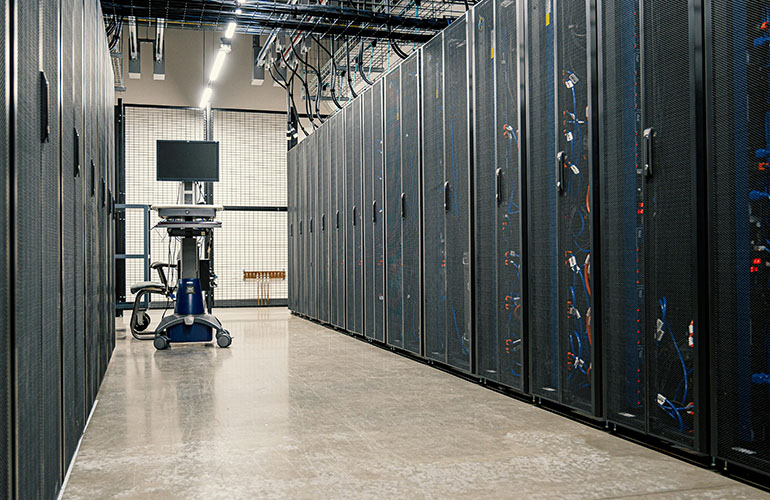 One of the biggest misconceptions about data center energy demand is that we simply don’t have enough electricity. In reality, most grids are only about 50% utilized much of the time. The real challenge shows up during peak demand. Think of a hot afternoon in Texas, when air conditioning is running at full capacity, and data centers still need to operate at 100%. That’s when constraints become visible.
So the problem isn’t just building more generation. It’s using the energy we already have far more efficiently. And today, data centers are not particularly efficient in their power use. A meaningful portion of the electricity they consume never reaches the compute itself.
The hidden cost of conversion
To understand why, it helps to look at how power flows through a typical data center. Electricity arrives from the grid as high-voltage AC, often around 34.5 kV. But the GPUs and chips powering AI workloads run on low-voltage DC. So before that electricity can be used, it has to be converted, and not just once, but several times.
First, the voltage is stepped-down but remains AC. Then it passes through a UPS system, essentially a battery, which requires converting AC to DC and then back to AC. From there, the voltage is reduced again through power distribution units before finally being converted to DC at the rack level. Depending on the design, this process can involve five to seven conversion stages.
Each step introduces losses. No conversion is perfectly efficient, so energy is dissipated as heat. In total, about 10-12% of incoming power can be lost this way. In a 100-MW facility, that’s 10 to 12 MW disappearing into inefficiency. That loss also generates heat, requiring additional cooling and consuming even more electricity. It’s a “double tax” — you lose power, then spend more power managing the loss.
AI is pushing the system to its limits
 This inefficiency was manageable when loads were smaller. AI is changing that, as a traditional data center rack is in the 10-kW range. Today’s AI-focused racks are already surpassing 100 kW, and within the next few years, they’re expected to approach 1 MW per rack, all within the same footprint. That’s a 100-times increase in power density.
Legacy AC infrastructure was never designed for this level of intensity. In many cases, it caps out at around 200 kW per rack. Beyond that, it simply can’t deliver the power. This is forcing the industry to rethink its approach.
The shift to DC and why it matters
To support higher power densities, major players like Nvidia, Google and Meta are moving toward 800-VDC and similar architectures. The principle is straightforward: power equals voltage multiplied by current. Increase the voltage, and you can reduce the current for the same power. Lower current means fewer conductors, less resistance and the ability to deliver more energy through the same footprint. That’s how you fit more power into the same space.
There are multiple paths forward, from retrofits to fully DC-native systems that convert grid power directly into the voltage required by compute racks. But the direction is clear: fewer conversions, higher efficiency and a shift away from AC-heavy designs. For those in solar, this should feel familiar.
The solar industry has been here before

Credit: Consumers Energy
Solar has always operated in DC. Panels generate DC. Batteries store DC. Over the past two decades, the industry has built deep expertise in managing and optimizing DC systems efficiently.
There’s also a broader reality: most of the world already operates in DC. Microchips run on DC. Most electronics convert AC to DC before they can function. Even some long-distance transmission lines now use DC for efficiency.
AC became dominant for historical reasons; it was easier to transmit electricity over long distances, using available AC equipment when the electricity grid was built over a century ago. But that limitation no longer exists. Power electronics have evolved. What we’re seeing in data centers isn’t a radical shift. It’s a return to a more efficient, DC-native way of moving energy.
From components to architecture
What makes this transition significant is the shift toward system-level architecture rather than individual components. In solar, we’ve learned that how energy flows through a system matters as much as how it’s generated. Where conversions happen, how components interact, and how losses are managed all impact performance. The same is now true for data centers. By reducing conversion steps and designing around DC-native systems, operators can improve efficiency and unlock more usable capacity from the same grid connection.
More output without more input
In many cases, the grid connection is the limiting factor for a data center. It can take years to secure additional capacity, and in some regions, it’s simply not available. So the question becomes: how do you do more with what you already have? Improving efficiency by even a few percentage points can translate into meaningful gains. Reducing losses allows operators to lower costs, increase compute capacity, or both, without drawing additional power from the grid. At this scale, even small efficiency gains translate into meaningful, real-world impact.
What this means for solar professionals

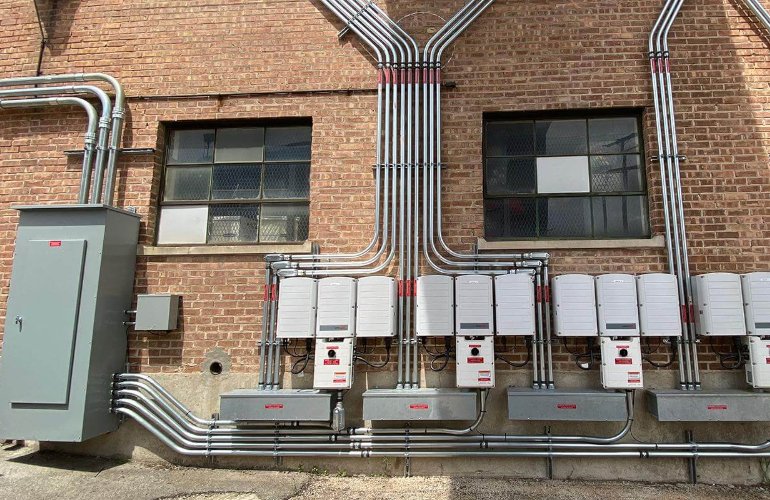
A SolarEdge installation in Chicago.
For solar contractors, developers and EPCs, this shift is worth paying attention to. First, it reinforces the value of what the industry already knows. Experience with DC systems, power electronics and system optimization applies beyond traditional solar projects.
Second, it highlights the growing importance of storage and flexibility. Data centers are not just large loads; they’re dynamic ones, with spikes that need to be managed. Storage will play a key role in smoothing those profiles and protecting the grid.
Third, it points to a broader convergence of energy systems. Solar, storage and large-scale loads are becoming more interconnected, both technically and economically.
Looking ahead
By 2030, we’re likely to see more data centers operating on DC-native architectures, supported by integrated storage and flexible energy strategies. Solar alone won’t power a 1-GW data center, but it will be part of the solution, especially as operators look for faster, more cost-effective ways to add capacity. What’s clear is that the infrastructure powering the digital economy is being redesigned in real time. And many of the principles guiding that redesign, efficiency, modularity and DC-native thinking, are ones the solar industry helped pioneer.
If there’s one takeaway, it’s this: the experience built in solar over the past two decades doesn’t just apply to solar. It’s becoming foundational to powering the next generation of infrastructure.
 Dafna Granot is a Senior Manager for Strategy and Innovation at SolarEdge Technologies. With a B.Sc. in Physics and an M.Sc. in Energy Sciences, she is passionate about developing more efficient, sustainable electricity systems to power the energy transition.