As solar portfolios scale, improving performance is becoming a more actionable opportunity.
 Recent data from Raptor Maps shows that equipment-driven losses across solar assets have increased from roughly 1-2% to more than 5% over the past five years, underscoring how much performance is influenced by distributed, system-level issues across the plant. These are often smaller conditions that can be difficult to detect and even harder to act on quickly.
This points to a clear opportunity: expanding both the physical operating data available across the plant and the ability to translate that data into timely, economically meaningful action.
AI and robotic services are beginning to make that possible. By extending visibility into previously inaccessible parts of the plant and connecting those insights to faster decision-making, these technologies help O&M teams and asset owners establish a new standard for plant performance defined by continuous awareness, proactive intervention and improved risk-adjusted outcomes.
Here are five ways AI and robotic services are enabling a new standard for operational efficiency and helping to lower levelized cost of energy (LCOE) across the project lifecycle.
1. Pre-commissioning component inspection
Many performance gaps originate before a plant is even commissioned. The DC balance of system — connectors, wiring, fuses — is widely recognized as a common point of failure. HelioVolta’s SolarGrade PV health report, based on field inspections across hundreds of solar projects in both construction and operation, finds that wiring and connector issues are present in over 80% of projects inspected. These risks are widespread and often undetected.
Detecting these issues at a gigawatt-scale is even more difficult. Aerial inspections miss components underneath the array; manual inspections are challenging at scale, and are also literally difficult to perform as components are often obscured.
In addition, a recent analysis of more than 2 GW of utility-scale inspections performed by Nextpower’s NX Ranger robot highlights a limitation of traditional thermal inspection. The data showed that 79% of high-risk connector and fuse issues — cracked housings, improper connections, insulation degradation, partial disconnections — exhibited no thermal signature at the time of inspection.
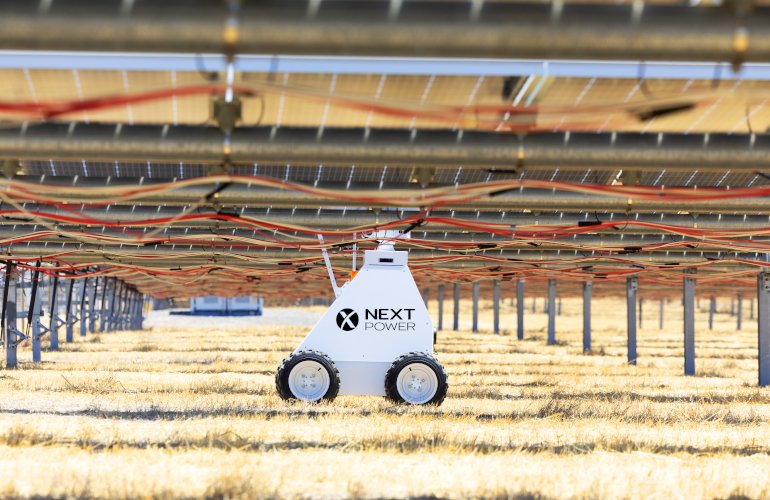
Ground-based robots like the Ranger equipped with thermal and optical cameras address this gap by inspecting beneath the array and capturing high-resolution data at the component level — providing precisely geo-tagged visibility where traditional methods fall short. This solution can be deployed at scale prior to commissioning for a thorough QA/QC audit.
2. Early and autonomous fire risk detection
The solar industry has already demonstrated how improved visibility and automation can reduce risk when it comes to extreme weather. Advances in weather forecasting and automated tracker controls have significantly mitigated hail exposure, with insurers beginning to recognize these improvements.
 In 2025 alone, post-event surveys from customers showed that Nextpower tracker systems executed more than 2,000 hail stows worldwide, with less than 0.007% module breakage reported.
The next frontier in risk reduction is fire — the second-largest loss-driver on utility-scale solar projects by gross claims in North America, according to Axis Capital. kWh Analytics says fire accounts for approximately 20% of losses both by dollar amount and by count. Further, kWh Analytics research shows that over 80% of solar fires originate on site, with PV equipment as the primary ignition source. Wiring or connectors have been identified as the cause of the fire in 3% of those cases, but an additional 27% are still attributed to unknown causes, suggesting underlying issues are not being detected early enough.
Regardless of origin, advances in imaging and AI are enabling operators to detect early indicators such as smoke, heat anomalies and even environmental factors like vegetation growth that can contribute to fire risk.
By identifying these conditions earlier, operators can intervene before issues escalate into major events, reducing both operational and financial exposure.
3. Moving quicker from detection to diagnosis
 Traditional inspection methods often separate detection from diagnosis.
Aerial inspections are effective at identifying anomalies, but those alerts typically require a second step — sending technicians into the field to investigate further. This delay can leave issues unresolved for extended periods.
Robotic services compress this process. By combining consistent imaging with AI-driven analysis, they move beyond identifying that something is wrong to diagnosing what is wrong and where.
Findings are precisely localized, contextualized and translated into actionable outputs, often including prioritized work orders and repair guidance. This enables operators to move directly from detection to decision to action.
4. Optimizing the economics of panel cleaning
Not all performance losses are tied to discrete failures. Some are gradual, variable and difficult to quantify, none more so than soiling. According to the IEA PVPS, soiling accounts for 4-7% of global energy loss.
 Soiling accumulates unevenly, responds inconsistently to weather and varies with local conditions such as dust, pollen, and agricultural activity. For years, soiling has been managed indirectly through fixed cleaning schedules or reactive decisions. That approach worked when portfolios were smaller and margins were more forgiving. It is far less effective today.
Without direct measurement, operators are left interpreting signals that were never designed to quantify loss. Cleaning may occur too early, increasing O&M costs without meaningful gain, or cleaning may happen too late, allowing energy losses to accumulate.
Sensor-based approaches close this gap by directly measuring the impact of soiling under real operating conditions. By comparing clean and soiled reference performance, operators can quantify energy loss in real time and make cleaning decisions based on actual conditions.
This transforms cleaning from a scheduled task into an economic decision: does the value of recovered energy exceed the cost of action? That analysis connects directly to action, with real-time soiling data enabling the deployment of robotic cleaning systems at the optimal moment.
5. Integrating data into a living digital twin
Beyond improving O&M efficiency, all this real-time data introduces a new level of visibility, verification and assurance.
The next step-change will be integrating these inspection, monitoring and performance data streams into a unified digital twin — a living, high-fidelity replica of the entire power plant. Here, every component, from trackers to connectors to autonomous robots, exists as a uniquely tracked digital entity and is visualized in a 3D map-based model of the entire solar site.
This intelligence layer transforms individual data points into a connected, self-aware power plant that enables all stakeholders, including owners and operators, to have unprecedented visibility into plant operations.
Setting new standards
Solar is increasingly defined by risk-adjusted LCOE, and the ability to reduce uncertainty is becoming a competitive advantage. By extending visibility into previously inaccessible parts of the plant — and translating that visibility into action with verifiable results — AI and robotic services are establishing a new standard for how solar assets are monitored, verified and optimized over their lifecycle.
This shift reduces uncertainty, improves planning and gives asset managers greater confidence that their plants are operating as expected.
 Francesco Borrelli is Chief AI and Robotics Officer at Nextpower, where he leads the design and deployment of autonomous control systems and advanced robotics that accelerate solar construction, improve energy yield, and enhance the resilience of utility-scale infrastructure. His work is central to Nextpower’s mission to scale intelligent, responsive solar technologies for a rapidly electrifying world. A globally recognized authority in model predictive control, Francesco’s algorithms power high-impact technologies — from autopilot and predictive powertrains to gigawatt-scale solar tracking systems now deployed globally. At Nextpower, he is applying that expertise to drive performance, precision, and speed across the solar lifecycle, from commissioning to real-time plant optimization.
Francesco is also a professor of Mechanical Engineering at the University of California, Berkeley, where, before joining Nextpower, he founded one of the world’s leading research labs in predictive control. His academic and commercial contributions span over 250 publications, 20 international patents, h-index of 88, and real-world systems that reduce emissions, increase energy efficiency, and produce more than 100 MW of solar power daily. He has been honored with the IEEE Fellowship and the IFAC Industrial Achievement Award for his groundbreaking work in autonomous systems. Today, Francesco bridges rigorous research and large-scale deployment, helping shape the next era of AI-powered clean energy.