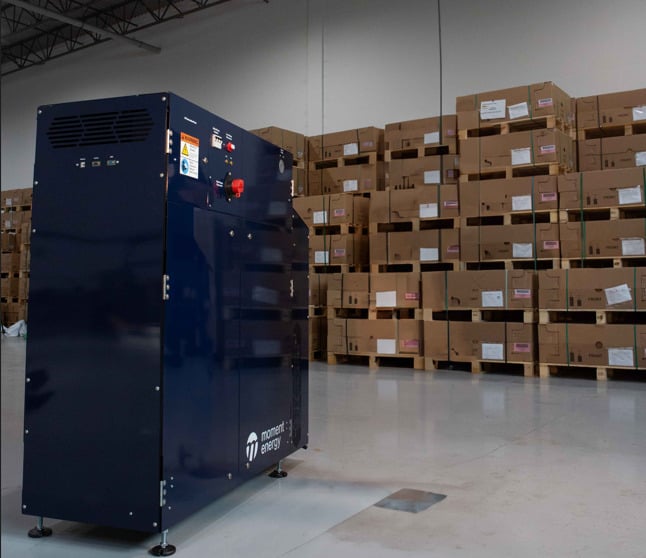
Second-life BESS
According to Mansfield, the US market will face a lack of products that can meet investment tax credit (ITC) compliance regulations through mid to late 2027, as developers grapple with foreign entity of concern (FEOC) compliance requirements and tariff uncertainty.
“We assessed probably six months ago that through mid to late 2027 we think there’ll be a lack of product in the US market that can meet the ITC compliance regulations,” Mansfield says. “We talk to a lot of distributors and supply consultants, and they’re telling us the same thing.”
Second-life battery manufacturers, such as Moment, are positioning themselves as a domestic alternative that sidesteps many of these challenges.
Adding to the uncertainty, Mansfield notes widespread confusion, or misrepresentation, around FEOC compliance claims.
“There’s a lot of sort of false claims being made by suppliers that they’re (FEOC) compliant when they either haven’t really looked at it in great detail, or they just like saying that because there’s some misrepresentation, intentional or unintentional, happening,” he explains.
The challenge is particularly acute under the safe harbour table approach for distributed generation projects, where cells alone account for 52% of content, making Chinese-origin cells incompatible with the current 45% maximum FEOC threshold.
The company is “highly, highly confident” that locally sourced, repurposed cells already in the US will not be considered FEOC material, regardless of original content origin.
“We de-risk that by our product meeting the compliance threshold even without that. We’ve been pretty heavily involved in reviewing with expert and outside legal counsel what the actual guidance is,” Mansfield says.
“World first” certification
Soares, co-founder of Moment Energy, explains that previous industry approaches to BMS for second-life BESS either reused existing automotive BMS or attempted to retrofit first-life systems not designed for ageing, mixed-health battery packs.
“We’ve created a technology that we can use, that is meant for second-life batteries. It knows how to deal with batteries that are ageing more than would be expected, batteries that are different states of health (SoH), where they all need to be working together,” Soares explains.
According to Moment, the BMS has passed all functional safety requirements, electromagnetic interference testing, destructive testing, and failsafe testing, the same standards required for first-life BMS.
The certification also differentiates Moment from other players in the second-life space. Mansfield draws a stark contrast with battery materials recycler Redwood Materials, which recently shifted focus toward its second-life business after staff reductions.
“The fundamental difference between what we do and what Redwood does, is Redwood basically takes the pack and tricks the auto BMS into thinking it’s driving.”
He continues, “So, they put these things open-air with sufficient spacing, kind of low deployment densities, where no one cares if they catch fire.”
He notes that while Redwood has tested to standards, Moment has pursued full UL certification, including UL 1974, the repurposing standard, which the company claims makes it the first and only entity providing repurposed BESS with this certification.
Moment was awarded a UL 1974 certification in 2023, also noting at that time that it was the first company to receive the certification in North America.
“Our approach has been to put all of our systems through the UL certifications, gain the actual certification, not just test to the standard, as Redwood has done,” Mansfield explains. “For all intents and purposes, you buy our BESS, it looks like a brand new lithium BESS. It’s a container solution with a rating, a 10-year life. It’s not something that you put on the ground in the desert on a couple of breeze blocks.”
Mansfield further characterises Redwood’s segment as “highly risk-tolerant remote rural deployment in front-of-the-meter (FTM) type of space,” while Moment targets built-up areas, data centres, and commercial and industrial (C&I) behind-the-meter (BTM) markets.
“Most jurisdictions, even when there’s not really good reason to, are pretty anti-lithium right now if you don’t carry the certifications,” he says. “You come up against too many roadblocks.”
Second-life technology
First-life BMS expect cells to be nearly identical, with manufacturers discarding cells outside tight tolerance bands during production. But, second-life applications must handle batteries at varying stages of health, potentially from vastly different operating environments.
“Your battery management system has to be able to handle batteries that are 80% and 100% and 90% and 70% and put all of those together, and maybe some of them were driven in the heat of Arizona and somewhere in Iceland or Alaska,” Soares explains.
This differs from approaches like Redwood Materials’ pack manager, which communicates with existing automotive BMS from the outside. Moment replaces the original BMS entirely with one designed for energy storage and second-life applications.
“We’re not relying on what existed from the car designer, when they were expecting this battery to be used in a car for a certain amount of time. We replaced that with a system that knows it’s going to be used for energy storage and that can handle the changes in the second life,” Soares highlights.
Soares explains that Moment sources batteries from across North America, working with automakers, fleet operators, and third-party logistics groups, with a Texas facility currently under development.
The company’s strategy includes a 10-year timeline that allows recycling technology and economics to mature before batteries need final breakdown and mineral recovery.
“Right now, recycling is tough. You’ve seen the economics have been a little harder to achieve,” Soares notes. “Repurposing is a very viable area, and it’s one that we believe should be the default step for all batteries first before they get broken down.”
Avoiding tariffs
While FEOC compliance dominates developer concerns, tariff volatility creates its own complications. Mansfield noted that most developers simply request delivered duty paid (DDP) US pricing, shifting tariff risk to suppliers.
The effects of changing policies can be complex, however. One developer reported a US$40 million tariff bill on a solar project that was worked into the ITC cost basis, only to face potential recapture issues when the tariff was later ruled illegal and refunded.
“There’s all kinds of weird knock-on effects that happen,” Mansfield notes.
As the industry navigates this uncertain landscape, Moment Energy believes it has “solved the safety gap in second-life” batteries through certification rather than workarounds.
Soares says, “We no longer need to rely on systems that don’t meet those safety requirements. We can really meet and exceed those in the industry.”
With FEOC guidance still evolving and supply constraints tightening, the second-life battery sector’s domestic sourcing, along with other potential benefits, may position it as an increasingly attractive option for developers seeking compliant, available BESS.