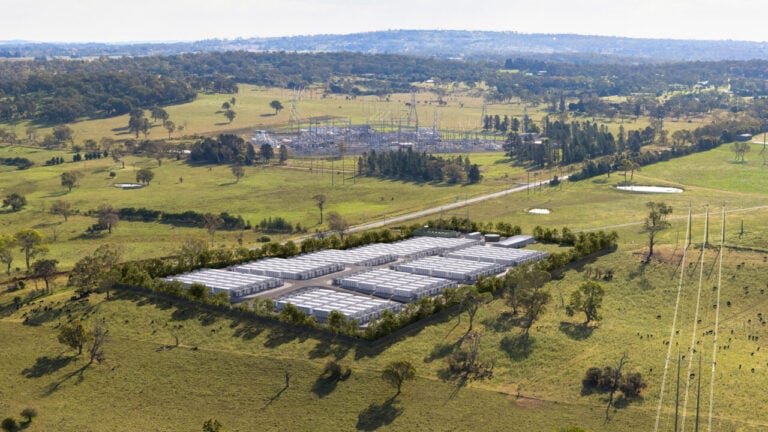
According to the EPBC Act submission, the site sits on agricultural land with the nearest dwelling approximately 500 metres away, and the referral notes the land is not within a declared irrigation district, a state-significant watercourse, or land identified as having state-significant landscape or agricultural value.
The project is designed for a 30-year operational lifespan, with battery cell replacements anticipated at the end of the 20-year warranty period of the original units.
The second project, the Wongalea BESS, is proposed near Armidale in northern New South Wales (NSW), with a 137-hectare project area spanning nine land parcels and the adjacent section of Waterfall Way.
According to official documents, the facility will connect to Transgrid’s existing Armidale Substation via a 1.5km underground 132kV cable. The disturbance footprint covers up to 42 hectares, though actual development is expected to disturb only around 10 hectares, with temporary laydown areas to be returned to agricultural grazing use following construction.
The project will feature approximately 288 battery units and is designed for a 20-year operational life, with associated infrastructure including inverters, an on-site substation, a detention pond for stormwater and fire-fighting infrastructure.
Both projects follow identical technical configurations: 300MW of power output and 1,200 MWh of storage capacity, for a duration of 4-hours.
Both are intended to store electricity during periods of surplus generation, typically from solar, and discharge it during periods of high demand, contributing to grid stability and reducing the curtailment of renewable energy generation in their respective regions.
A repeatable development template
The two submissions extend a pattern already established in Eku Energy’s broader Australian portfolio.
The developer’s Griffith BESS in Yoogali, NSW, was submitted to the EPBC Act at an expanded 100MW/1,000MWh configuration. This 10-hour-duration system evolved from its original 800MWh design after securing a long-duration energy storage (LDES) Long-Term Energy Service Agreement (LTESA) from AEMO Services in February 2025.
In its original 800MWh form, the Griffith BESS was one of the first 8-hour battery storage systems to secure an underwriting agreement through the NSW government’s Electricity Infrastructure Roadmap in 2023, alongside RWE’s Limondale project, which is now operational.
Eku Energy currently has the 250MW/500MWh Williamsdale BESS under construction, alongside six further projects under construction or in development, three in NSW and two in Queensland, with most built to the same 300MW/1,200MWh specification.
That repeated sizing suggests a deliberate strategy of standardising project design to streamline engineering, procurement and regulatory submissions across multiple sites, reducing the marginal cost and time required to bring each subsequent project through approvals.
Eku Energy is jointly owned by Macquarie Asset Management and the British Columbia Investment Management Corporation. This ownership structure gives the developer access to long-horizon infrastructure capital rather than relying solely on project-level debt and equity raised deal by deal.
In a conversation with ESN Premium, Eku Energy CEO Daniel Burrows discussed the company’s approach to attracting infrastructure capital into large-scale battery storage, framing the company’s growth strategy around building a portfolio of standardised, replicable projects that institutional investors can underwrite with greater confidence than one-off developments.
That logic appears directly reflected in the Tramway Road and Wongalea submissions. Identical technical specifications across different states reduce design and engineering risk for financiers assessing the projects.
As readers of Energy-Storage.news will be aware, the EPBC Act referral process itself has become a well-trodden path for standalone battery storage developments sited on modified agricultural land away from areas of high conservation value.
Interested in Australia? Read Energy-Storage.news’ Energy Storage Summit Australia coverage and related content.