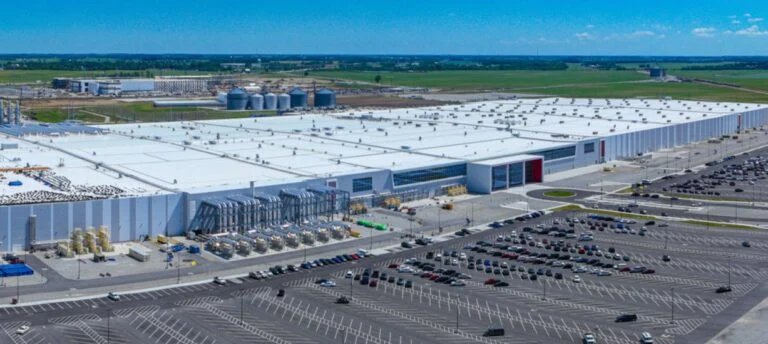
The cells produced at the Ohio facility will serve multiple market segments, from residential installations to commercial and industrial applications, and ultimately large-scale utility grid projects.
The first cells rolling off production lines will be integrated into complete ESS solutions by LG ES Vertech, the American energy storage system integrator division of LG ES.
L-H Battery CEO Chahun Ku acknowledged the strategic importance of the change during the facility’s launch ceremony, emphasising that energy storage represents a critical component of the company’s long-term vision alongside future production of hybrid-EV batteries.
Ku credited the facility’s workforce for their adaptability in launching production for applications different from those originally planned.
Automotive cells typically prioritise energy density, charging speed, and cycle life under demanding thermal and mechanical conditions.
Stationary storage cells emphasise cost-effectiveness, longevity, and safety, with less stringent weight and volume constraints. The manufacturing infrastructure required for both applications does overlap, enabling facilities to shift production focus as market conditions warrant.
This flexibility may prove particularly valuable given uncertainty surrounding EV demand trajectories. While long-term electrification trends remain intact, near-term adoption rates have proven more volatile than many manufacturers anticipated when planning capacity expansions.
Energy storage markets, by contrast, have demonstrated consistent growth driven by renewable energy integration requirements and grid modernisation initiatives.
L-H Battery chief operating officer Rick Riggle highlighted the facility’s significance for Fayette County, noting the economic benefits generated through construction activity, permanent employment, and ongoing operations.
The plant represents a substantial manufacturing investment in a region that has seen traditional industrial employment decline in recent decades.
Battery manufacturing facilities typically employ several hundred to over a thousand workers in production, quality control, maintenance, and support roles. These positions generally offer wages above regional averages and require technical skills that can anchor broader workforce development initiatives.
The presence of advanced manufacturing can also attract complementary investments and enhance a region’s competitiveness for future projects.
Industry-wide trend
L-H Battery’s pivot reflects a broader pattern across the battery manufacturing sector. Several facilities originally planned for EV cell production in the US have incorporated energy storage capabilities or shifted production emphasis as companies respond to market signals.
There is also a growing appetite for domestic content in the US market due to the Inflation Reduction Act (IRA) legislation, which brought in investment tax credit bonuses for projects using an eligible portion of domestically produced equipment and materials, the ‘One, Big, Beautiful Bill Act’ that makes projects using Chinese-made or financed battery cells ineligible for the ITC and Section 301 import tariffs on Chinese products.
In June, Japanese consumer electronics giant Panasonic announced its intention to convert a Kansas EV cell manufacturing facility to produce batteries for data centre applications.
LG ES has transitioned Michigan-based EV production lines to BESS cell manufacturing, adding roughly 17GWh of annual capacity.
The General Motors-LG ES joint venture (JV) Ultium Cells has redirected its Spring Hill, Tennessee manufacturing operations from EV batteries toward lithium iron phosphate (LFP) cell production for stationary storage applications. This week, Ultium Cells announced that mass production of LG Energy Solution JF2 LFP cells has begun, noting, as with the L-H Battery announcement, that the battery cells will be used in LG ES Vertech projects and emphasising that they will be US domestic content-compliant.
South Korean battery manufacturers Samsung SDI and SK On have both expanded their American manufacturing footprint and secured contracts with energy storage system integrators.
Ford Motor Company recently established Ford Energy as a dedicated energy storage subsidiary, while separately to the Ultium Cells JV, General Motors (GM) recently began a partnership with US sodium-ion (Na-ion) BESS startup Peak Energy, aiming to produce prototype grid-scale BESS solutions based on the emerging chemistry by the end of this year.