
While a logistics failure in retail might only result in a customer complaint, a failure on a utility-scale solar project can lead to significant fines and project delays that threaten partnerships that take years to develop. This represents a completely different category of risk, yet most third-party logistics companies (3PLs) fail to reflect that reality in their pricing.
Project sites are not warehouses
 Solar logistics is more than just complex freight management; it is project coordination that simply happens to involve trucks.
While a few hours of variance is typically absorbed without significant consequence when moving product between warehouses, project sites operate under a much stricter reality. Active construction follows a precise sequence where labor is staged and materials must arrive in a specific order — you can’t install subsequent components until the preceding ones are in place. When managing 10 to 20 truckloads daily, precise timing is not merely a preference, it is the core of the operation. When loads arrive outside their designated window, it can disrupt driver hours, trigger expensive weekend shifts and delay the project. These delays incur significant costs, but, more importantly, it can lead to difficult questions regarding the competence of the logistics partner.
This is exactly what most freight providers miss: they see a simple delivery rather than the broader project.
Do you speak solar?
To determine if a logistics provider truly understands this space, use a simple test: ask them about microcracks, how many full truckloads are required for 1 MW of solar capacity, and what equipment is needed for a tracker shipment vs. a panel shipment.
Generalists will pivot by citing renewable energy experience, handling capabilities and track records with fragile freight. Such responses sound professional but fail to address the core inquiry.
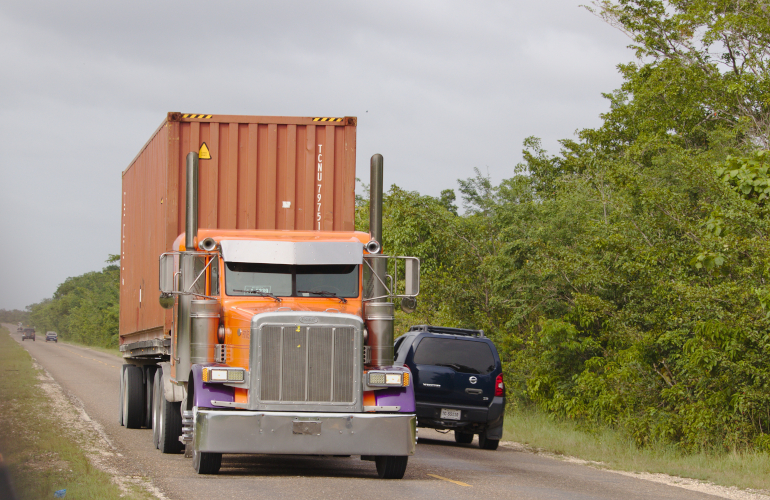 A solar operator likely understands that three full truckloads roughly fill out 1 MW. Microcracks, internal fractures reducing panel efficiency without visible damage, are known risks, often occurring when solar panels are stacked incorrectly, vibrated on rough roads or mishandled by inexperienced forklift drivers. Additionally, an understanding of equipment requirements is standard: panels typically move on dry vans, trackers on flatbeds and BESS, transformers and large equipment require specialized trailers such as eight- and nine-axle removable gooseneck trailers (RGNs), built for significant weight.
That is not trivia. It is the baseline for a real conversation with a solar manufacturer’s logistics team.
Solar manufacturers maintain relationships with a limited number of utility-scale developers and EPCs, often spanning many years. This concentration of customers creates a high-stakes environment, especially as the United States remains on track to add 43.2 GW of new utility-scale solar capacity in 2026 — a 60% increase over the prior year. These hundred-million-dollar projects operate on aggressive timelines where a logistics failure resulting in delays forces the manufacturer to absorb significant reputational damage. Recurrent delivery issues often prompt developers to seek alternative panel suppliers, a critical risk in a hyper-competitive market. Consequently, established manufacturers must prioritize flawless delivery to retain a viable customer base.
Documentation is the only defense
Damage is another problem that is unfortunately prevalent in the renewable energy space. When working with providers that do not have experience with these commodities, those risks increase exponentially. Industry estimates put breakage at 1 to 2% at every major handling point in the solar supply chain, which, across the volumes these projects move, adds up to millions of dollars a year. The cause is usually the same: a forklift driver who does not know the product, a trailer that was not properly strapped or a load that arrived fine until it hit a construction site with temporary labor who had never unloaded a solar panel before.
When project site issues arise, blame is often quickly cast across the entire chain. To navigate this, rigorous documentation is the only defense. Maintaining inbound and outbound photos, collecting signed proofs of delivery (confirming freight in good condition), verifying driver information and following pre-established safety protocols is the first line of defense to protect yourself against claims. It is often the difference between swift resolution and payment vs. a drawn-out process where no party takes responsibility.
Proven over promised
The aggressive build-out of industrial infrastructure across the United States, from data centers and power generation to manufacturing and energy projects, is placing unprecedented pressure on an already strained supply chain, as demand drives utility-scale development into markets previously considered unviable. For the small logistics teams managing these projects, often just three-to-five people overseeing tens of thousands of annual loads, there is simply no capacity to juggle fragmented providers or troubleshoot project site disruptions at midnight. These teams require a singular, comprehensive partner that can manage the entire move within a unified system, proactively addressing logistical hurdles before they escalate into project-threatening delays.
As project scales increase and timelines tighten, the opportunity to demonstrate operational competence on live sites is rapidly disappearing. Logistics providers with established solar experience hold a distinct competitive advantage, as manufacturers prioritize proven partners over unverified vendors.
If you are a solar manufacturer looking at your logistics partners right now, start here: ask them about microcracks. Ask them what goes into 1 MW. See how long it takes them to answer.
The right partner already knows.
 Craig Wadas is Vice President of National Accounts at TRAFFIX, where he helps organizations design resilient, scalable supply chain solutions for complex transportation networks across North America. He works closely with manufacturers and large enterprise shippers to optimize freight strategies, improve service reliability, and navigate evolving market conditions.
Craig has extensive experience supporting industries with demanding transportation requirements, including the rapidly growing solar sector. He understands the unique logistics challenges associated with moving solar modules, inverters, racking systems, and other high-value components across domestic and cross-border supply chains. His expertise includes coordinating multimodal transportation, managing port-to-project logistics, reducing transit risk, and building transportation strategies that help solar manufacturers, EPCs, and distributors maintain project schedules while controlling costs.
Before joining TRAFFIX, Craig held leadership roles at C.H. Robinson, where he specialized in enterprise supply chain solutions and helped build one of the company’s Port Services business units, connecting international freight movements with domestic transportation networks. His background in port logistics, cross-border transportation, and enterprise account management gives him a comprehensive understanding of the end-to-end supply chain challenges facing today’s manufacturers.
Craig partners with customers to develop practical, data-driven logistics strategies that improve supply chain resilience, strengthen carrier relationships, and support long-term business growth.