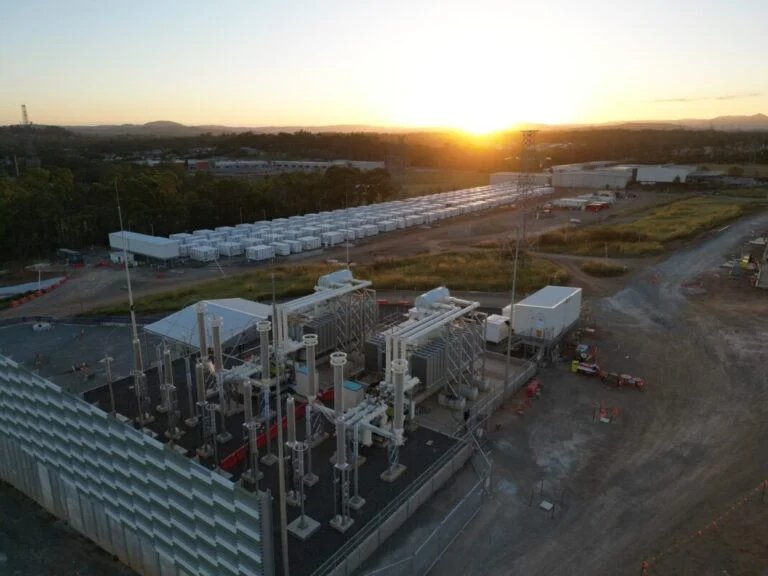
The disturbance footprint covers approximately 60 hectares, dominated by non-native and degraded grassland, and the design has been refined to avoid all mature trees, hollow-bearing trees, drainage lines, and identified ecological communities of national significance.
The BESS infrastructure will use lithium-ion technology and will be split across two areas within the disturbance footprint, connected via an overhead transmission line to a Transgrid substation near the project’s point of connection to the existing electricity transmission network. A second substation will be located at the BESS site itself.
The project will connect to the National Electricity Market (NEM) and is designed to store electricity during periods of low demand and release it when demand is high or renewable energy generation is low.
Construction is expected to take approximately 36 months, with an estimated start date of January 2028.
The facility is planned to operate 24 hours a day, seven days a week, for up to 50 years, at which point the infrastructure would be removed and the disturbance footprint rehabilitated.
The ACT Planning Act 2023 classifies the project as a major electricity storage facility capable of storing more than 150MW, making it a prescribed development proposal that requires an Environmental Impact Statement unless an Environmental Significance Opinion is granted.
The referral assesses the project’s potential impacts on matters of national environmental significance.
Biodiversity surveys conducted in March 2026 confirmed that no EPBC-listed threatened ecological communities were present within the project area.
Two threatened fauna species were assessed as likely to occur within the project area: the Gang-gang Cockatoo and the aptly named Superb Parrot.
The proponent concludes that impacts will be limited to low-quality foraging habitat in the form of non-native grassland, with all hollow-bearing trees retained outside the disturbance footprint.
Assessments of significance for both species concluded that the project does not have the potential to result in significant impacts. The referral does not self-identify the project as a controlled action and records no offset liability.
A growing EPBC pipeline in and around the ACT
The Flat Rock submission adds to a rapidly expanding queue of battery storage projects entering the EPBC Act process across Australia’s east coast, at a time when the regulatory framework governing those assessments is itself in transition.
The Flat Rock site is notable for its ACT jurisdiction, which requires that development proposals classified as major electricity storage facilities must either obtain an Environmental Impact Statement or secure an Environmental Significance Opinion confirming that no likely significant adverse environmental impact is likely.
This adds an ACT-specific planning layer to the standard EPBC federal environmental assessment process, which runs in parallel, mirroring the dual-track state and federal assessment processes common to large battery projects in New South Wales and Queensland.
Samsung C&T Renewable Energy Australia, the local development arm of South Korean conglomerate Samsung C&T Corporation, submitted the 250MW/1,000MWh Boro solar-plus-storage project in New South Wales to the EPBC Act in July 2026, with biodiversity surveys across 2024 and 2025 identifying no EPBC-listed species within its 410-hectare project area south of Goulburn.
AGL Energy, one of Australia’s largest electricity retailers and generators, submitted the 50MW/100MWh Awaba BESS near Toronto on the New South Wales Central Coast in June 2026, a project that already holds State Significant Development consent, meaning the EPBC submission represents the final federal environmental assessment step before construction can begin.
Goldwind Capital submitted the 250MW/1,000MWh Milpulling wind-plus-storage project near Gilgandra in New South Wales to the EPBC Act in June 2026, a DC-coupled hybrid project located within the Central-West Orana Renewable Energy Zone and covering approximately 11,670 hectares across nine landholdings.
That pipeline is accumulating at a point when the EPBC Act framework governing all of these assessments remains partially incomplete.
The Clean Energy Investor Group (CEIG) published a report in July 2026 calling on the federal government to prioritise consistent and timely implementation of the reformed framework, warning that National Environmental Standards, the offsets calculator and the definition of “net gain” remain under development ahead of a December 2026 full commencement deadline.
Never miss an Australian energy storage story. Sign up for our Australia newsletter and get the latest project announcements, policy updates and market analysis delivered directly to you.
Solar Media (part of Informa Group) will host the Battery Asset Management Summit Australia 2026 on 25-26 August at the Amora Hotel Jamison in Sydney, bringing together asset owners, operators, trading teams and optimisers to address revenue strategy, lifecycle management and operational performance across Australia’s fast-growing battery storage fleet.
Readers of Energy-Storage.news can get 20% off their tickets using the code ESN20 at checkout. Find out more about the Summit on the official website.