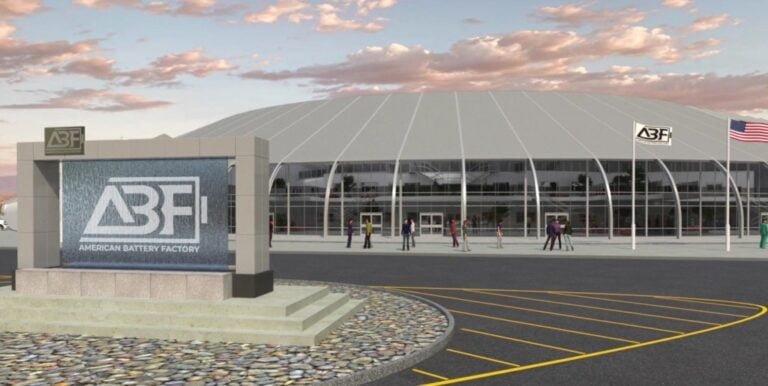
The production facility in Pima County, AZ, will have a 5.5GWh output for the first five years of production. ABF plans to continue scaling up the facility, which will also house its R&D centre and headquarters, to 15GWh.
AFB says that its LFP battery cells produced onsite will be distinct from other lithium battery chemistries, incorporating the “safest chemistry” and “environmentally friendly design” while lasting up to 10,000 life cycles or over 20 years.
According to its latest announcement, production at the Arizona gigafactory is expected to begin in late 2027, with full 5.5GWh capacity expected the following year. ABF is using Sprung Structures’ “rapid-deploy factories,” constructed using a tensioned fabric membrane that the company claims will only take weeks to construct at 33%-50% lower cost than traditional construction.
The site is the first of several US-based manufacturing plants ABF plans to develop. It said its targets for the Arizona site are informed by production experience at its pilot line, operated by a subsidiary, ABF-Asia, in China.
In 2024, ABF partnered with KAN to utilise a 1GWh factory for high-capacity prismatic cells, as part of its preparation for the Arizona gigafactory. It said that by beginning its pilot line in China, it will be better positioned to enter into the production of cells in the US and assist with growing a US supply chain for LFP battery cells.
At the time, it said it was targeting offtake deals agreements with battery pack manufacturers and system integrators in markets including utility, data centres, telecoms, commercial and agricultural equipment as well as power tools, national defense and others.
It did not clarify with whom the 4.5GWh-worth of deals are, but did note offtake and material supply with with Wuxi-LEAD, Honeywell, Advanced Energy Materials, First Phosphate, Anovion, Celgard, FNA Group, Microporous, Lion Energy and Aqua Metals.
When Energy-Storage.news interviewed ABF’s former CEO Paul Charles in 2022, he said its supply would target military uses, larger low-speed electric vehicles (EVs), and stationary energy storage.
Charles accurately predicted that storage would grow larger than the EV sector in the US.
At the time, he said that the company would have a 3GWh production facility, its R&D centre and a substantial pilot line running by early 2024. It broke ground in October 2023, but construction has been delayed because of tariffs on specialist manufacturing equipment that would need to be imported from China.