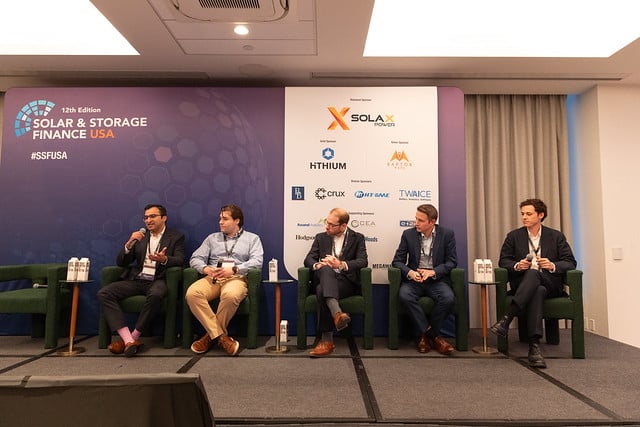
“Under the lease, the tenant may retain responsibility for power supply or transfer that responsibility to the data centre developer,” Khatri said. “We’re looking for developers with strong utility relationships. Approvals are needed to build substations for these large loads of 100MW and, in some cases, 1GW-plus data centres,” he added. “There are also typically transmission upgrades. At a minimum, lenders want to see that the developer has secured permits to build a substation if one doesn’t already exist.”
Energy-Storage.news has heard from multiple sources that energy storage is expected to play a key role in addressing power and energy supply challenges associated with data centre growth.
In the US market, renewable power paired with storage offers the fastest way to build new power, outpacing gas or nuclear options. Data centres—particularly those supporting AI training workloads—can experience sudden and extreme swings in power demand.
The sub-millisecond response times of battery energy storage systems (BESS) may make them well-suited to manage these fluctuations more effectively than many alternative solutions. Yet concerns persist, Khatri noted, about whether renewables and batteries alone can reliably meet the 99.999% uptime requirements that energy-intensive data centres typically demand.
Developers are wrestling with the revenue model that will support storage projects. Some are considering if a project sited near a data centre can run merchant until it attracts a revenue contract.
The “merchant first” strategy is not without risk. Recent years of relatively mild weather have limited the ability of merchant battery storage systems to capture high-revenue upside from price volatility, particularly in markets such as Texas’ ERCOT. A further consideration is the extent to which data centre tenants will ultimately utilise the installed power capacity, given the built-in redundancies, especially in power infrastructure.
While the above dynamics could change, Khatri noted that underperformance relative to investor expectations has made lenders cautious.
“From a lender’s standpoint, even if we see the need for storage, we still typically require a contract covering at least a portion of the batteries’ energy output,” Khatri said. “For the most part, the financing community will be very careful in assessing merchant risk,” he said.
“But we expect to see developers coming forward with creative solutions that offer some combination of contracts and merchant exposure to create a degree of revenue certainty that we can finance. The demand is too great for the industry not to find solutions.”
Maniesh Khatri of NORD/LB is among the speakers at Energy Storage Summit USA, which will be held from 24-25 March 2026, in Dallas, TX. It features keynote speeches and panel discussions on topics like FEOC challenges, power demand forecasting, and managing the BESS supply chain. ESN Premium subscribers receive an exclusive discount on ticket prices. For complete information, visit the Energy Storage Summit USA website.