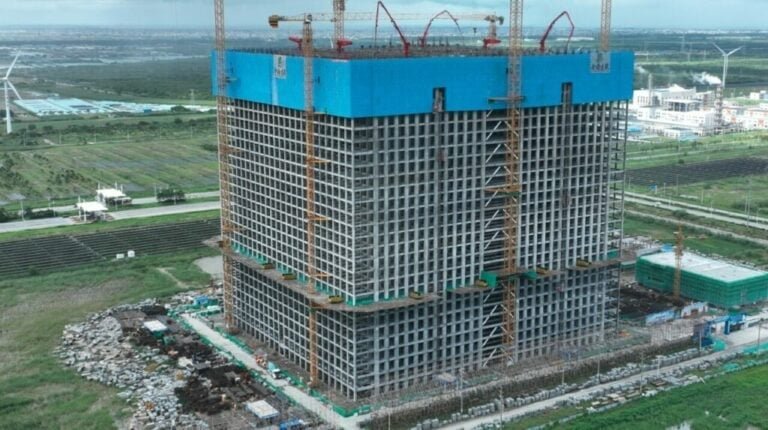
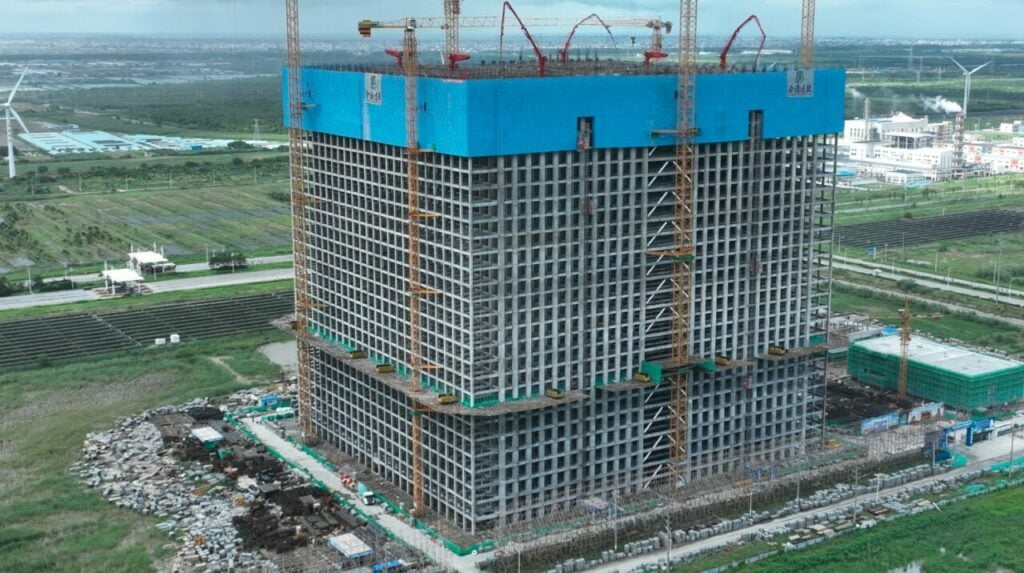
Energy storage developer and system integrator Energy Vault has released its Q4 and full year 2025 financial results, showing growth credited to entering the AI infrastructure market, expanding projects in Australia and its ‘Asset Vault’ subsidiary.
Energy Vault gained recognition as the developer and intellectual property owner of a gravity-based energy storage solution. Since then, it has broadened its scope to include lithium-ion battery energy storage systems (BESS) and long-duration hydrogen storage technology.
The company’s latest financial results show 2025 revenue of US$203.7 million, a 340% increase from US$46.2 million in the prior year.
2025 GAAP net loss was US$103.6 million, reflecting a US$32.2 million improvement from the previous year’s loss of US$135.8 million.
This article requires Premium SubscriptionBasic (FREE) Subscription
Already a subscriber? Sign In
Try Premium for just $1
- Full premium access for the first month at only $1
- Converts to an annual rate after 30 days unless cancelled
- Cancel anytime during the trial period
Premium Benefits
- Expert industry analysis and interviews
- Digital access to PV Tech Power journal
- Exclusive event discounts
Or continue reading this article for free
2025 Adjusted EBITDA decreased to a loss of US$21.2 million, compared to a US$58 million loss in the previous year. The company claims this improvement was fueled by increased revenue, improved gross margins resulting from lower costs per unit during project execution, and reduced operating expenses.
For 2025, the adjusted net income improved to a loss of US$42.1 million, better than the US$65.4 million loss in the previous year. As of 31 December 2025, total cash, including restricted cash, reached US$103.4 million, more than tripling the previous year’s amount and increasing by 67% from Q3 2025, also exceeding the earlier guidance range.
Energy Vault reaffirmed its Q3 2025 statement, noting that its improved financials were partly due to an increase in ESS projects in Australia and initial revenue from US-based, owned, and operated Asset Vault projects.
Asset Vault is the company’s wholly owned subsidiary dedicated to developing, constructing, owning, and managing energy storage assets worldwide.
Energy Vault remains active in Australia. The company recently supplied BESS technology for a 320MWh project in the country, scheduled for completion later this year.
In February, Energy Vault finalised a supply agreement for 1.5GWh of sodium-ion (Na-ion) batteries, produced in the US by Peak Energy. The two firms will collaborate on developing a storage platform that integrates Peak Energy’s Na-ion batteries with Energy Vault’s proprietary digital stack, emphasising Energy Vault’s AI infrastructure portfolio. They assert that this approach accelerates deployment, enhances safety, and reduces costs by eliminating “complex legacy systems.”
Energy Vault projects total revenue for 2026 to be between US$225 million and US$300 million. This estimate considers the schedule of US battery deliveries, third-party project timelines, revenue from operating assets within Asset Vault throughout the year, and initial income from modular data centre and AI infrastructure projects.
The Energy Storage Summit USA 2026 will be held from 24-25 March 2026, in Dallas, TX. It features keynote speeches and panel discussions on topics like FEOC challenges, power demand forecasting, and managing the BESS supply chain. ESN Premium subscribers can get an exclusive discount on ticket prices. For complete information, visit the Energy Storage Summit USA website.
The Energy Storage Summit USA is the only place where you are guaranteed to meet all the most important investors, developers, IPPs, RTOs and ISOs, policymakers, utilities, energy buyers, service providers, consultancies and technology providers in one room, to ensure that your deals get done as efficiently as possible. Book your ticket today to join us in 2026!
Held alongside The Battery Show Europe, Energy Storage Summit provides a focused platform to understand the policies, revenue models and deployment conditions shaping Germany’s utility-scale storage boom. With contributions from TSOs, banks, developers and optimisers, the Summit explores regulation, merchant strategies, financing, grid tariffs and project delivery in a market forecast to integrate 24GW of storage by 2037.
You can expect to meet and network with all the key industry players again in 2025 from major US asset owners, operators, RTOs and ISOs, optimizers, software and analytics providers, technical consultancies, O&M technology providers and more.
Launching September 2026 in Berlin, Energy Storage Summit Germany is a new standalone event dedicated to Germany’s energy storage market. Bringing together investors, developers, policymakers, TSOs, manufacturers and optimisation specialists, the Summit explores the regulatory shifts, revenue models, financing strategies and technology innovations shaping large-scale deployment. With Germany targeting 80% renewables by 2030, it offers a focused platform to connect with the decision-makers driving the Energiewende and the future of utility-scale storage.
The Energy Storage Summit Central Eastern Europe is set to return in September 2025 for its third edition, focusing on regional markets and the unique opportunities they present. This event will bring together key stakeholders from across the region to explore the latest trends in energy storage, with a focus on the increasing integration of energy storage into regional grids, evolving government policies, and the growing need for energy security.
Read Next
A new report from the US Energy Storage Coalition (ESC) indicates that the American battery manufacturing sector surpasses 100% of US demand for energy storage systems (ESS) and modules.
Indian solar PV module manufacturer Saatvik Green Energy is to enter the energy storage market through a newly launched subsidiary.
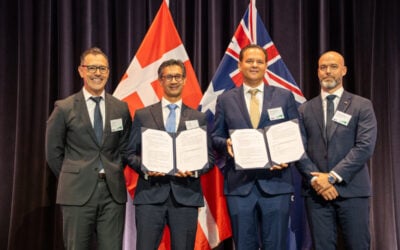
Vena Energy has signed a long-term revenue share agreement with Danish energy trading company InCommodities for its 204MW/510MWh Bellambi Heights battery energy storage system (BESS) in Central West New South Wales, Australia.

A collaborative team of Australian scientists from CSIRO, the University of Melbourne and the Royal Melbourne Institute of Technology (RMIT) has successfully developed and tested the world’s first proof-of-concept quantum battery system.
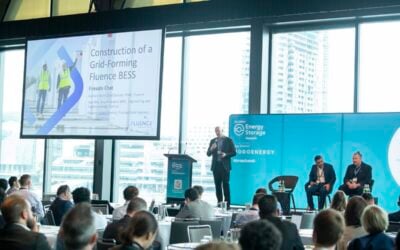
“When we started back in two years ago, there was a lack of understanding in the market about how the grid-forming inverters operate,” said Ghasem Jahedi, principal grid engineer at AGL.