Remote monitoring has become a cornerstone of modern commercial and industrial solar operations. Dashboards provide real-time visibility into system performance, alert operators to outages and support portfolio-level decision-making at scale. As commercial solar fleets grow and age, these tools are essential.
Despite widespread adoption of monitoring platforms, many asset owners continue to face chronic underperformance, persistent alerts and avoidable maintenance costs. Recent industry data shows that inconsistent documentation, communication gaps and unnecessary site visits remain common. These challenges raise an important question for the industry: If monitoring technology has advanced so rapidly, why do so many operational issues persist?
The answer often lies not in the software itself, but in what monitoring cannot see.
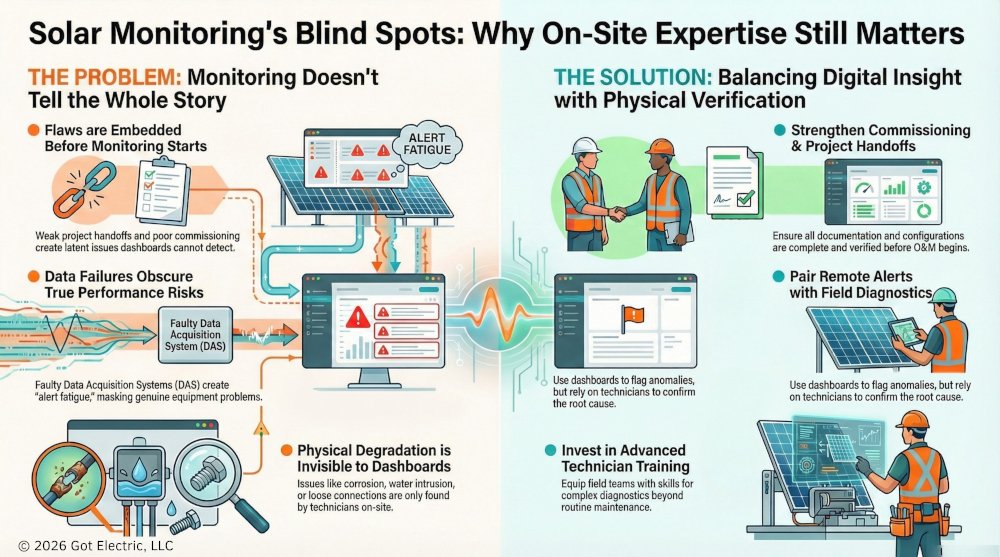
The root cause starts before most dashboards ever see it
Most commercial solar assets do not underperform because of defective equipment. They underperform because of weak transitions between project phases. Poor commissioning and incomplete handoffs from EPC teams to long-term operations introduce latent issues that monitoring platforms are not designed to detect.
Incomplete commissioning documentation, misconfigured protection settings, undocumented field changes and unresolved construction defects can all become permanent features of a system’s operating life. When responsibility shifts from EPC to O&M to ownership, critical context is frequently lost. Monitoring systems may report that a system is operating, but they cannot determine whether it is operating as designed.
Over time, these early gaps manifest as chronic performance degradation, repeated service calls and reduced asset value. Once embedded, these problems are difficult to diagnose remotely because the baseline assumptions about system configuration are no longer reliable.
What is often missing is clear accountability across the asset lifecycle. Commissioning, handoff and early operations are typically treated as discrete phases managed by different parties, each optimizing for their own scope. Without defined ownership of long-term performance outcomes, latent issues are rarely addressed early and instead surface during operations, often years later, when remediation is more costly and disruptive.

Why DAS failures undermine dashboard confidence
Data acquisition systems (DAS) are the backbone of remote monitoring, but they are also one of its most fragile components. In practice, DAS communication failures account for a significant share of daily alerts across many operating portfolios. When communication interruptions, sensor issues or network problems dominate alert streams, they obscure genuine performance risks and create alert fatigue.
In these conditions, dashboards become less effective as diagnostic tools. Operators may spend time responding to communication faults rather than addressing underlying electrical or mechanical issues. Worse, persistent DAS failures can create blind spots, allowing real system problems to go undetected behind a wall of noisy alerts.
Remote monitoring is only as reliable as the field infrastructure supporting it. Without regular verification and maintenance of DAS hardware, communications pathways and sensor accuracy, the data itself becomes a liability rather than an asset. For example, a soiled pyranometer can underreport irradiance, leading to misleading performance assessments.
The skills gap monitoring cannot fill
 Another limitation of monitoring platforms is their inability to compensate for the growing shortage of specialized technical skills in the solar workforce. Diagnosing complex system behavior often requires expertise that extends well beyond standard electrical maintenance.
Skills such as DAS troubleshooting, protective relay programming, medium-voltage equipment testing and advanced inverter diagnostics are increasingly critical as systems age and interconnection requirements evolve. These capabilities are not widely available, and many organizations struggle to recruit and retain technicians with the necessary training and field experience.
Monitoring tools can flag anomalies, but they cannot interpret root causes that stem from relay logic errors, grounding issues or subtle MV equipment failures. These problems require hands-on investigation by technicians who understand both the electrical theory and the practical realities of field conditions.
What the data confirms
Recent industry surveys reinforce these field observations. Asset owners and EPCs continue to report inconsistent data collection, poor communication between field and office teams and frequent extra site visits driven by missing or unreliable information. The cost of unnecessary truck rolls adds up quickly, particularly when visits are required simply to verify conditions that monitoring data cannot clarify.
At the same time, survey respondents consistently rank photo documentation, standardized checklists and system integration among the most valuable operational tools. These priorities point to an underlying truth: reliable data still depends on field teams consistently applying disciplined practices.
Over a portfolio’s life, these inefficiencies translate into material financial impact through lost production, elevated O&M costs, delayed problem resolution and increased safety and compliance risk. In practice, the cumulative cost of repeated misdiagnosis and delayed corrective action often rivals or exceeds the cost of proactive field verification.
Issues only technicians catch onsite
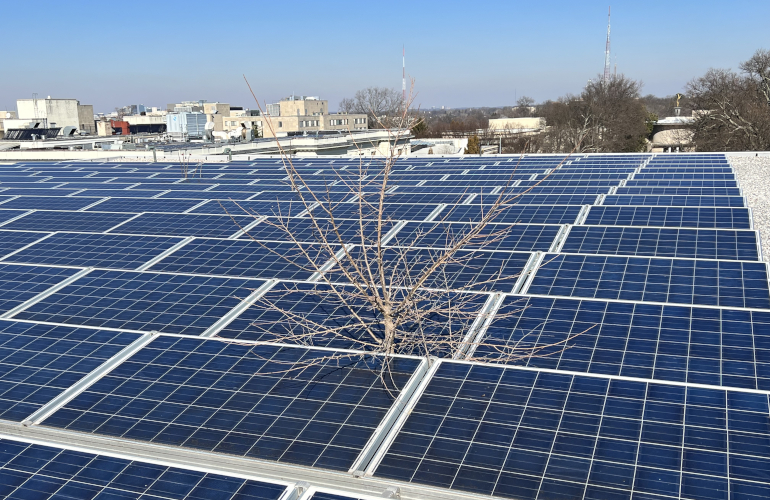
A tree takes root in a rooftop array, highlighting the limits of remote monitoring and the critical role of on-site inspections in commercial solar O&M.
There is a category of problems that no dashboard can reliably identify. Loose or improperly torqued connections, corrosion developing inside enclosures, water intrusion, animal damage, vegetation interference and installation oversights often remain invisible to remote systems. Even thermal issues may be undetected if sensors are misaligned or absent.
Field inspections frequently uncover these conditions long before they escalate into outages or safety hazards. In many cases, technicians also discover that monitoring alerts attributed to equipment faults are symptoms of upstream communication failures or configuration errors.
Rebalancing modern solar O&M
None of this diminishes the value of remote monitoring. On the contrary, monitoring is indispensable for managing large, geographically dispersed portfolios. The challenge arises when monitoring is treated as a replacement for field diagnostics rather than a complement.
The most resilient O&M strategies deliberately pair remote monitoring with technician-led field diagnostics, treating software as an intelligence layer rather than a substitute for physical verification. Monitoring provides visibility and alerts, but technicians deliver confirmation, root-cause analysis and corrective action.
Practical recommendations for asset owners
As commercial solar assets enter mid-life, several best practices can help balance monitoring with field diagnostics:
- Strengthen commissioning standards and ensure complete documentation is transferred during project handoffs.
- Schedule periodic field inspections to validate monitoring data and DAS reliability.
- Invest in technician training for advanced diagnostics, not just routine maintenance.
- Treat recurring alerts as signals to investigate underlying causes, not just reset systems.
- Align monitoring insights with hands-on verification before performance issues escalate.
Remote monitoring has transformed solar operations, but it cannot replace the insight gained from skilled technicians in the field. Long-term performance depends on strong commissioning, clear lifecycle transitions, reliable data infrastructure and access to specialized expertise.
As the industry continues to mature, the highest performing portfolios will be those that balance digital visibility with physical verification. In commercial solar O&M, dashboards tell part of the story. Technicians uncover the rest.
 Grant Gotlinger is the President of Got Electric, a Maryland-based electrical contractor specializing in commercial solar, EV charging, and O&M services. With over two decades of field experience and a passion for solving complex energy challenges, Grant leads a team of licensed electricians dedicated to performance-driven solutions. He is a strong advocate for technician-led solar maintenance and continues to support workforce development through hands-on apprenticeship training.