
Responsible solar panel end-of-life (EOL) management is no longer a distant concern for the United States — large volumes are arriving on recyclers’ doorsteps now. As large-scale repower trends continue and the solar industry grows, EOL infrastructure and regulations will need to grow with them. The challenge isn’t solely awareness; it’s action. Keeping pace will require aligned legislation and solid solar panel recycling infrastructure that can serve the entire nation efficiently, sustainably and with integrity. The legislative and social foundations built today will determine the best path forward to a true circular economy.
Reaching true scale will require policy that enables achievable frameworks — supporting sustainability and circularity while strengthening national supply chains.
A new legislative landscape emerges
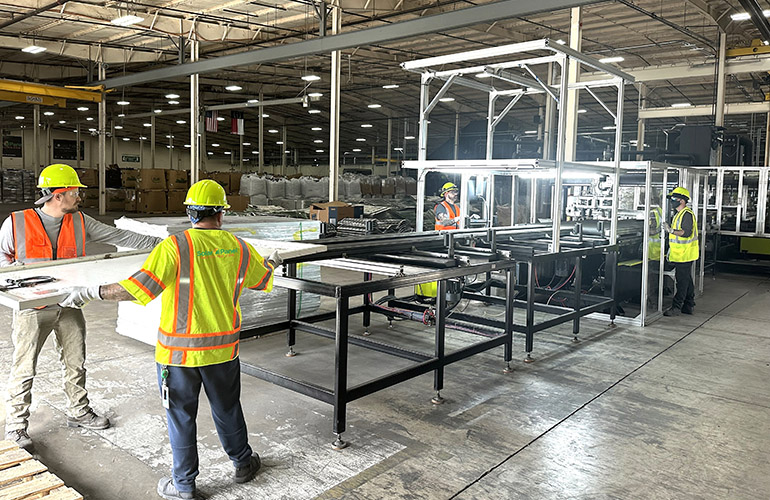
Solar panels are fed into a processing machine at a SolarPanelRecycling.com facility.
Multiple states have taken meaningful action by establishing EOL regulations. In North Carolina — home of the nation’s fifth largest solar market — two key measures are now in effect.
- Beginning December 1, 2026, PV modules will be banned at construction and demolition landfills and other unlined landfills under C. General Statute 130A-309.10.
- Beginning this year, utility projects greater than 2 MW must make decommissioning, recycling and financial insurance details available to the Dept. of Environmental Quality under C. General Statute 130A-309.240.
These measures are reinforced by the North Carolina Circular Economy Council, which has explicitly highlighted solar in the state’s 2024-2034 waste management plan — a model other states may soon follow.
Texas, the second largest solar market in the nation, is also making strides. Last year, Texas introduced an outright landfill ban and became the first state to mandate reporting requirements for recycling facilities processing renewable energy equipment.
- Effective September 1, 2025, all new solar facility lease agreements in Texas are required to include decommissioning, recycling and financial assurances to the landowner under Texas House Bill 3228’s amendment to Section 302.0004 of the Utilities Code.
- Under Texas House Bill 3229, all facilities recycling renewable energy components are required to annually report unprocessed inventory, processing timelines, cost estimates and financial assurances to the Texas Commission on Environmental Quality.
Both bills unanimously passed through the House and the Senate — a positive sign that responsible solar EOL management is a bipartisan priority.
At the federal level, the EPA has been developing a proposal to reclassify solar panels as universal waste, as opposed to the misleading designation of “hazardous waste.” This reclassification will make panels easier to transport, more economical to manage and will encourage best practices through further reporting requirements.
These are meaningful steps, but legislation alone won’t deliver circularity. As this landscape quickly evolves, policymakers must ensure laws are aligned and actionable, while solar panel recycling companies must meet the moment with the operational integrity that true circularity demands.
How to achieve circularity

Credit: Solarpanelrecycling.com
These best practices developed by SPR can help policymakers and recyclers move the industry beyond landfill disposal.
Ensure realistic compliance pathways: States should phase in regulations with sufficient lead time and ensure they are complemented by clear recycling, transportation and insurance guidelines. Compliance must be achievable, not just mandated.
Leverage EPA’s reclassification move: Universal waste classification will help standardize policy across the country and accelerate the development of a consistent EOL framework. States can accelerate the process by incorporating appropriate language now for storage, transport, and permitting.
Continue establishing landfill restrictions: Landfill restrictions become more effective as more states adopt them. Wider coverage of outright landfill bans prevents EOL panels from traveling across state lines to more permissive jurisdictions. The more states that follow Texas and North Carolina’s lead, the better.
Encourage recycler integrity: Standardizing EOL legislation must go together with standardizing what qualifies as responsible recycling. Incomplete recycling practices, such as commingling materials or only attempting to recover a portion of components, can introduce liability, waste and environmental consequences. True, responsible solar panel recycling practices are paramount to establishing circularity.
Develop smart infrastructure: A distributed network of recycling facilities strategically positioned across the United States is a critical aspect of a circular framework. Centralizing collection and processing creates long transport distances, higher emissions and supply chain bottlenecks that undermine the economics of recycling at scale. Geographical expansion, smarter logistics, and domestic consumption of recovered materials will be essential to building an economically viable, efficient and truly circular economy for EOL solar.
Time to get to work… together
Solar panel disposal is now presenting one of the bigger recycling challenges the United States has recently seen. The policy choices made now will determine whether the country builds a genuinely circular and sustainable solar recycling infrastructure or simply moves the problem around.
North Carolina’s landfill bans, Texas’s bipartisan decommissioning requirements and the EPA’s push toward universal waste classification are promising trends. But policy alone won’t keep panels out of landfills. Regional infrastructure, smart logistics and true recycling practices must be implemented in tandem with legislation.
The industry as one can build a truly circular model through intentional, aligned action — but it requires all parties to move in the same direction. Policymakers must establish coordinated, achievable frameworks. Recyclers must operate with the integrity that genuine circularity demands. And the infrastructure connecting them must be built for scale and efficiency — not centralized collection points and the long transport distances that come with them. This is how a solar economy is built to last.
 With a lifelong commitment to recycling, Brett Henderson, CEO and Co-Founder of SPR, has over fifteen years of experience in the recycling industry. Brett has advocated for a circular economy all while creating eco-friendly and efficient recycling programs for Fortune 100 companies, government agencies, universities, manufacturers and more. He served as an elected board member of the Carolina Recycling Association, serves on NC State Department of Environmental Quality Advisory Board, and commonly speaks at trade shows in the solar, ITAD, and electronics recycling industries. He earned his bachelor’s from The Ohio State University’s, Fisher College of Business and his MBA from Monte Ahuja College of Business at Cleveland State University.