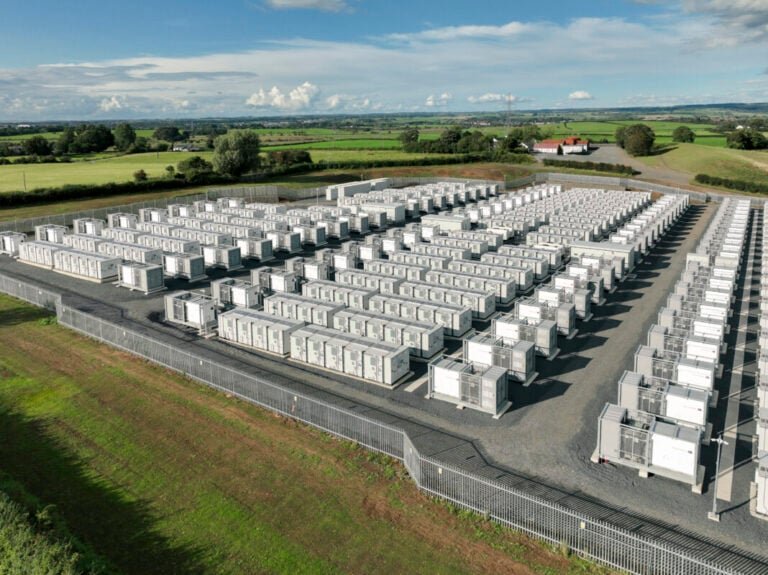
This was the highest gigawatt-hour deployment total recorded so far and represented 30% year-on-year growth from 2024. However, the growth rate fell from the 53% recorded between 2023 and 2024.
There were fewer sites completed in 2025 than in the previous year, with a growing emphasis on large sites—more than 75% of new capacity came from sites exceeding 50MW, according to the Solar Media Market Research Battery Storage: UK Pipeline & Completed Assets Database.
Analyst Charlotte Gisbourne wrote for Energy-Storage.news in January that the UK market has “yet to settle,” due to the turbulent nature of BESS revenue generation, particularly in the ancillary services market and changing government policy, though the market remains appealing to investors.
Meanwhile, Kevin Byrne at global consulting, engineering and quality control firm Enertis Applus+ wrote in his blog for Solar Power Portal that barriers within the planning and development cycle also need to be addressed.
Byrne highlighted three of the most significant challenges as being: gaps in technical knowledge of planning authorities, inconsistent planning frameworks across different regions and a “surge in public opposition rooted in safety concerns and misinformation.”
‘Generic’ planning policies and a need to step up fact-based community engagement
Whereas local authorities such as town and county councils are becoming familiar with solar PV and wind project planning, for many, BESS developments are much newer to them. Local authorities are not helped by the absence of a unified and specific planning classification for BESS, Byrne said, leading to inconsistent decisions made by planners confronted with their first-ever battery storage planning application.
This is creating inappropriate requirements on safety and noise limits, for example, often due to councils applying “generic planning policies,” Byrne wrote.
Battery storage is not explicitly included in the UK’s National Planning Policy Framework. Therefore, local authorities are adopting their own approaches, with Byrne citing an example where one council in southern England rejected a BESS application while a neighbouring council approved another just 600 metres from the first proposed site.
Land use concerns need to be dealt with, Byrne argued, as do inconsistent requirements for engagement with fire services, landscape screening for visual impact and buffer zones that have “created a complex mosaic of different requirements that developers must navigate on a case-by-case basis.”
Perhaps the biggest factor is local opposition to BESS development, which appears to most commonly centre on fire safety concerns.
To date, there have only been two thermal incidents at UK BESS projects added to the US Electric Power Research Institute (EPRI) global BESS Failure Event Database, five years apart in 2020 and 2025. The industry’s safety record is also improving both in the UK and globally, the latter showing a fall from one incident per 0.15GWh deployed in 2020 to one per 1.5GWh of deployments as of 2024.
Byrne also noted that local opposition groups often mention incidents at overseas projects that the consultant said would not comply with UK safety standards.
Nonetheless, a “fear factor” persists, especially in rural communities and Byrne highlighted examples of projects that have been withdrawn by developers, delayed by multiple years or blocked entirely by local authorities despite having no objections from technical experts or bodies such as the Environment Agency.
Industry standards such as NFPA 855 and safety tests such as UL9540A continue to evolve and improve, and are increasingly adopted by major BESS suppliers internationally, while in the UK, the recent publication of BESS incident emergency response guidance from the National Fire Chiefs Council is a step forward in elevating “the importance of demonstrable safety performance, making compliance with recognised testing standards increasingly essential for gaining stakeholder confidence,” Byrne wrote.
“The UK has made substantial progress in deploying grid‑scale batteries, but planning barriers now threaten to stall momentum at precisely the moment storage is most needed,” the consultant wrote in the article’s conclusion.
“Eliminating the current patchwork of requirements, improving technical capacity within councils, and strengthening communication with communities will be essential to accelerating deployment.”
Read Kevin Byrne’s article for Solar Power Portal, Accelerating UK battery storage deployment through modern safety standards and smart planning.
The upcoming Energy Storage Summit 2026, focused on the UK and European markets, will take place 24-25 February at InterContinental London – The O2. Use the discount code ESN20 for a 20% discount, while ESN Premium users can get 30% off.