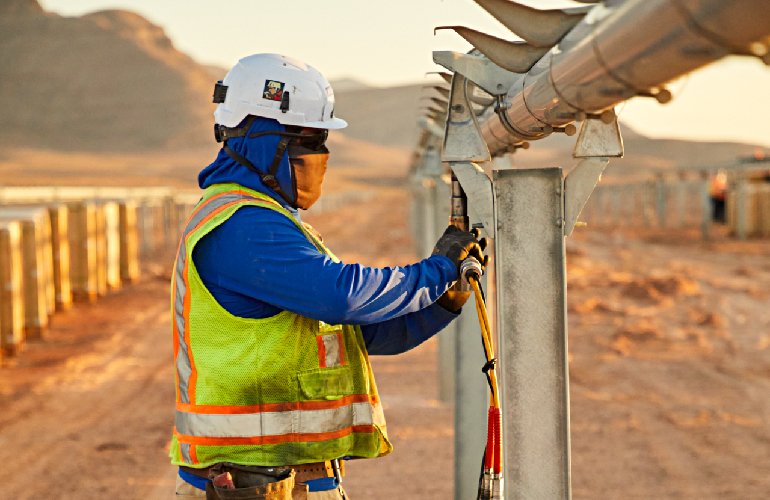
Although 2025 presented considerable challenges for the solar energy industry, utility-scale solar power continues to generate substantial benefits for communities throughout the United States. Rural regions, where many of these projects are located, have experienced notable economic benefits through tax revenue, new income streams for landowners, job creation and enhanced energy infrastructure. Consequentially, farmers and rural area schools, businesses, governmental agencies and residents who pursue careers in solar energy construction are benefiting from increased stability.
Solar energy supports needs for efficient sustainable power

McCarthy’s solar electrician apprenticeship program has participants from across the U.S., offering training and career opportunities to individuals in rural areas. Credit: McCarthy Building Companies
SEIA recently reported that solar energy accounted for 56% of all newly installed electricity-generating capacity on the U.S. grid during the first half of 2025. Solar projects help to address the growing energy needs of manufacturing, data center and AI industries because they are cost-effective and can be rapidly deployed, usually requiring only about 18 months to design and construct. Since utility-scale solar power generates electricity for the power grid rather than a single home or business, these projects are powering entire communities, infrastructure projects and major business operations while also providing affordable and reliable energy that is distributed to consumers by utilities.
Solar projects also bring new career opportunities with training in construction trades and provide additional economic and community benefits. The solar industry is transforming rural communities in lasting ways.
Rural solar projects drive job growth
Utility-scale solar construction firms across the country are hiring and training thousands of workers to build these energy facilities. According to the 2024 National Solar Jobs Census by the Interstate Renewable Energy Council (IREC), the U.S. solar industry employed 280,119 workers in 2024 — roughly level with 2023 employment despite a rise in solar capacity deployment. This stability reflects greater labor efficiency and stronger workforce training across the industry.

A solar + storage project in Arizona in the process of adding BESS. Credit: McCarthy Building Companies
Energy storage jobs also continued their upward trajectory, with storage occupations growing 4% in 2024 and 17% over the last five years, underscoring strong demand for solar + storage solutions. Since solar + storage solutions can store excess energy for use when sunlight is unavailable, they are improving reliability and grid stability during hot summer months and very cold winter months.
Electricians are among the most sought-after tradespeople in the energy and construction sectors. With the industry’s growth there has been an expansion of apprenticeship programs, which are providing rural residents with opportunities to secure long-term careers, often without the need for traditional college pathways.
McCarthy Building Companies, one of the nation’s largest utility-scale solar EPC contractors, is at the forefront of this shift. Through its electrical apprenticeship program and comprehensive solar construction trade worker training model, McCarthy invests directly in rural talent while helping communities benefit from the economic stability renewable energy brings.
“Utility-scale solar has become one of the strongest drivers of rural economic growth,” said Dhruv Patel, president of renewable energy at McCarthy. “We’re not just building projects — we’re building careers and strengthening communities. The demand for skilled electricians [and] trades professionals has never been greater, and solar is serving as an entryway for people to obtain experience that establishes a strong career path.”
The benefits of apprenticeships: A direct pathway to economic mobility
Utility-scale solar apprenticeships are proving to be the most effective workforce solution in today’s developing energy economy. They allow workers to earn while they learn, gain nationally recognized credentials and advance quickly into higher-paying roles.
Electrical apprenticeships are especially critical, as the United States is short about 80,000 electricians, and that gap is projected to widen to 107,000 to 224,000 unfilled roles by 2030, according to the U.S. Dept. of Labor Statistics.
Currently, McCarthy’s renewable energy team has over 160 participants in its apprenticeship program and has graduated more than 30 apprentices in the past two years. Their lives and the lives of their families have been transformed by the solar industry.
Jo-Anthony Riggs: From uncertainty to journeyman electrician

Jo-Anthony Riggs
At just 24 years old, Jo-Anthony Riggs recently became a licensed journeyman electrician. Raised in Sabinal, Texas, and now supporting a young family in Itasca, Texas, Riggs entered the solar industry at only 18 during the pandemic.
After starting on the mechanical installation team, he quickly stood out for his leadership skills and was encouraged to join the electrical apprenticeship program — a pivotal moment in his life.
“I didn’t know what I wanted to do before this,” Riggs said. “Now I have a career, job security and a goal to work toward.”
Riggs completed 8,000 hours of electrical work and rigorous coursework through Emily Griffith Technical College, contributing to multiple major McCarthy solar projects across the Southwest. With more than 11,000 hours logged, he is already eligible to pursue his Master Electrician license.
“Even better,” he said, “this career lets me build a future for my family. That’s what matters most.”
Michaela Chavera: A single mom building a career in renewable energy

Michaela Chavera
For Michaela Chavera, 33, of Pearsall, Texas, solar construction was not just an opportunity — it was a breakthrough. A single mother of six, she struggled to support her family in a small town with limited jobs. McCarthy’s Morrow Lake project changed everything.
“I was working my second solar site when they introduced the apprenticeship to us,” she said. “They explained it was a two-year program and could really benefit us.”
Chavera embraced a wide range of roles — trackers, quality control, pin-and-feather layout and system inspections — before becoming a site surveyor, a newly established position at McCarthy’s Centennial Flats project.
She recently graduated from the apprenticeship and received a State of Arizona apprenticeship award, recognizing her as key leader in McCarthy’s graduating apprentice class.
“It’s helping me provide for my family,” Chavera said. “I went from being a laborer to working in the office. I’ve built leadership skills and become more vocal.” She adds that the apprenticeship program “is a really great opportunity for people who didn’t go to school because the certifications and knowledge become very valuable anywhere you go.”
David Green: Lighting the way for his daughters

In Arizona, workers install solar panels while participating in McCarthy’s solar apprenticeship program. Credit: McCarthy Building Companies
Originally from Florida, David Green, 31, worked as a carpenter and then as a stay-at-home parent before a McCarthy general foreman encouraged him to try solar construction. That introduction reshaped his future.
Now working on the Jones City I project in Abilene, Texas, Green has gained experience in underground DC systems, conduit installation, wire terminations and more.
“Electrical work really makes you think,” Green said. “This is the one thing I’ve done that has brought me some direction in life and helped me provide for my daughters.”
He is now in the first year of his four-year apprenticeship and aspires to one day run his own electrical business.
“It’s easy to follow the path McCarthy lays out for you,” he said. “More people should take advantage of it.”
Building the workforce that will power America’s future
As AI data centers, cloud computing and energy-intensive industries continue expanding, demand for reliable utility-scale energy — especially solar + storage — will soar. Meeting that demand requires a stable, well-trained workforce, and apprenticeships being made convenient for rural residents are proving to be one of the strongest solutions.
The stories of Riggs, Chavera and Green show how solar construction is not only powering America — it’s transforming lives, strengthening families and revitalizing rural economies.
This interview series was contributed by McCarthy Building Companies.