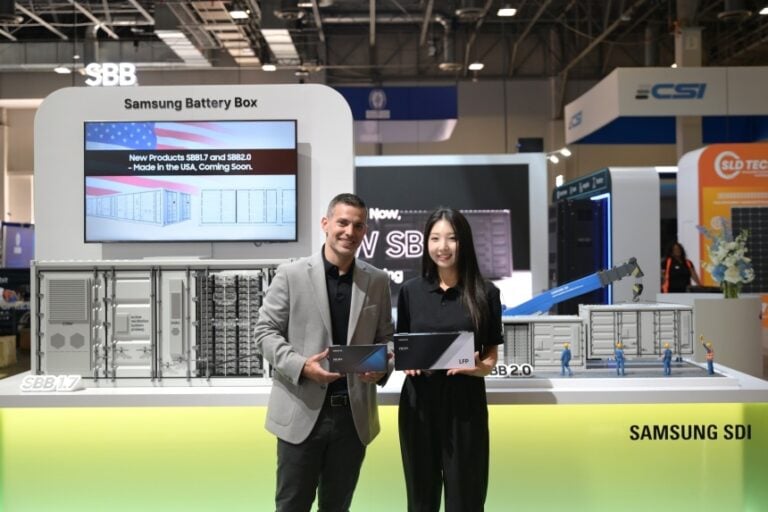
Newspaper The Korea Herald and news agency Reuters, each cited unnamed sources familiar with the matter at the time. This also followed a separate, unverified report suggesting Tesla reached a similar agreement with LG Energy Solution. Tesla’s energy storage division is more vulnerable to US-China trade tariffs than its electric vehicle (EV) business because its EV batteries are produced domestically in the US, while ESS cells are bought from international suppliers, most of which are Chinese.
Earlier this month, Hanjung America, a subsidiary of South Korea-based battery manufacturer Hanjung NCS, announced it would build its first ESS manufacturing facility in Huntington, Indiana, to support StarPlus Energy.
South Korean battery manufacturers are increasingly repurposing EV factories or establishing ESS-specific facilities in the US, a trend driven in part by the passage of the ‘One Big Beautiful Act’ and its foreign entity of concern (FEOC) restrictions.
In addition to Samsung SDI, LG Energy Solution and SK On have increased their local manufacturing capacity and announced domestic supply agreements with BESS integrators. Similarly, US-based system integrators like Fluence and non-lithium battery companies such as Eos are also expanding their local supply networks.
In a recent interview with ESN Premium, Isshu Kikuma, energy storage analyst at BloombergNEF (BNEF), who will be speaking at the upcoming Energy Storage Summit USA, noted of this trend:
“I think in a few years’ time, the US supply chain will be different. And then I think if many developers or many companies are willing to take on expensive equipment to avoid policy risk, we’re going to see US domestic equipment, or maybe other imports from South Korea or Southeast Asia, as long as those countries don’t have any ties to China.”
USITC determines China AAM does not hinder US AAM industry
The US International Trade Commission (USITC) has concluded that imports of active anode material from China have not significantly delayed the development of an industry in the US.
The USITC said in its 12 March news release, “USITC today determined that imports of active anode material from China that the US Department of Commerce (Commerce) has determined are sold in the United States at less than fair value and subsidised by the government of China have not materially retarded the establishment of an industry in the United States.”
Because of the USITC’s findings, the US Department of Commerce will not impose an antidumping or countervailing duty (AD/CVD) order on imports of this product from China.
The negative decision indicates that Commerce will revoke the high tariffs it temporarily imposed on graphite imports last month and will refund cash deposits to importers.
In July 2025, Commerce tentatively decided to impose anti-dumping (AD) duties of 93.5% on active anode material (AAM) imports from China.
The tariff included AAM contained within finished batteries but not finished BESS products. At the time, market intelligence firm Rho Motion pointed out that this means US BESS manufacturers and system integrators will be affected by it if they import batteries from China, but Chinese BESS manufacturers shipping finished products won’t be.
In February, Commerce raised countervailing duties (CVD) on AAM from China to 66.8%, keeping AD duties at 93.5%. This made the total effective rate on AAM imports from China 220%.
The AD/CVD investigation was initiated in December 2024 at the request of American Active Anode Material Producers (AAAMP), a coalition of startup companies aiming to establish domestic AAM production.
Amy Bennett, Principal Consultant at price reporting and analytics platform Fastmarkets, noted of the USITC’s recent decision on LinkedIn, “In order to develop domestic anode capacity, the US industry certainly needs government support, but AD and CVD cases may not have been the best approach for protection. AD/CVD cases require proof of injury to a domestic industry, and have worked incredibly successfully in well-established industries such as the domestic steel industry.”
Bennett continued, “However, the US has yet to establish a successful, qualified, commercially viable domestic anode industry, making it incredibly difficult to argue proof of existing injury, with the injury more hypothetical and forward-looking. The question now becomes how will the US government support the development of this incredibly important processed critical mineral supply chain with deep involvement in defence applications, as well as ESS and EV lithium-ion batteries.”
James Willoughby, Principal Analyst at market research firm Wood Mackenzie, similarly noted, “There are still incentives to switch to non-Chinese material: 45X credits will require battery producers to source non-Chinese anode, but these will begin to be sunset from 2030. Is this a long enough runway to bring new capacity online?”
The USITC’s public report, ‘Active Anode Material from China’ (Inv. Nos. 701-TA-752 and 731-TA-1730 (Final), USITC Publication 5719, March 2026), will include the USITC’s perspectives and investigation findings. This report is expected to be released by 26 April 2026 and will be accessible on the USITC website.
The Energy Storage Summit USA 2026 will be held from 24-25 March 2026, in Dallas, TX. It features keynote speeches and panel discussions on topics like FEOC challenges, power demand forecasting, and managing the BESS supply chain. ESN Premium subscribers can get an exclusive discount on ticket prices. For complete information, visit the Energy Storage Summit USA website.