For a glass rectangle with a simple appearance, a solar panel has a lot of components. Besides the obvious glass, frame, junction boxes and wiring, there are also many minerals and elements that control how a solar panel functions. The recent price increase of one critical mineral — silver — is influencing solar panel designs in a big way.

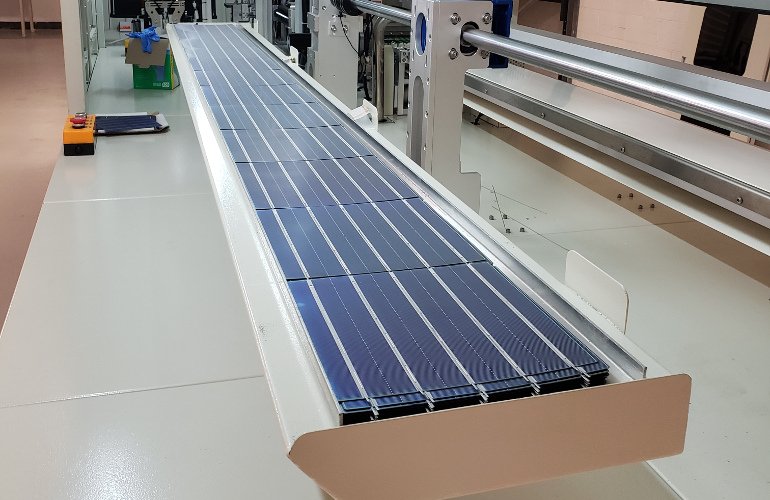
Archive photo of a string of solar cells at Crossroads Solar. Credit: SPW
The most electrically and thermally conductive metal, silver represents about 14% of a silicon solar panel’s manufacturing cost. For advanced n-type designs that are dominating the market, the cost of silver metallization is even higher.
Silver prices have recently been on a steep incline. Costs were steadily below $1/g between 2013 and 2024 before reaching a peak of $3.70/g on Jan. 29, 2026. Prices have fluctuated between $2.65/g and $2.90/g so far in March. With between 5 and 15 g of silver needed for each silicon solar panel, those costs can add up.
Major solar brands are experimenting with ways to use less silver in their solar panels, often increasing the percentage of copper instead. In certain cases, copper is a straightforward swap to silver, but researchers note this new process could lead to future durability issues that aren’t yet understood.
How silver is used in solar
Silver is incorporated into solar panel production when a silicon wafer turns into a solar cell. Silver powder is made into a paste and applied to a silicon wafer to form grid patterns to transport the electrons. It is part of common busbar designs soldered onto cells.
Silver usage has increased in silicon solar panel production due to the industry’s move into n-type technologies. Tunnel oxide passivated contact (TOPCon) and heterojunction (HJT) cells require higher amounts of silver per watt compared to traditional passivated emitter and rear contact (PERC) cells.
On a p-type PERC cell, silver is only required for the front n-type contact, while the rear p-type contact is typically formed using aluminum. TOPCon uses silver for the rear n-type contact as well as mixed with aluminum for the front p-type contact to improve efficiency. HJT solar cells use silver paste for both contacts.
Processes are improving, but silver usage is estimated at:
- PERC cells: ~10 mg of silver per watt
- TOPCon cells: ~13 mg/W
- HJT cells: ~22 mg/W
ITRPV estimates that the 703 GW of modules shipped in 2024 contained cells that consumed about 8,616.7 tons of silver. This corresponds to about 27.6% of global silver supply in 2024.
Where silver is produced
In a 2022 review, the U.S. Geological Survey found Mexico to be the leading global producer of silver, accounting for 24% of world production. China is the second-highest silver producer, with 14% of the market. The United States is tied with several other countries and accounts for 4% of the market. Fourteen countries control 92% of global silver production.
Eighty percent of silver production comes as a byproduct of mining lead, zinc, copper and gold, which makes rapid output increases difficult. The Silver Institute estimates that global demand of silver in 2025 reached 35,884 tons while supply only came to 32,206 tons. Global demand has outpaced supply every year since 2021. Prices have shot up as the demand-supply gap becomes more pronounced.
The risk of using less silver in solar
Since there isn’t a way to get significantly more silver into the market, manufacturers are trying to deal with shortages and high prices by using less. Copper is second only to silver for electric conductivity, and it’s already used in solar panel production.
“Copper offers high electrical conductivity at a significantly lower cost than silver, but it introduces technical challenges, such as diffusion into silicon and increased corrosion risk,” said Shivam Kholsa, project engineer with advisory group VDE Americas. “To mitigate these risks, copper metallization typically incorporates diffusion barrier layers (often nickel) and modified plating processes. As a result, the current industry trend is toward progressive silver reduction while copper-based metallization technologies continue to mature.”

Thermal cycling and damp heat testing would show copper oxidation and busbar failures. Credit: Kiwa PVEL
Copper is more prone to oxidation, and it “corrodes in ways silver does not and gets worse at elevated temperatures,” said Cherif Kedir, president and CEO of VDE Group’s Renewable Energy Test Center (RETC). This risk is more pronounced in TOPCon production, as those cells are processed at a very high temperature (700°C) compared to HJT’s lower processing temperature (200°C).
“For [TOPCon] cells, oxidation during processing is particularly difficult to control. On top of that, copper ions can migrate into silicon under electrical bias and moisture exposure, degrading cell performance over time,” Kedir said. “Given that TOPCon holds roughly 85% of Chinese cell manufacturing capacity, this is where the silver cost pressure is most acute and where the substitution is most technically constrained.”
Back-contact and HJT designs offer easier “long-term paths away from silver,” Kedir said, and that could change what types of modules are being installed in the very near future.
“This transition will move at different speeds for each cell type. That timing mismatch could shift market share over the next few years, and it’s something manufacturers, developers and lenders should all be watching closely. The silver price isn’t going to wait for the engineering to catch up,” he said.
What panel manufacturers are doing today
LONGi announced it would begin substituting base metals for silver in its solar cells in Q2 2026. Both LONGi and Jinko Solar have reportedly already used silver-coated copper pastes for rear-side contacts and are testing front-side applications. Their efforts have remained compatible with existing screen-printing lines, Kedir said, which keeps capital expenditures manageable. If manufacturers turn to copper electroplating, which is more common in HJT setups, new process equipment would be needed, so it wouldn’t be an easy swap.
“From where we sit as a test lab, the question that matters most isn’t whether manufacturers will adopt copper; they will,” Kedir said. “The important question is whether the products being shipped today and next year have been validated adequately to support the manufacturers’ performance claims.”

Silver usage in different silicon technology types. Credit: ITRPV
ITRPV expects the amount of silver per solar cell to decrease over time for all technology types, and testing organizations are already determining what to look out for. Jean-Nicolas Jaubert, director of China operations at Kiwa PVEL, said the group will focus on thermal cycling (to find solder bond fatigue and oxidation failures) and damp heat testing (for oxidation failures and corrosion).
“Both our own experience and the industry knowledge of copper paste is extremely limited. In short, we should brace for new failures as people start trying these solutions commercially, as it may be challenging to deploy quickly in a realistic way,” he said. “Copper could diffuse into the cell and create new defects, or possibly interact with other BOM components, such as encapsulant additives.”
Kedir agrees that failure areas in copper metallization aren’t prominent with silver and thus must be closely watched.
“A marginal edge seal or a small encapsulant defect that you wouldn’t think twice about in a silver-based module becomes a real problem when the metallization underneath is copper. Moisture gets in, hits the copper and corrosion starts,” he said. “As copper-metallized products start entering the pipeline, that benchmarking data is going to matter a lot more for developers and financial stakeholders trying to evaluate what they’re buying. The standards themselves don’t change. Emphasis does.”

A Silevo cell from 2011 showing only one visible busbar, which is much different than today’s designs. Credit: Facebook
There is some existing copper metallization data to reference. Silevo, the HJT manufacturer from the early 2010s that was eventually acquired by SolarCity and then Tesla, produced a silver-free solar cell using a copper electroplating process. RETC ran reliability experiments on Silevo’s copper-metallized HJT cells, and that data provides today’s industry with a detailed analysis of how copper reacts in real-world conditions.
“Silevo demonstrated 20-21% cell efficiency in pilot production. Their modules passed extended damp heat testing at 2,000 hours with negligible degradation,” said Kedir, who was involved in the original testing. “[Silevo] never scaled the way it might have, but the proof of concept was real. Copper can work in a solar cell.”
One silver-free module has already been introduced to certain markets. Chinese manufacturer Aiko has launched its latest all-back-contact module in Australia, China and Europe. The 545-W, 25% efficient module replaces silver-paste soldering with the company’s proprietary copper electroplated interconnection. It’s still early days, and only extending testing will show if moving away from silver is the right choice.
“Copper metallization at the mass-production scale has maybe two to three years of history. The engineering looks promising, and the cost pressure is real. But two or three years of manufacturing data doesn’t tell you what happens over a 25-year warranty period, and the only way to close that gap faster is accelerated lab testing,” Kedir said.