While all having the same function — taking energy, storing it, then releasing it — energy storage systems come in many different types. Whether thermal, electrochemical, mechanical or an emerging category, each energy storage system is important to the electrical grid of today and tomorrow. But when it comes to much-needed long-duration energy storage (LDES), certain types shine brighter. As grid-scale energy storage construction shifts away from the standard short-duration lithium-ion, contractors may need to get familiar with some novel technologies.
Traditionally, energy storage systems installed at the utility-level are lithium batteries working in two- to four-hour durations. These battery energy storage systems (BESS) store intermittent renewable energy generation and quickly release it when it’s most needed, smoothing out the country’s power production curves.
When reliable power is needed beyond the four-hour limits of lithium BESS, utilities and grid operators turn to advanced LDES — pumped hydropower, flow batteries and compressed-air systems. These systems can provide power for at least eight hours, sometimes for days, at more efficient levels and more cost effectively than a bank of lithium batteries, said Priya Shrivastava, research manager at Wood Mackenzie.
“Lithium-ion batteries generally exhibit higher capital costs per kilowatt for long-duration applications and experience relatively high degradation rates (approximately 1.5 to 3%),” she said. “LDES technologies typically feature significantly lower capital costs per kilowatt and minimal degradation (less than 1%), allowing for longer discharge durations while maintaining capacity over time.”

The Rock Island Dam on the Columbia River in Washington State. Credit: Dept. of Energy / Karl Specht
The most popular LDES is pumped hydro-storage, which pumps water between water reservoirs at different heights, generating electricity as the water passes through turbines. Pumped hydro-storage accounts for 95% of the world’s grid storage and 88% of installed utility-scale storage in the United States. While the most efficient LDES options out there, there aren’t many new pumped hydro-storage systems being built — most appropriate water sources have already been adapted for hydropower systems. That’s why utilities across the country are looking at new LDES options.
“In New York State, we have about 20 GWh of pumped storage hydropower. You can’t indefinitely increase your pumped storage. You need to find some other solutions to complement that technology,” said Brandon Owens, VP of innovation and research at the New York State Energy Research and Development Authority (NYSERDA). “We have funded and are looking at demonstration technologies across the range of electrical, thermal, mechanical and chemical storage. We’re trying to invest in those other technologies and move them to commercialization.”
NYSERDA has released multiple LDES competitive solicitations, pledging millions of dollars to advancing scalable LDES. Some incubator projects being championed in New York include a sodium-ion battery, a vanadium redox flow battery and a super-capacitor demonstration. Spending time now to test different LDES will help the future decarbonized grid.
“There’s an increasing need for longer-duration as the energy system across the globe transitions. You’re electrifying transportation and buildings. You’re adding more intermittent or variable resources to the grid, so you’re creating this need for longer-duration storage,” Owens said. “You’re talking about time shifting, either day to night or seasonal. The need to fill gaps is growing over time.

The iron-flow technology within the ESS Inc. energy storage system is considered to be long-duration, functioning beyond eight hours.
“We’ve gained some operational experience on [LDES] technologies through pilots in demonstration. There’s a lot of learnings that have happened, but they’re not focused on, ‘We learned that iron-air is the ultimate solution and that’s where we need to put all our money,’” Owens continued. “We’ve learned that it’s really use-case dependent, and that’s why we continue to diversify our research spend in this area.”
Already well-versed in the benefits of short-duration lithium BESS, California is also exploring LDES, said Kris Van Vactor, director of power resources for community choice aggregator (CCA) Silicon Valley Clean Energy (SVCE).
“In time, our [power demand vs. generation] peak is going to become much shallower, not going to be as pointy. In order to shift everything down, you need longer periods of charging to change the shape of the portfolio. That’s really why the eight-hour product is becoming more popular,” he said. “When a peak goes up like a mountain, you only need a two-hour or four-hour slice to take the peak off. But if it’s like a hill, then you need an eight-hour piece to reduce everything down.”

A rendering of the Willow Rock compressed-air LDES by Hydrostor.
California Community Power (CC Power), a joint agency of nine California CCAs including SVCE, has been testing LDES designs for years, issuing its first major request for projects in 2020. CC Power recently began discussing buying power from a 500-MW compressed-air system with an eight-hour discharge. A compressed-air system works similarly to a pumped-hydro system, using air and water movement to turn turbines. If greenlit, the Hydrostor-developed Willow Rock compressed-air LDES project would be sited in Kern County, California, and come online by the end of 2030. This would be the first non-lithium LDES project for SVCE, and that’s why the SVCE board is encouraging CC Power to sign on as an offtaker on the Willow Rock project.
“The value proposition of CC Power is that it’s nine CCAs. We bind together to find projects like this that we can be supportive of. It’s not experimental because it’s somewhat proven, but the money hasn’t really adopted it,” Van Vactor said. “We can support the project and improve the diversity of our portfolio. This is about trying to find other technologies that can fill the role of lithium-ion. You don’t want to have too many eggs in one basket.”

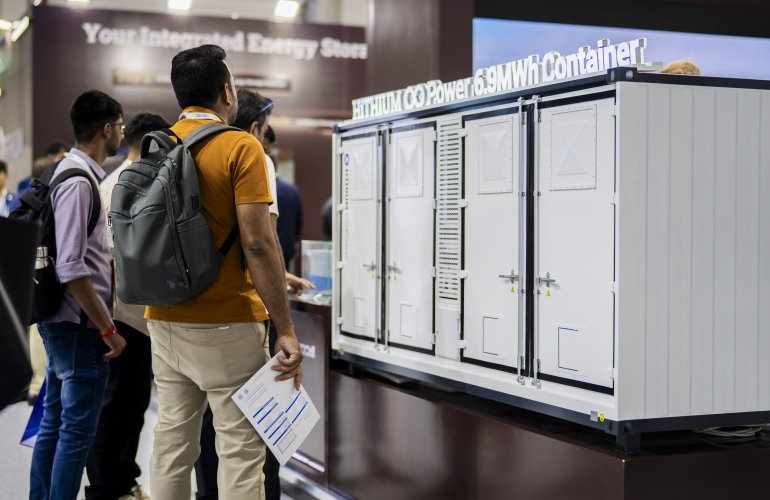
A model of Hithium’s eight-hour lithium battery at the World Future Energy Summit (WFES) in Abu Dhabi.
There are some promising trends for LDES. A recent study by EPRI and the LDES Council found that the cost of many long-duration energy storage technologies is expected to decline by 2030, reflecting continued technology development and manufacturing scale up. And that could mean lithium re-enters the LDES conversation.
Although not typically seen in LDES, advances in lithium storage durations are ongoing. Chinese lithium battery developer Hithium unveiled in December its ∞Power system — a 6.9-MW BESS that uses eight-hour lithium cells to reach 55.2 MWh. Hithium says the eight-hour cells reach 1,300 Ah and reduce system component count by 30%. Wood Mackenzie’s Shrivastava said it’s a promising advancement for lithium LDES.
“Hithium’s proprietary ultra-thick electrode technology, which overcomes key challenges such as electrode cracking, slow ion and electron transport and limited electrolyte penetration, enables higher energy storage at lower cost as well as increasing system density and lifetime,” she said, while also predicting that an eight-hour lithium system will be twice as large in its footprint as a four-hour system.

The eight-hour ∞Power system from Hithium.
Owens with NYSERDA said he welcomes any developments in lithium LDES.
“We’re comfortable with lithium-ion batteries in general, because of the installed base and the experience that market has with those technologies. We welcome any expansion. We’re talking about moving it from short duration to medium duration. We absolutely would welcome that as a technology option,” he said. “We’re not necessarily partial to lithium-ion, but if it fills a solution and it can do that cost effectively, we’d certainly welcome that in the marketplace.”
Those parties motivated to deploy the technology will continue to explore LDES options.
“We’ve put a lot of money in long-duration storage over the last several years, and we’ve got more investment plans over the next five years,” Owens said.