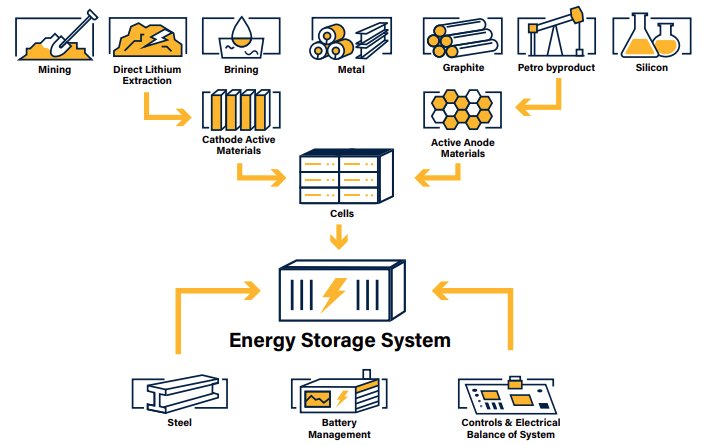
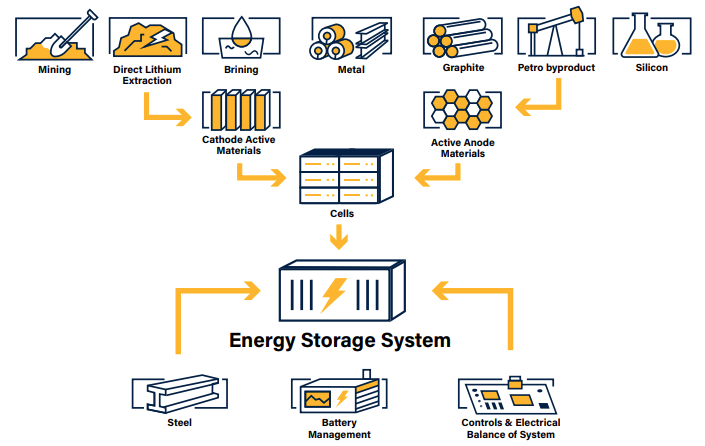
A new report from the US Energy Storage Coalition (ESC) indicates that the American battery manufacturing sector is set to surpass 100% of US demand for energy storage systems (ESS) and modules.
The ESC comprises battery and battery energy storage system (BESS) manufacturers, project developers, owners and operators, utilities and contractors.
The report, ‘Energy Storage Powers American Manufacturing’, states, “In 2025, for the first time, ESS emerged as the leading driver of battery supply chain investments, surpassing the automotive manufacturing industry.”
ESC’s report continues, “This momentum follows the industry’s 2025 commitment to invest US$100 billion in American manufacturing and minerals production, which ultimately is expected to generate over 350,000 new jobs.”
This article requires Premium SubscriptionBasic (FREE) Subscription
Already a subscriber? Sign In
Try Premium for just $1
- Full premium access for the first month at only $1
- Converts to an annual rate after 30 days unless cancelled
- Cancel anytime during the trial period
Premium Benefits
- Expert industry analysis and interviews
- Digital access to PV Tech Power journal
- Exclusive event discounts
Or continue reading this article for free
For 2026, ESC notes a US ESS annual energy storage project demand capacity of 60GWh. The report highlights a current capacity of just 69MWh, with 146GWh total pending additional capacity by the end of the year.
This would mean that the US would produce approximately 86GWh of capacity more than is needed to satisfy project demand, assuming everything comes online in time.
Three companies are noted as large contributors to this prediction. System integrator Fluence and its partners manufacture cells, modules, and associated equipment at facilities across the US, in Utah, Tennessee, Arizona, and Texas.
In May 2025, the company began production of enclosures and battery management system (BMS) hardware for BESS at its factory in Goodyear, Arizona. Fluence also opened a battery module factory in Utah in 2024 and started sourcing around half of the cells used in its US projects from a factory owned by AESC in Tennessee.
ESC notes Tesla’s operating 40GWh Megapack factory in Lathrop, California, and that the company is set to add 50GWh of system manufacturing capacity outside Houston, Texas.
Additionally, South Korean battery manufacturer LG Energy Solution (LG ES) assembles US-made cells into ESS at a final assembly facility in Phoenix, Arizona. Production is scheduled to expand in 2026 to support LG ES’ approximately 50GWh of North American ESS manufacturing.
Recently, the Trump administration announced via the US Department of the Interior (DOI) that LG ES closed a US$4.3 billion supply agreement with Tesla, which will see LG ES build a lithium iron phosphate (LFP) prismatic battery cell manufacturing facility in Michigan. The LFP cells will be used in Tesla’s Megapack 3 ESS.
Active anode material
Although the report highlights several other significant increases in manufacturing, such as for energy storage battery cells and Lithium, the most notable one is for anode materials.
According to ESC’s report, anode material production for US batteries could grow from 12GWh in 2025 to 121GWh in 2030, a 109MWh difference.
ESC also highlights three companies for graphite and anode manufacturing: oil and gas giant Exxonmobil, battery recycling and materials company Redwood Materials, and battery manufacturer Sila Technologies.
ExxonMobil aims to enhance its production by acquiring important assets and technology from Superior Graphite, such as the Kentucky graphitisation facility. This will allow the company to convert carbon-rich feedstocks from current refining processes into synthetic graphite suitable for battery anodes.
Redwood Materials is investing heavily at its facilities in Nevada and South Carolina to produce essential battery input materials from recycled batteries. This effort includes manufacturing copper foil, a vital part of large-scale battery anodes.
Earlier this year, Redwood closed its Series E financing round at US$425 million, noting Google as a new investor.
Sila Technologies aims to offer alternative anodes as a domestic option for battery manufacturers. Its facility in Moses Lake, Washington, signifies a US$100 million investment in producing alternative battery materials locally.
Based on the USITC’s findings, the US Department of Commerce will not issue an antidumping or countervailing duty (AD/CVD) order on Chinese imports of this product. The investigation into AD/CVD was launched in December 2024, prompted by American Active Anode Material Producers (AAAMP), a coalition of startup firms working to develop domestic AAM production.
James Willoughby, principal analyst at market research firm Wood Mackenzie, noted of the USITC’s finding, “There are still incentives to switch to non-Chinese material: 45X credits will require battery producers to source non-Chinese anode, but these will begin to be sunset from 2030. Is this a long enough runway to bring new capacity online?”
ESC maintains that by the end of the year, energy storage battery cell manufacturing could surpass domestic demand, working to create an end-to-end domestic energy storage supply chain.
The Energy Storage Summit USA 2026 will be held from 24-25 March 2026, in Dallas, Texas. It features keynote speeches and panel discussions on topics like FEOC challenges, power demand forecasting, and managing the BESS supply chain. ESN Premium subscribers can get an exclusive discount on ticket prices. For complete information, visit the Energy Storage Summit USA website.
The Energy Storage Summit USA is the only place where you are guaranteed to meet all the most important investors, developers, IPPs, RTOs and ISOs, policymakers, utilities, energy buyers, service providers, consultancies and technology providers in one room, to ensure that your deals get done as efficiently as possible. Book your ticket today to join us in 2026!
Held alongside The Battery Show Europe, Energy Storage Summit provides a focused platform to understand the policies, revenue models and deployment conditions shaping Germany’s utility-scale storage boom. With contributions from TSOs, banks, developers and optimisers, the Summit explores regulation, merchant strategies, financing, grid tariffs and project delivery in a market forecast to integrate 24GW of storage by 2037.
You can expect to meet and network with all the key industry players again in 2025 from major US asset owners, operators, RTOs and ISOs, optimizers, software and analytics providers, technical consultancies, O&M technology providers and more.
Launching September 2026 in Berlin, Energy Storage Summit Germany is a new standalone event dedicated to Germany’s energy storage market. Bringing together investors, developers, policymakers, TSOs, manufacturers and optimisation specialists, the Summit explores the regulatory shifts, revenue models, financing strategies and technology innovations shaping large-scale deployment. With Germany targeting 80% renewables by 2030, it offers a focused platform to connect with the decision-makers driving the Energiewende and the future of utility-scale storage.
The Energy Storage Summit Central Eastern Europe is set to return in September 2025 for its third edition, focusing on regional markets and the unique opportunities they present. This event will bring together key stakeholders from across the region to explore the latest trends in energy storage, with a focus on the increasing integration of energy storage into regional grids, evolving government policies, and the growing need for energy security.
Read Next

Energy storage developer and system integrator Energy Vault has released its Q4 and full year 2025 financial results, showing growth credited to entering the AI infrastructure market, expanding projects in Australia and its ‘Asset Vault’ subsidiary.
Indian solar PV module manufacturer Saatvik Green Energy is to enter the energy storage market through a newly launched subsidiary.

A collaborative team of Australian scientists from CSIRO, the University of Melbourne and the Royal Melbourne Institute of Technology (RMIT) has successfully developed and tested the world’s first proof-of-concept quantum battery system.

“When we started back in two years ago, there was a lack of understanding in the market about how the grid-forming inverters operate,” said Ghasem Jahedi, principal grid engineer at AGL.

Energy-Storage.news speaks to Dr. Kai-Philipp Kairies, CEO and co-founder of ACCURE Battery Intelligence, ahead of the upcoming Energy Storage Summit USA 2026.