
The legalese of the new rules governing solar drives many developers to hire more lawyers. In practice, they should lean on experienced engineers instead.
The One Big Beautiful Bill Act (OBBBA), Executive Order 14315 and IRS Notices 2025-42 and 2026-15 collectively ended the 5% safe harbor for utility-scale projects, leaving the physical work test as the governing standard for beginning of construction, and set July 4, 2026, as the date separating projects that can preserve §45Y production tax credit and §48E investment tax credit eligibility under favorable terms from those that cannot.
What reads as a complex regulatory reshuffling amounts, in practice, to a closing window. For many projects, it closes faster than their development schedules allow, and only industry veterans truly understand the cascading effects and how they will impact steel-in-the-ground projects.
The 18-month grace period is a mirage
Four dates define the post-OBBBA framework:
- 2, 2025: the 5% safe harbor ended for utility-scale solar
- 1, 2026: FEOC enforcement began
- July 4, 2026: the begin of construction (BOC) deadline triggering the four-year continuity safe harbor, which gives qualifying projects until Dec. 31, 2030, to reach placed-in-service
- 31, 2027: the hard deadline for any project missing the July BOC cutoff
That last date exposes the grace period’s limits. The OBBBA’s 18-month post-BOC window sounds like a safety net; the development timeline makes it a false floor. A utility-scale solar project typically runs 33 to 66 months end-to-end. High-voltage transformers alone consume a substantial portion of that window before site work begins — and while developers working with OEMs experienced in custom, project-specific configurations can compress those timelines, no supply chain relationship bridges a fundamental gap of that magnitude.
The 18-month extension functions, in practice, only for projects whose long-lead equipment was already procured and moving before the July deadline — those projects have already safe harbored. For new projects that miss the July 4, 2026, safe harbor deadline, securing tax credits is no longer an option with the time left.
 Capital commitments signal long-term conviction
Based on transformer radiator procurement for solar projects targeting placed-in-service dates between 2028 and 2031, Camelot Energy Group estimates that U.S. developers are on track to lock up more than $3.8 billion in safe-harbored equipment between July 4, 2025, and July 4, 2026 — corresponding to an intended solar investment of up to $200 billion in total project costs. Numbers from a December 2025 survey from Roth Capital validate this estimate, roughly one-quarter of the U.S. utility-scale solar market confirms that solar companies are rushing to lock in favorable tax treatment before July 2026, and the scale of this effort across the whole industry could be enormous — roughly 250 GW worth of projects.
Based on our analysis, ERCOT, PJM, MISO and the vertically integrated markets will have the largest pipeline of safe-harbor projects, reflecting confidence in power price trajectories, permitting pathways and curtailment profiles in those markets.
Markets like ERCOT show new demand forming in virtual power plants, distributed energy resources and battery storage — suggesting the capital commitment to clean energy infrastructure extends well past the current safe harbor window.

FEOC compliance starts at procurement, not at closing
The BOC deadline is only half the story. Any project beginning construction after Dec. 31, 2025, must satisfy the OBBBA’s “material assistance from a prohibited foreign entity” rules — and failure means the ITC and PTC are forfeited, regardless of physical work test compliance.
The framework defines prohibited foreign entities to include specified foreign entities organized in or controlled by China, Russia, Iran or North Korea, and also includes restrictions on “foreign-influenced entities,” which are organizations that can be based in the United States subject to control by the Chinese, Russian, Iranian or North Korean governments.
Material assistance cost ratio (MACR) thresholds — which determine if a project meets domestic content requirements — climb from 40% for solar projects with a 2026 BOC to 60% by 2030, with energy storage thresholds running higher at each step. Material definitional questions — particularly around debt-based foreign-influenced entity status and the contours of “effective control” — were deferred by Notice 2026-15 to forthcoming proposed regulations. Rules are being enforced, even as the government continues to refine exactly how companies are supposed to comply with said rules, significantly complicating project financing.
The penalty structure reflects the stakes. Section 6695B imposes the greater of 10% of the tax underpayment or $5,000 for false certifications. Supplier certifications require six years of retention of documentation to prove compliance.
FEOC compliance belongs in procurement strategy from Day 1, not on a pre-closing checklist. By the time lawyers are reviewing documents before closing, every supplier has been selected, every contract signed and equipment is already in production or on site — there is nothing left to fix.
The leverage to demand supply chain transparency, require audit rights and make sourcing decisions that satisfy the MACR sits entirely in the procurement window and must be done in partnership with competent engineers who understand the entire commissioning process from start to finish.
Legal risk and execution risk require different solutions
The safe harbor window remains open — but the margin for error is gone, and legal counsel can’t mitigate all risks.
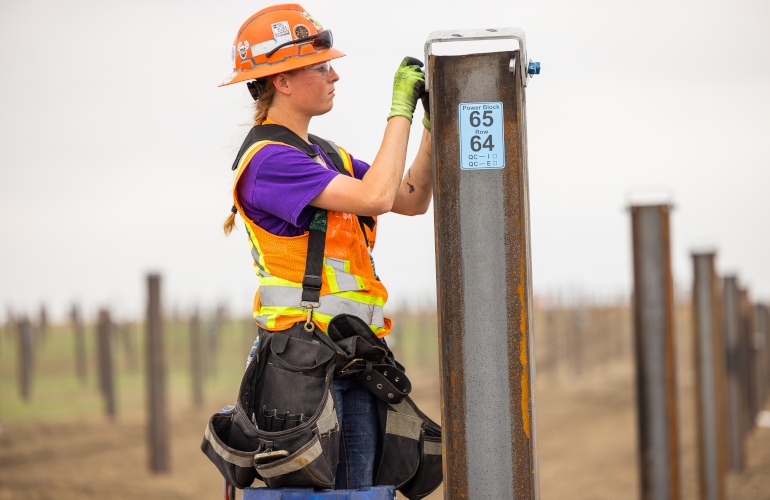
Credit: Quanta Services
Specialist law firms remain essential for structuring BOC documentation and working through the unresolved FEOC questions. That legal foundation does not, by itself, get a project permitted, procured and built.
Successful projects do several things at once. They bring in legal counsel early and pair them with engineering partners experienced in managing construction timelines — important when EPC contractors are in high demand.
They also keep meticulous records to pass a physical work test audit: timestamped photos, signed contracts dated before manufacturing begins and delivery receipts. On the financial side, they calculate depreciation at the individual asset level and prepare bills of materials, country-of-origin certificates and cost breakdowns tied to invoices — all organized correctly before they ever reach legal review.
Engineers fluent in both the technical detail and the policy context reduce the back and forth that drives up legal costs and project delays. When the documentation package already reflects what counsel needs, the legal review moves faster and requires fewer billable hours. Combining engineering expertise with legal review will best position developers for success after July 4.
The solar industry has navigated the first step in the OBBA gauntlet well, with large volumes of projects safe-harbored. The next step is equally fraught, with challenging yet unclear FEOC rules and guidance. Minimizing those risks and legal fees requires working with specialist engineers who understand both the policy and the technical aspects of project development.
Raafe Khan, Head of Energy Storage and Emerging Markets at Camelot Energy Group, an advisory group that supports asset owners, investors, public agencies and others through owner’s engineering, technical due diligence and strategic advisory services.