Domestic content has become one of the most important levers available to solar developers. For years, procurement teams were trained to optimize around the lowest upfront cost. That made sense in a market where global supply was abundant, lead times were predictable and domestic manufacturing was often treated as a premium option. But that market is quickly changing.

Credit: American Steel and Aluminum
Today, domestic content can directly improve project economics by helping developers qualify for the ITC domestic content bonus when the required U.S.-manufactured components are incorporated. But the value goes beyond the tax credit. Domestic sourcing also gives developers more control over schedule certainty, traceability, supply-chain risk and procurement flexibility.
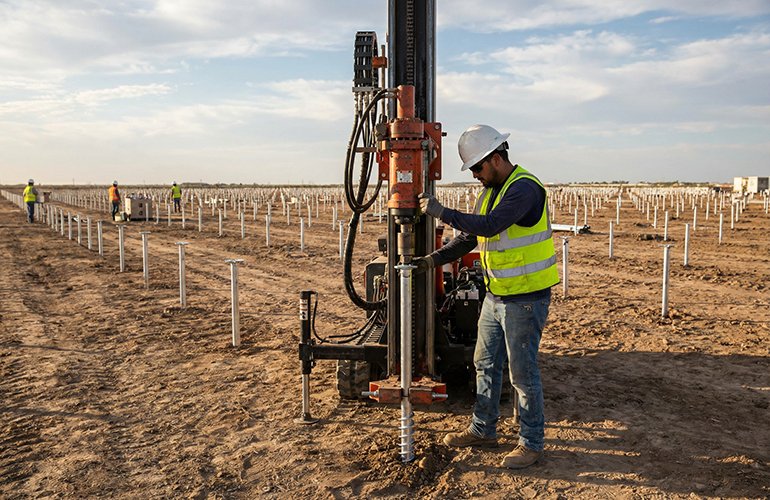
For most utility-scale projects, the total installed cost is typically driven by major categories: modules at approximately 35% to 40%, trackers and racking at 15% to 20%, electrical BOS at 15% to 20%, and civil/foundation-related structural BOS costs at approximately 10% to 15%. Because the domestic content calculation is based on the cost of manufactured products, early procurement decisions in these categories matter. Steel-intensive foundation systems, including piles, ground screws and related structural assemblies, may not be the largest cost category, but they are among the most practical and controllable ways to help move a project toward the required domestic content threshold.
That makes foundation and structural steel components strategically important. They are domestically manufacturable, traceable, procured early in the project lifecycle and relatively straightforward to document. When a project is close to the threshold, these components can help close the gap between almost qualifying and actually securing the ITC domestic content bonus.
This is where vertically integrated U.S. manufacturing matters. When a supplier controls the process from steel sourcing through fabrication and finished product delivery, it can provide the traceability, documentation and production reliability developers need. That means supporting projects with U.S.-produced foundation and structural steel solutions aligned with domestic content requirements.
At the same time, Section 45X manufacturing incentives have helped expand domestic production capacity. While those incentives benefit manufacturers rather than developers directly, they have strengthened the domestic supply base and improved the availability and competitiveness of U.S.-made components.
The result is a rare alignment: project-level incentives are pulling developers toward domestic content, while manufacturing incentives are helping build the capacity needed to supply it.
For developers, the takeaway is clear. Domestic content should not be treated as an after-the-fact compliance exercise. It should be built into the procurement strategy from the beginning. The projects that capture the most value will be the ones that identify domestic content opportunities early, secure traceable U.S.-made components and use domestic supply not only to improve returns, but also to reduce schedule and supply-chain risk.
In this market, domestic steel is not just a material choice. It is a project strategy.
Robert Souliere is a solar infrastructure expert and the Director of Business Development at American Steel and Aluminum (ASA), a New England-based manufacturer of domestically produced ground screws for utility-scale and commercial solar applications. ASA’s ground screws are compatible with most major tracker systems, fixed-tilt racking and cable management platforms.
Information and statements in this article are not meant to be tax or legal advice and ASA encourages readers to confer with their tax advisers and attorneys for advice on tax credits and incentives.