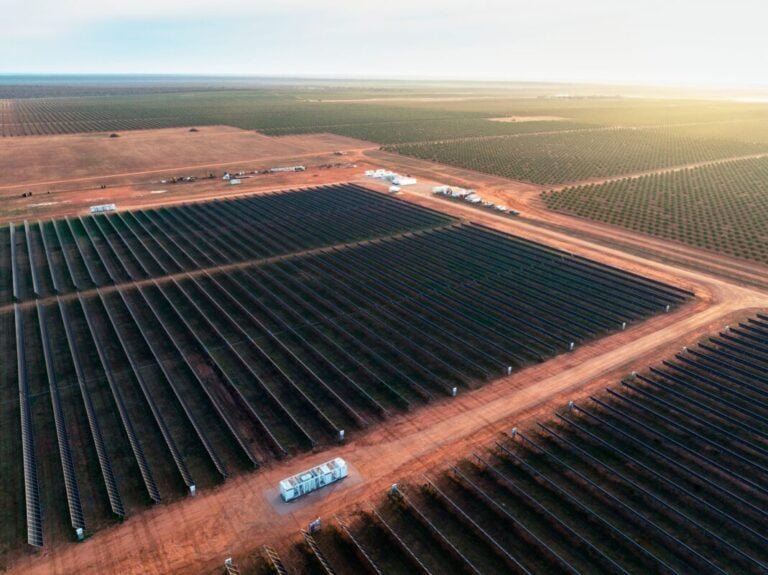
The project will connect to the SA Power Networks distribution network at 11kV, with solar generation augmenting grid supply when network capacity falls short of the site’s peak demand.
The microgrid will be delivered for RRG Capital Management, a US-based private equity fund that began developing its South Australian almond investments in 2023 across more than 2,500 hectares of plantings.
AGL has structured the project as a 20-year power purchase agreement (PPA) under which it builds, owns, operates and maintains the assets and supplies power to Koompartu Farms, leaving the orchard’s management team free to focus on agricultural operations rather than energy infrastructure.
AGL general manager of sustainable business energy solutions, Brendan Weinart, said the project illustrates how tailored microgrid solutions can address the energy reliability demands of large-scale agribusiness.
“This is a first-of-its-kind project and has been designed to improve local grid capacity and provide the reliability needed to keep critical irrigation systems operating,” Weinart said.
“With diesel genset usage expected to fall by 88%, the project shows the role tailored microgrid solutions can play in helping businesses reduce emissions and improve resilience.”
The Koompartu project is the largest in a series of agricultural microgrid developments AGL has delivered in South Australia and New South Wales (NSW).
In May 2024, AGL completed a 4.8MW solar and 4.2MWh battery microgrid at Cadell Orchards in the NSW Riverina for Australian Farming Services, reducing diesel dependence by 85% and cutting the orchard’s carbon emissions by up to 4,700 tonnes annually.
AGL also developed a 6.5MW solar and 5.1MWh battery storage system at the nearby Canally Almond Orchard under the same long-term PPA model.
The Koompartu system is considerably larger than those earlier projects, and the 19km underground high-voltage network across the 9,340-hectare property reflects the infrastructure complexity required to power a site of that scale from a distributed generation source.
Electrical substation work was carried out by TGOOD Australia, which supplied 11 interconnected substation kiosks with unique configurations to manage load flow across the site.
Microgrids as a market opportunity
The Koompartu microgrid will sit within a broader push to develop distributed energy infrastructure for commercial and industrial customers that cannot easily access grid-scale renewable energy through conventional connections.
In 2023, the Australian Renewable Energy Agency (ARENA) supported Australian microgrid deployment with targeted funding, recognising that remote and semi-remote operations face grid access constraints that make behind-the-meter generation and storage the most commercially practical route to decarbonisation.
The model is also being deployed in contexts beyond agriculture. ARENA-backed funding has supported community and bushfire-resilient microgrids in regional areas, with EDP recently winning AU$3 million (US$2 million) in funding for a bushfire-resilient microgrid that demonstrated how solar, battery storage and backup generation can be combined to maintain power during emergencies when grid connections fail.
AGL’s broader energy portfolio spans both behind-the-meter microgrid solutions and grid-scale assets.
The company acquired Tesla’s South Australian virtual power plant in 2025, adding a portfolio of home batteries coordinated as a distributed resource in the National Electricity Market (NEM) to its generation and retail operations.
Our publisher, Solar Media (part of Informa Group), will host the Battery Asset Management Summit Australia 2026 on 25-26 August at Amora Hotel Jamison in Sydney. You can find out more about the Summit on the official website.