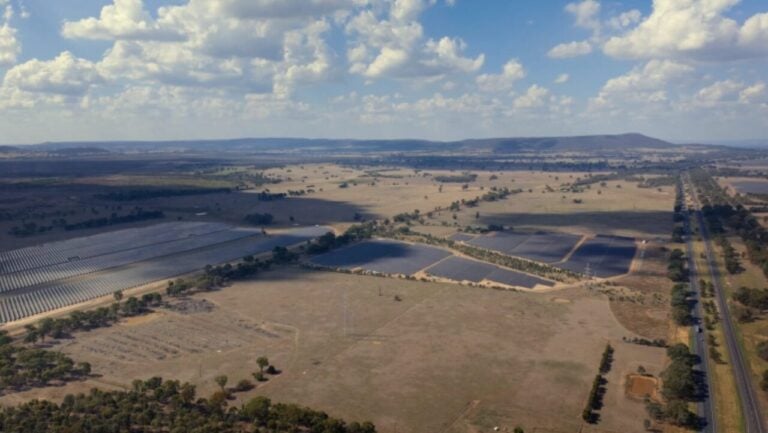
The investment directly supports Amazon’s AU$20 billion (US$14.34 billion) commitment to expand data centre infrastructure across Australia by 2029, announced alongside Prime Minister Anthony Albanese in June 2025.
That expansion aims to strengthen Australia’s cloud computing and AI capabilities, with the renewable energy deals providing the carbon-free power needed to meet both operational demands and Amazon’s goal of reaching net zero carbon across its operations by 2040 under The Climate Pledge.
Since 2020, Amazon has invested an estimated AU$2.8 billion in renewable energy projects across Australia, with the 20 projects now contracted.
Hybrid projects demonstrate land rehabilitation and agricultural co-use
The nine projects include the Golden Plains 2 wind farm developed by TagEnergy in Victoria, alongside solar-plus-storage sites at Forest Glen (X-ELIO), Stanbridge (Anza) and Muswellbrook (OX2) in New South Wales.
In Victoria, Anza is developing four distributed solar-plus-storage projects at Laceby, Indigo, Barnawartha, and Mooroopna, while European Energy is adding battery storage to the 58MW Mokoan Solar Park, which became operational earlier and was part of Amazon’s June 2025 announcement covering three utility-scale solar projects totalling 333MW of generation capacity.
That earlier agreement with European Energy also included the 150MW Winton North Solar Park in Victoria and the 125MW Bullyard Solar Park in Queensland, both in pre-construction procurement phases.
Jens-Peter Zink, deputy CEO of European Energy, indicated at the time that the company’s Australian operations were “just ramping up,” suggesting further expansion ahead.
Amazon’s approach mirrors strategies employed by other hyperscale operators in Australia, including Microsoft’s 15-year power purchase agreement with FRV Australia for a 300MW solar plant in New South Wales to power the company’s data centres in that state.
| Project Name | Location | State | Developer | Technology Type | Generation Capacity | Battery Storage |
|---|---|---|---|---|---|---|
| Muswellbrook Solar Farm | Muswellbrook | NSW | OX2 | Solar + Battery | 94.5MW | 70MW |
| Forest Glen Solar Farm | Forest Glen | NSW | X-ELIO | Solar + Battery | 72MW | 72MW |
| Stanbridge Solar Farm | Stanbridge | NSW | Anza | Solar + Battery | 3.8MW | 3.8MW |
| Golden Plains 2 Wind Farm | Golden Plains | VIC | TagEnergy | Wind | 201.8MW | N/A |
| Laceby Solar Farm | Laceby | VIC | Anza | Solar + Battery | 48MW | 48MW |
| Indigo Solar Farm | Indigo | VIC | Anza | Solar + Battery | 3.6MW | 3.6MW |
| Barnawartha Solar Farm | Barnawartha | VIC | Anza | Solar + Battery | 3.6MW | 3.6MW |
| Mooroopna Solar Farm | Mooroopna | VIC | Anza | Solar + Battery | 3.4MW | 3.4MW |
| Mokoan Solar Farm Battery | Mokoan | VIC | European Energy | Battery Storage | N/A | 32MW |
Battery storage emerges as critical infrastructure for AI workloads
The emphasis on battery storage within Amazon’s latest portfolio reflects broader industry recognition that energy storage systems will play a crucial role in supporting data centre expansion.
As Fluence chief growth officer Jeff Monday noted in an exclusive interview with ESN Premium at the Energy Storage Summit Australia 2026 last month, battery storage addresses three primary use cases for hyperscale operators.
This includes accelerating grid connection timelines by reducing firm power commitments, providing more efficient backup power that can replace diesel generators, and smoothing power loads between data centres and the grid or on-site generation.
Monday predicted that once standardised battery storage blueprints are finalised with hyperscale customers in the US, deployment in Australia will experience a “slingshot” moment of rapid acceleration.
“I know you talked about the data centre progression that’s happening here in Australia, but I actually see it’s probably a bit of a slingshot in that once the blueprints are defined, I think it’s going to massively scale here locally,” Monday said.
The integration of battery systems into data centre infrastructure also creates opportunities for these assets to participate in wholesale electricity markets during periods when capacity is not required for facility operations, helping to turn the data centre boom into a grid growth story by improving investment economics while providing grid flexibility services.
However, concerns are mounting about whether data centre developers are contributing adequately to grid infrastructure costs, with various members of the energy industry warning that social backlash is inevitable if facilities are perceived as freeloading on Australia’s clean energy transition.
The challenge of integrating substantial new baseload demand into a grid increasingly reliant on variable renewable energy has prompted calls for data centres to move beyond simply purchasing renewable energy and actively participate in grid stability solutions.
As a result, the Australian Energy Market Commission (AEMC) has begun developing regulatory frameworks to accommodate what it terms “inverted baseloads”, defined as large, constant electricity consumers like data centres, with draft access standards released in March 2026 proposing different requirements based on facility size thresholds at 30MW and 100MW.
The International Energy Agency (IEA) projects that global electricity demand from data centres will more than double by 2030 to exceed 945TWh annually, driven substantially by AI-optimised facilities where demand is expected to more than quadruple over the same period.
Interested in Australia? Read Energy-Storage.news’ Energy Storage Summit Australia coverage and related content.