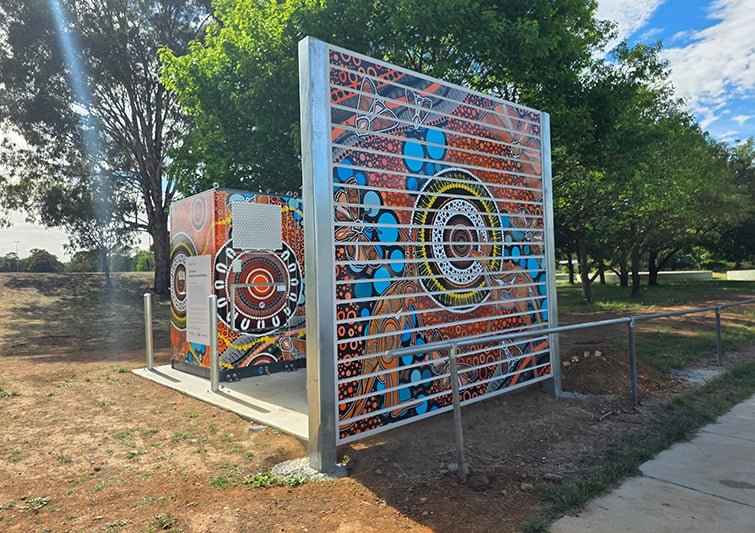
The completion of Canberra’s community battery network occurs as Australia’s deployment of neighbourhood-scale storage systems continues to expand, with 244 community battery storage systems now connected across the country, according to recent Australian Energy Regulator (AER) data.
The national programme aims to deliver 400 community batteries nationwide, targeting areas where households face barriers to installing private battery systems.
Dickson operates as a grid-connected storage system with 450kWh capacity and a maximum power output of 220kW, designed to serve up to 47 local homes and units.
Located on Hawdon Place adjacent to Dickson Oval, the battery storage unit connects directly to the local electricity network to capture excess rooftop solar generation during peak production hours and discharge stored energy during evening demand periods.
The three-battery network demonstrates varying capacity configurations optimised for different local conditions. The Casey system provides 225kWh of storage with 110kW of output, serving 86 households, while the Fadden installation offers 450kWh of storage with 220kW of output, supporting over 1,400 households.
Combined, the three systems deliver 1,125kWh of total storage capacity and 550kW of aggregate power output.
Community batteries function as shared infrastructure that can defer network upgrade costs by managing local demand peaks and voltage fluctuations caused by high rooftop solar penetration.
Unlike home battery storage systems, community batteries connect directly to the local electricity network and typically have power capacities of up to 5MW, storing energy from the grid for use during peak demand or when there is low or no sunlight.
ACT Minister for Climate Change, Environment, Energy and Water, Suzanne Orr, noted that community batteries act as local energy buffers, capturing excess rooftop solar during the day and releasing it during evening peak periods while enabling more households to install solar without expensive network upgrades.
The federal Community Batteries for Household Solar programme targets deployment in areas with high solar penetration but limited private battery adoption, focusing on rental properties, apartments, and households facing financial or technical barriers to individual storage installations.
Completion of Canberra’s community battery network occurs alongside broader energy storage developments in the territory, including the under-construction 250MW/500MWh Williamsdale grid-scale battery storage project scheduled for completion by late 2026.
Eku Energy is developing the battery storage project, whilst Habitat Energy will utilise its integrated service, harnessing AI-powered algorithmic forecasting to optimise it.
Once complete, it will operate in grid-forming mode and provide system strength services and fast-acting frequency control ancillary services (FCAS). Through trading in the National Electricity Market (NEM), Eku Energy will receive fixed quarterly payments from the Territory over a period of 15 years.
The Energy Storage Summit Australia 2026 will be returning to Sydney on 18-19 March. It features keynote speeches and panel discussions on topics such as the Capacity Investment Scheme, long-duration energy storage, and BESS revenue streams. ESN Premium subscribers receive an exclusive discount on ticket prices.
To secure your tickets and learn more about the event, please visit the official website.