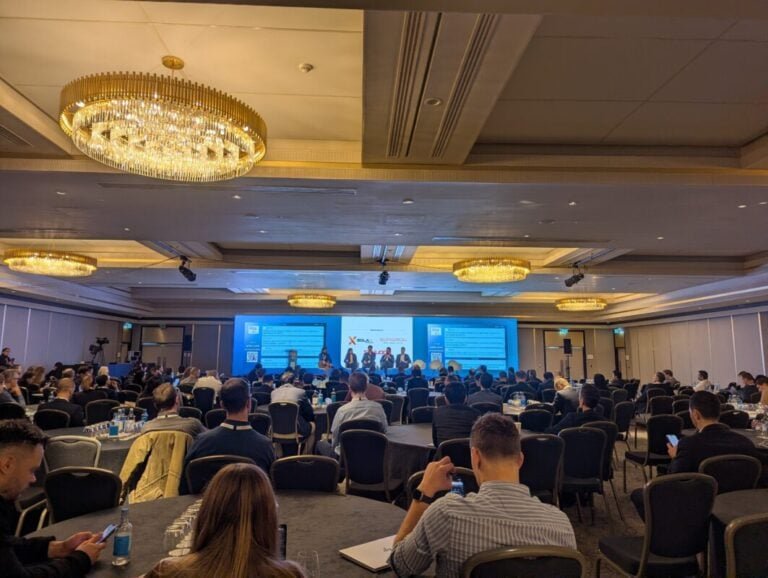
He went on to describe tolling as a “big word” in the industry, echoing sentiments expressed at a panel discussion the previous day on the role of physical tolling agreements on balancing profitability and predictability.
Martin Daronnat, head of flexibility and structured origination at Engie, argued that revenues are rather fragile in Europe at present, and that more hedging could be required in the battery industry to protect revenues.
“As long as capacity prices stay high, all will be well,” he said, referring to the example of Germany. “When those go down, I won’t be surprised if we see revenues go down by 40-50%.
“You need to think of starting to hedge,” he continued, suggesting that the German market is an attractive investment destination, but that more storage needs to be deployed to make these investments bankable. “More and people that are going merchant, or partially merchant, are starting to hedge.”
Ancillary services continue to drive revenue
However, this uncertainty does not mean that European storage is devoid of investment opportunities; one of the panels yesterday saw speakers describe the sector as the “hottest renewables market in Europe”.
Indeed, speakers today argued that battery energy storage systems (BESS) are uniquely placed to provide revenue-generating applications as they can participate in ancillary services, still described as a “high proportion” of revenues in Europe at present.
“The high proportion of revenue comes from ancillary services,” explained Rimshah Javed, senior originator at Danske Commodities. “In the Baltics we see high revenues come from ancillary services; in the case of Germany, for instance, it’s a very liquid market, but it’s a very deep market—it’s the largest power market in Europe.”
She argued that “low revenue markets”, like Sweden, have fewer arbitrage opportunities, but Ingmar Grebien, managing director and head of commodities and sustainable solutions at Goldman Sachs, said that mature markets like the UK present opportunities for ancillary services as a revenue driver.
“Market maturity matters because of the ancillary services,” said Grebien. “If we look at the market in the UK, the lower price hours are dominated by wind in Scotland. The high price hours are dominated by gas. That sets the scene for the long-term profitability.”