The solar industry continues to face a persistent workforce challenge. The U.S. solar industry employed more than 280,000 workers in 2024, with solar-plus-storage employment reaching over 460,000 workers, reflecting rapid growth across the sector. Despite this expansion, the pipeline of skilled technicians has not kept pace with the increasing complexity of commercial solar systems.
This gap is not limited to labor availability. It is increasingly defined by a shortage of workers trained in advanced electrical systems, diagnostics and long-term operations. Nearly 90% of solar employers reported difficulty filling open roles in 2024, with 53% citing lack of experience, training or technical skills as the primary barrier. As commercial solar assets mature and integrate with storage, grid infrastructure and more sophisticated monitoring systems, the demand for deeper technical expertise continues to grow.
At the same time, many educational institutions and public-sector organizations are facing rising energy costs, with some campuses allocating a significant portion of operating budgets to utilities rather than instructional resources. This intersection of workforce demand and financial pressure is driving renewed interest in more aligned training models.
A model built on alignment
Partnership-based workforce development is not new to the solar industry. Demand-driven training programs have existed for years, often supported by policy incentives or educational partnerships. What is evolving is how closely aligned these programs have become with the real-time needs of contractors and asset owners.

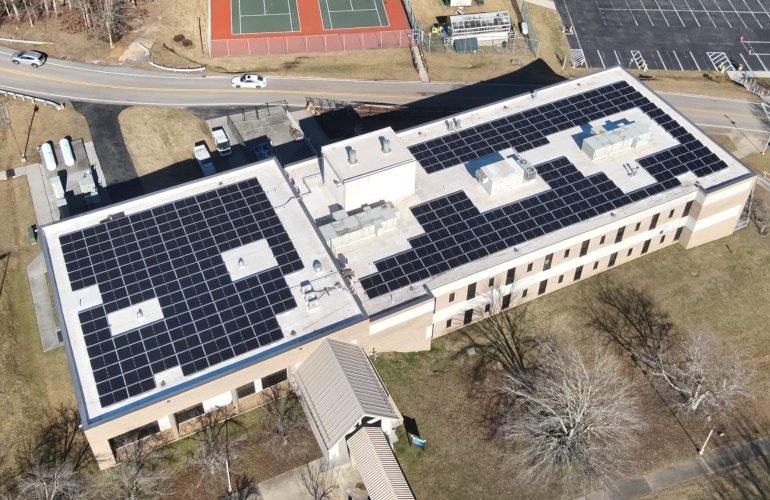
Mountain Empire Community College solar installation
A recent workforce development initiative at Mountain Empire Community College in Virginia illustrates how collaboration among an educational institution, a solar developer and an electrical contractor can better align classroom instruction with active commercial project work. The project, developed by Secure Solar Futures and constructed with support from Got Electric, included more than 1,600 solar modules and was designed to offset approximately one-third of the campus’ total energy consumption, producing over 1 million kWh annually. Structured through a power purchase agreement, the system required no upfront capital investment and is projected to deliver approximately $2.4 million in lifetime energy cost savings.
Students participated in both structured coursework and hands-on installation while earning wages during the process. Programs structured this way have demonstrated strong outcomes, including full job placement for participating cohorts and immediate transition into full-time roles.
This type of alignment reduces the gap between learning and employment. Instead of completing a training program and entering a job search phase, participants move directly into the workforce with practical field experience already in place.
Why traditional pathways fall short
Many workforce programs still operate independently from the realities of field operations. Graduates may understand installation basics but lack exposure to live jobsite conditions, electrical troubleshooting or system-level thinking.
For commercial solar, this gap becomes more pronounced over time. Systems require not only installation but also long-term maintenance, diagnostics and coordination with utility infrastructure. Without a workforce trained beyond entry-level installation tasks, asset performance can suffer.
This challenge is particularly evident in operations and maintenance (O&M). According to IREC workforce data, O&M was the only segment of the solar industry where hiring difficulty increased in 2024, reflecting the growing need for technicians capable of supporting long-term system performance as more assets come online.
In practice, this leads to longer commissioning timelines, more frequent service calls and increased reliance on a limited pool of experienced technicians. Industry feedback continues to highlight inconsistent documentation, communication gaps and repeat site visits as ongoing operational challenges.
The role of real-world experience
Programs that integrate fieldwork into training provide a different outcome. When students work on active installations, they gain exposure to real conditions, real timelines and real problem-solving. They also develop familiarity with tools, safety procedures and team coordination in ways that classroom instruction alone cannot replicate.
In some cases, these programs provide hourly wages during training, along with stipends, tools and academic credit. These incentives help remove barriers to entry and create a more direct pathway into the skilled trades.
This approach aligns with broader workforce data: Registered Apprenticeship programs report 93% employment retention after completion, with average starting wages of approximately $86,000, demonstrating the effectiveness of earn-while-you-learn models in building durable career pathways.
This model has proven particularly effective in regions transitioning from legacy energy economies, where workforce development is closely tied to long-term economic stability.
Implications for the Industry
As commercial solar continues to expand, workforce development will play a critical role in determining long-term system performance and reliability. This urgency is underscored by federal projections: solar installer roles are expected to grow 42% between 2024 and 2034, with approximately 4,100 job openings annually.
The industry is moving beyond a model focused solely on installation capacity toward one that must support decades of operation. This shift requires technicians who understand not only how to build systems, but how to maintain, diagnose, and optimize them over time.
At the same time, financing models such as power purchase agreements enable institutions to adopt solar without upfront capital investment. In the community college example, the system is projected to deliver long-term cost savings over a multi-decade period while supporting workforce training on-site.
Partnership-driven training models that align education, employment, and field experience offer a practical way to support both workforce development and system performance.
Looking ahead
The solar workforce challenge is not simply a question of scale. It is a question of alignment between what the industry needs and how technicians are trained.
As systems become more complex and expectations for performance increase, the most effective workforce strategies will be those that integrate education with hands-on experience from the start.
For asset owners, developers, and contractors alike, investing in these aligned training models is not just a workforce solution. It is a long-term investment in system reliability and performance.
 Andy Hershberger is the director of Virginia operations of Got Electric LLC, a Maryland-based electrical contractor specializing in commercial solar, and O&M services. With extensive experience in design-build solar projects and large-scale commercial construction, Andy has led projects exceeding $45 million while managing multiple active developments. He is a strong advocate for technician-led solar maintenance and continues to support workforce development through hands-on apprenticeship training.