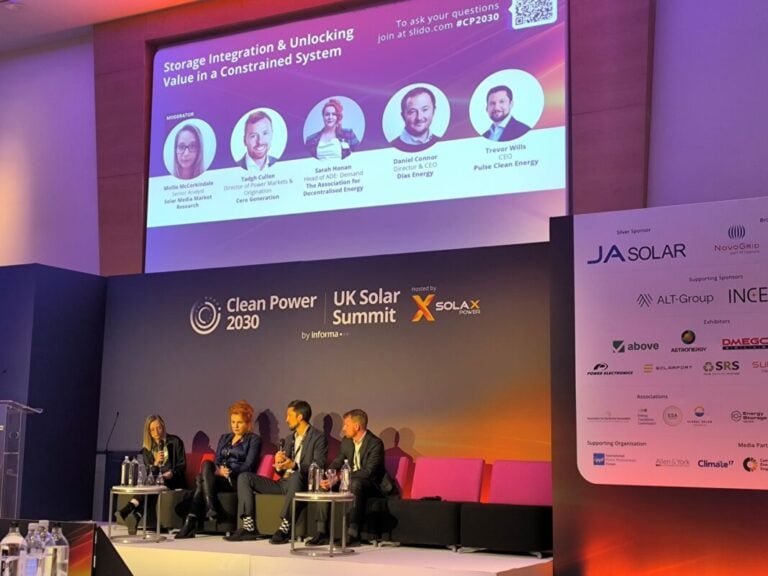
Wills gave the example of how battery storage is oftentimes modelled as a generator when it can be both a generator and a load.
“The argument that we might hear from the grid in certain circumstances is that they can’t connect us because when the system is massively oversupplied, if we generated, we would create a problem. Our response is we wouldn’t, we would be absorbing some of that oversupply and actually fixing the problem that you think that we’re going to contribute to.”
To Wills’ point, Tadgh Cullen, director of power markets & origination at independent power producer (IPP) Cero Generation, explained how batteries and solar PV don’t actually compete for the same capacity on the grid.
“Our co-located projects, we effectively modelled them as the PV getting unconstrained access to the grid connection, because it makes things easier from a financing perspective and from an approvals perspective,” explained Cullen.
However, Sarah Honan, Head of ADE: Demand at trade body The Association for Decentralised Energy, argued that “it’s not just about grid code, it’s about cultural transformation.”
She added that the new National Energy System Operator’s (NESO) new regime is “incredibly liberal”.
“Ofgem’s quote was lighter on regulation, even though they were losing basically all their financial incentives over NESO, and so they have empowered NESO to be more outcome-focused, as opposed to regimented ideals.”
UK versus Europe: co-location models still lacking
When looking at what other markets are doing, Wills highlighted that Spain has moved “very quickly in terms of its co-located structure”, whereas in the UK, most of the projects have secured a CfD and the battery operates around that profile.
“To get a new project now to financial close, what we’re seeing is we’re not actually structuring the projects as we would in the UK. You’re structuring it as a proper co-located project with one revenue contract where the battery is actually taking that generation from the PV and moving it to a time of the day when it’s actually needed.”
He added that although this sounds easy and has been the way batteries have been operating over the last 10-15 years, the reality is that they don’t work like that in the UK adding that how these projects are structured in Spain would potentially be a better way of structuring projects.
“It would open up questions like ‘should we be looking at the CfD and trying to incentivise better co-location, because I’ve never seen a policy in the UK that actually makes me think that the benefits of co-location and battery storage, in particular, are understood,” said Wills.
Cullen added that he doesn’t see any market doing it really well, emphasising that the UK was “doing a lot of right, but there’s always room to improve.”
He also highlighted the example of Italy and its schemes for storage and solar PV and how Fer X is great for a project’s bankability and getting solar PV built, while MACSE gets standalone BESS built.
“But again, there’s no thought put around actually putting those two technologies together and not competing with them against each other.”