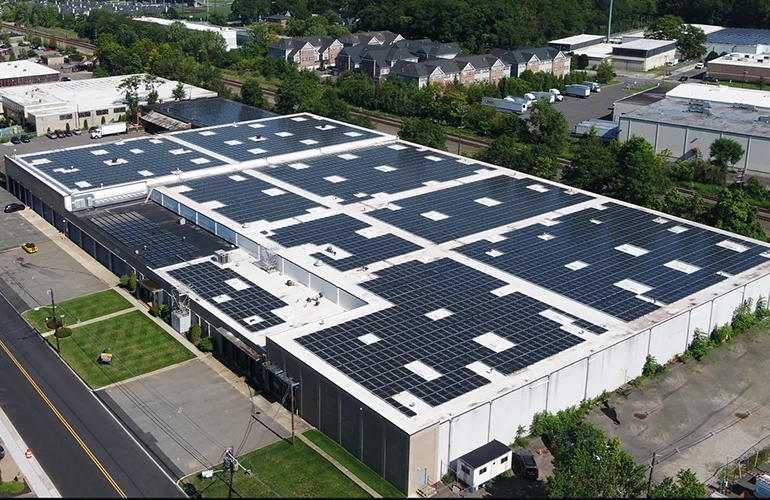
There are 88,429 commercial and industrial rooftops in New Jersey. Together, they hold 22 GW of viable solar potential. Only 7.2% of those rooftops have solar today.
Solar Landscape completed this 1.7-MW community solar project in New Jersey that services an LMI area.
That means 17.5 GW of untapped capacity is sitting on roofs that are already at load, already grid-connected and already permitted for commercial use. For context, that figure is more than four times New Jersey’s current total installed solar capacity, and the industry has barely touched it.
New Jersey should be seen less as an anomaly and more as a window into what the C&I solar market actually looks like when you stop prospecting from referral lists and start prospecting from data.
Why the addressable market is larger than most developers treat it
Most commercial solar developers work on an inbound pipeline. They rely on referrals and repeat relationships with property managers they already know, leaving a big portion of the addressable market unattended.
The New Jersey data illustrates where the gap is widest. Rooftops above 50,000 sq ft, the large-format segment, delivers the most attractive project economics, but show adoption rates below 30%. Distribution centers, pharmaceutical campuses, cold-storage facilities and big-box retails are among the building types where behind-the-meter solar pencils out most clearly. Yet the majority of them have never had a solar conversation.
Across Northern New Jersey alone, there are roughly 50,000 commercial rooftops with nearly 14 GW of untapped power potential without requiring a single new land use permit. PSE&G territory shows 10.5 GW of unbuilt rooftop solar across 48,422 sites. Middlesex, Union, Bergen and Hudson counties hold the majority of that large-format untapped capacity.
The opportunity is geographically concentrated. Solar developers who map it can prioritize accordingly.
The demand pull has changed
The way commercial building owners think about energy volatility has shifted dramatically in the last three years. The 2022 Russia-Ukraine gas crisis sent European energy prices to record levels and triggered a wave of C&I rooftop solar adoption across the continent. Industrial consumers started shifting towards on-site generation once fuel-cost risk became tangible and the logic behind the decision was a financial one, rather than environmental. Rooftop solar became a hedge against commodity exposure.
The same pattern is beginning in the U.S. The March 2025 missile strikes on Qatar’s Ras Laffan facility took roughly 17% of its LNG export capacity offline, contributing to renewed volatility in global gas markets. Companies signing C&I solar contracts in 2026 aren’t doing it just to hit ESG targets. They’re doing it to lock in a fixed portion of their energy cost for 25 years.
That framing matters for how solar developers approach the conversation. A building owner who has watched their utility bill climb year over year is not looking for a green upgrade, they’re looking for a cost-control mechanism. Developers who lead with fuel-risk exposure rather than environmental value proposition will find a much shorter sales cycle, particularly in the large-format industrial segment.
Where interconnection is the real constraint

Credit: Planno
With the economic case this strong and this much viable capacity sitting idle, why hasn’t the large-format C&I segment moved faster? The answer isn’t demand. It’s interconnection.
In PJM territory — which covers much of the Mid-Atlantic and Midwest — queue times for commercial-scale solar interconnection have stretched significantly. A small number of state-PUC-level rule variations account for the majority of the delay. In New Jersey, anticipated regulatory changes to how solar is developed — including expected restrictions on agricultural land use — are likely to redirect developer attention back toward rooftops, increasing competition for interconnection queue slots on the commercial side.
The developers who will move fastest in the next 24 months are those who prioritize projects in utility territories where interconnection processes are clearest, who front-load interconnection applications and who are already engaging with the specific PJM queue dynamics in their target corridors. PSE&G territory, JCP&L’s suburban industrial zones and the dense commercial corridors of Middlesex and Union counties are the clusters where those conversations should be happening now.
A different way to prospect
The fundamental problem is a data problem. When a solar development team prospects from a referral list, they see the fraction of the market that has already raised its hand. When they prospect from rooftop data, they see the full addressable landscape and can identify the highest-yield, lowest-competition opportunities before anyone else does.
That shift is not theoretical. Geospatial AI platforms can now map entire utility territories, rank rooftops by size and solar suitability and filter for non-adopted sites in days rather than months. A developer targeting the large-format industrial segment in PSE&G territory can walk into that market with a pre-qualified list of the best rooftops, sorted by project size and current non-adoption status, before making a single cold call.
What solar developers should do now
New Jersey is a case study, not a ceiling. The same structural gap between actual rooftop potential and current solar adoption exists in nearly every dense commercial market in the country. The developers who reprice their pipeline around fuel-risk framing, who prospect from data rather than referrals, and who concentrate resources on the large-format segment will outgrow the C&I market over the next two years.
Three priorities stand out for developers operating in the Mid-Atlantic today. Identify the highest-concentration utility territory clusters in your geography. Lead with the energy-cost conversation. Prioritize interconnection early.
The rooftops are there. The demand is building. The question is which developers will reach the large-format segment before the queue fills up.