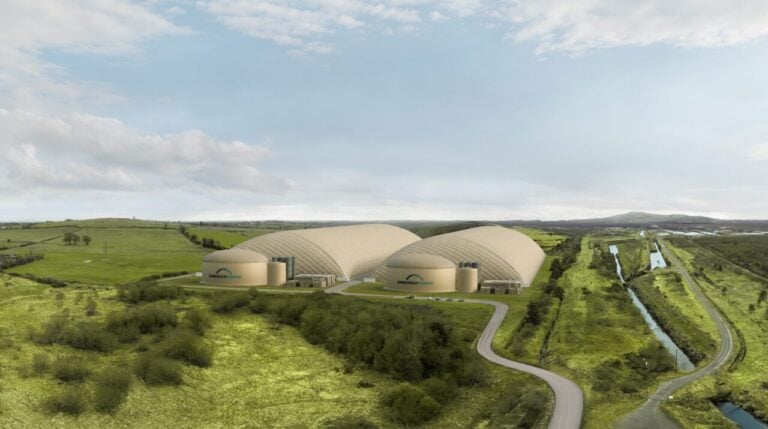
“It’s a large load area, and we can develop our project outside of Dublin, but stabilise and feed the Dublin grid.”
The area is also rich in energy resources, including a large-scale wind farm, solar PV assets, battery energy storage systems (BESS) and other technologies like flywheels, synchronous condensers and open-cycle gas turbines (OCGT).
“It’s a very, very strong renewable area, but there’s a high amount of congestion between this area in Offaly and the Irish Midlands and Dublin. So the use case for long-duration energy storage here is congestion relief, providing grid benefits for this area, so that all of that concentration of energy can get to Greater Dublin by moving it around the peaks and moving it around the congestion of the area, so it’s going to unlock a lot of the renewables.”
Second unit could bid into Irish government LDES scheme
Energy Dome’s technology, invented by founder and CEO Claudio Spadacini, stores energy through the adiabatic compression of carbon dioxide gas. The gas is liquified during charging and evaporates during discharging in the thermodynamic Brayton Cycle. In a closed-loop process, heat is stored during the compression process and then used to expand the CO2 gas. The gas is driven through turbines to generate electricity.
Energy Dome’s first 20MW/200MWh project in Sardinia, Italy, has been in operation for a year with utility Engie as its offtaker, while the company has other similarly sized projects in development in markets including India, Texas, and Wisconsin in the US.
Potter calls the latest project a “really nice story of energy transition for an area which has a legacy fossil fuel and bringing new technology to enable both carbon-free energy, but also greater affordability.”
Energy Dome will build, own and operate the system, which Potter clarifies is an 8-hour duration system in practical terms. The company also bid for and received a 10-year T-4 capacity market contract from transmission system operator (TSO) Eirgrid, competing against resources including thermal generation, hydro and battery storage.
There is also scope to add a second 23MW/200MWh unit at the site, for which Energy Dome has already secured planning consent, capacity contracts and grid connection as well as land. The second unit could be used to bid into the forthcoming LDES procurement mechanism, which is being developed in line with the Irish government’s Electricity Storage Policy Framework, Potter said.
First bilateral deal in multi-continent partnership
While the two companies signed off just a few weeks ago on a deal for a project in Arizona, US, the County Offaly project is the first bilateral deal. In Arizona, the two parties contracted for energy capacity through the utility Salt River Project (SRP), whereas in Ireland, they have contracted directly. Energy Dome co-founder and CCO Francesco Oppici recently spoke with ESN Premium about the technology’s suitability for data centre applications.
Google and Energy Dome formed a global commercial partnership towards the end of last year, with the tech company also making a strategic investment in the LDES provider.
“We identified commercial mechanisms to work together at scale, so basically we could then see from Google what the demand was for our technology, which gave us a demand signal at scale to deploy our technology with them. They could similarly see how the technology works, where the price points would be, and they could secure capacity from us to meet their growing load,” Potter said.
“The first projects, which are bearing fruit out of that partnership, are now being announced. The one in Ireland, the one in Arizona, and absolutely, these are the first of many to come. We’re working on a multi-continent, many-hundreds-of-megawatts pipeline together.”